
In the fast-paced world of online travel, few names stand as tall as Rob Rosenstein, co-founder of Agoda. While today Agoda is one of the world’s leading online travel agencies (OTAs), specializing in the Asia-Pacific market, its beginnings were far humbler.
In a candid conversation at Phocuswright 2024 in Phoenix, Rosenstein reflected on the origins of Agoda, its rapid rise, and the lessons he’s learned along the way as both a founder and an industry veteran.
What emerges is a story not just about building a business but also about adaptability, collaboration, and the art of knowing when to seize an opportunity.
The reality behind Agoda’s origin story
Forget the romanticized tales of two visionaries sitting on a beach in Phuket, Thailand, sketching plans for a revolutionary travel company. As Rosenstein himself puts it, “No truth to that story at all. It sounds very romantic, but the real origin was much more mundane.”
The seeds of Agoda were planted in the early 2000s when Rosenstein, who had invested in a friend’s travel agency, saw the potential to take the business online. “We thought there was a great opportunity to service Asian consumers,” he recalls. Along with his co-founder, Michael Kenny, Rosenstein began working on what would eventually become Agoda.
But it wasn’t easy. The partners argued “every day for two years” as they shaped their vision, ironing out details and learning on the fly. By the time Agoda launched in 2005, it had already become clear that they were operating in a fiercely competitive environment.
Why Agoda sold so early
In 2007, just two years after its launch, Agoda was acquired by Priceline Group (now Booking Holdings), with an earnout clause till 2011. For some, it seemed like the exit came too early—why sell before reaching the full potential of what they were building? Rosenstein acknowledges these questions but offers a pragmatic perspective. “This was a different time,” he explains. “Travel companies didn’t get billion-dollar valuations before they made a single dollar of profit.”
The environment also played a significant role in their decision. “We were afraid of what was coming. There were the global financial concerns – which ended up being true with the 2008 crisis – and the fear of big players like Expedia, Travelocity, Orbitz, and others aggressively entering Asia.” With competitors looming and consolidation accelerating, the partnership with Priceline offered the resources Agoda needed to mature and compete on a larger stage.
Still, hindsight shows that the decision was the right one. “We never thought we’d become one of the five or six biggest OTAs in the world on our own,” Rosenstein admits. The acquisition by Priceline gave Agoda the chance to build on its foundation without the pressure of going it alone.
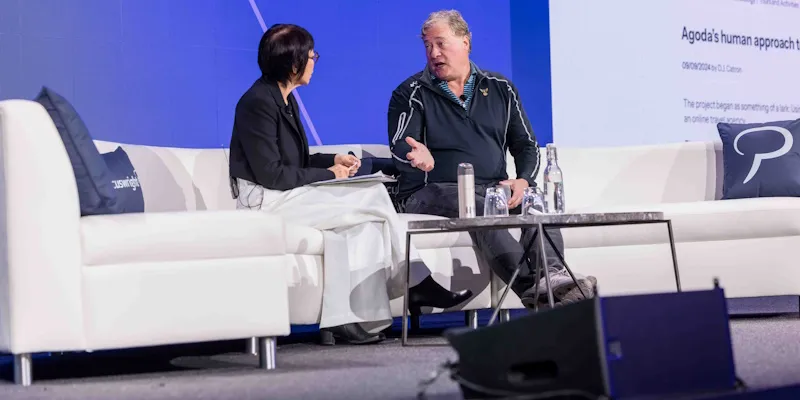
Rob Rosenstein: “It’s not about the shiny objects everyone’s talking about. It’s about doing the basics better than anyone else – building the factory and getting the product to market efficiently.”
Staying the course: The role of founders
Rosenstein didn’t leave after the sale. He stayed on as CEO until 2018 and remains chairman today. So, what makes a founder stay so long? Rosenstein believes it’s about advocating for the long term. “Founders are uniquely positioned to focus on priorities that others might not. Hired executives tend to optimize for the short term, but founders think about the future of the business.”
Rosenstein’s presence also helped ensure continuity in leadership while attracting fresh talent. One of his most important contributions during his tenure was bringing in exceptional leaders, such as Omri Morgenshtern, Idan Zalzberg, and Ittai Chorev. These hires came from Agoda’s 2014 acquisition of their Israeli ad tech company Qlicka, which Rosenstein described as pivotal.
That deal helped it shift from being “a travel company with some tech” to a “tech company that happens to sell travel”.
This evolution into a tech-driven company enabled Agoda to remain competitive in an increasingly digital landscape, where execution and data-driven decision-making are critical.
Real challenge lies in solving structural problems
As a seasoned entrepreneur, Rosenstein has his eyes firmly on the future of travel and technology plays a key role in his vision. “We’re about to see an incredible transformation on the consumer side,” he says. “AI is going to make planning, booking, and traveling easier, more reliable, and more fun.”
But he warns that the real challenge lies not in consumer-facing innovation but in solving structural problems. “Everyone gets excited about the shiny new object – a smarter trip planner, for example – but the harder problems are at the bottom of the funnel: reaching consumers and addressing inefficiencies in how we transact.”
One of Rosenstein’s pet projects has been rethinking the hotel experience. He envisions an Agoda app that isn’t just for booking but continues to enhance the traveller’s experience after check-in, streamlining processes like room upgrades, meal planning, and concierge services.
“I hate checking into a hotel,” he says bluntly. “It’s miserable. There’s so much room for innovation in how we transact and interact with hotels.”
The pan-Asian myth: Hyper-localisation is key
Agoda’s dominance in the Asia-Pacific region is no accident. “You can’t succeed in Asia by being a pan-Asian player. You have to be hyper-localized,” Rosenstein explains. With its mix of languages, cultures, and consumer preferences, Asia is one of the most complex markets in the world. Agoda has invested heavily in localizing everything from payment methods to property offerings.
“For example, in Japan, meal plans are essential. In Korea, the accommodation market looks completely different from the West. You have to understand these nuances to succeed,” he says.
This attention to detail has allowed Agoda to maintain its foothold in an increasingly crowded space, where local giants like Trip.com and MakeMyTrip compete with global players like Expedia in home and regional markets.
Advice to entrepreneurs: Less glamour, more basics
Rosenstein is quick to dismiss the notion that it’s harder than ever to succeed as a travel entrepreneur. “If I were to start something now, I’d only do it if I thought the conditions were right. But don’t bet against me – I’m pretty damn sure I’d succeed,” he says with confidence.
His advice for today’s founders? Focus less on the glamorous aspects of entrepreneurship and more on execution. “It’s not about the shiny objects everyone’s talking about. It’s about doing the basics better than anyone else – building the factory and getting the product to market efficiently.”
His own journey with Agoda has been one of continuous learning, from navigating the challenges of an early-stage startup to steering a global company. Even investments and acquisitions that he helped advise on and didn’t go as planned have taught valuable lessons. “Sometimes things don’t work out the way you hope, but those experiences raise the game,” he says. “They help you understand markets, customers, and how to execute better.”
As chairman of Agoda, Rosenstein remains deeply invested in the company’s success, attending board meetings and guiding the next generation of leaders. His vision for the future is one of optimism and opportunity, not just for Agoda but for the travel industry as a whole. “There’s so much left to solve,” he says. “And that’s what keeps it exciting.”
Watch the full session: