
Karl Loo wants to transform the services marketplace in South-east Asia and lift income levels of small businesses and individual professionals.
Tell anyone there’s a new services app in town and eyes will roll and you’ll hear, “There are so many now.” And that’s true. Today, in a world gone P2P, anyone can sell anything to anyone and you can order, with a swipe or a tap, tour guides, chefs, plumbers, contractors, taxis, dates and married folk with adulterous inclinations.
The thing that will differentiate one app/service from another however is – actually several things – ambition, deep pockets, talent and team. And it is those who can execute fastest and best, scale biggest and best and tell a good story best that will prevail.
Look at Airbnb and its latest round of US$500m funding that gives it a US$10 billion valuation and its CEO Brian Chesky is featured in this month’s Fortune magazine. From its launch in 2008, it was able to execute fast and best, scale big and best and it tells a really good story of making the world a happier place because it helps everyone make money and meet happy people who want local, real experiences.
Closer to home, GrabTaxi, the Malaysian-based taxi hailing service, which recently got valued at US$1.5 billion, was also able to execute fast and best, scale big and best and it also tells a very good story of empowering taxi drivers and consumers throughout South-east Asia where getting taxis can be a dodgy affair, depending on where you are.
Never mind if those stories are true or not but capture the public’s imagination and they’ll become your biggest brand ambassadors and defend you, if necessary, against government regulations.
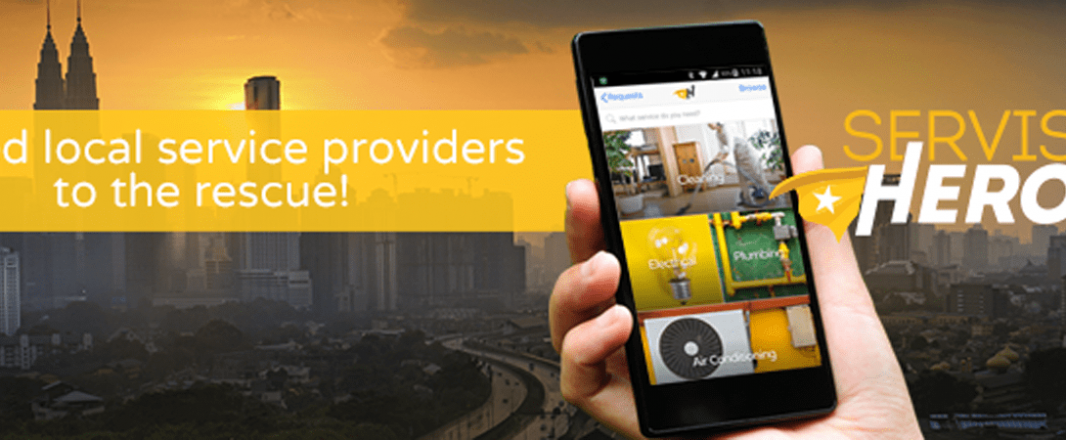
GrabTaxi is one of the most successful start-up stories to emerge from South-east Asia which is why ServisHero, a new services app launched in Malaysia, is calling itself the “GrabTaxi for services”, clearly wanting to emulate the taxi hailing app’s success story.
Founder Karl Loo has a pedigree background when it comes to tech start-ups. A Malaysian, he studied in New Zealand and Oxford, worked in South Africa, China and Silicon Valley and has now returned to Kuala Lumpur to work on scaling ServisHero across industries and across ASEAN. The app is now available in Singapore and will be launching in Jakarta shortly.
It’s secured what Loo calls “the biggest pre-product funding for any start-up in Malaysia”, in a $750,000 round led by YTL Corp. YTL owns Yes, the Malaysian communications provider as well as the 4G Innovation Network which aims to link Malaysian developers to their peers globally through a twinning programme with Clearwire.
Loo got the idea for ServisHero when he moved into a new apartment in Kuala Lumpur and couldn’t find an air-con repairman. “I asked, what is going on in Malaysia? Everyone has a smartphone.”
With his background in founding e-commerce companies, it seemed a no-brainer for the entrepreneur to build an app connecting service providers with customers.
“We want to disrupt the way services are delivered and requested in the region,” he said. The goal is to cover 1,000 categories in 18 months. It now has homes and event planning – and you can see the possibilities provided he can scale fast enough in terms of supply and demand.
In truth, these new disruptors to the previously-regulated marketplace model could enter travel easily. Marketplaces such as Amazon and Alibaba have already entered travel. What’s to stop GrabTaxi, for instance, from launching “GrabAGuide” and enable travellers to call a tour guide once they are in-destination? Or ServisHero from offering a trip planning service where travellers could put out a call for itineraries and travel agents could bid for that job?
The question is whether you want to be a one-stop shop for everything or a one-stop shop for just one thing, and which will travellers prefer?
Loo is clearly an ambitious young man with a vision. Trained as an information technology lawyer, he worked in the field for three years but hated it. He bought a one-way ticket to China where he became Groupon’s Employee #12. He was 26 years old. “I got addicted to the marketplace then, and the power the web can have in societies.”
He went to South Africa after that and started several e-commerce companies. Then he was off to Silicon Valley where he launched the Silicon Valley office for Y-Combinator company, Memebox, and, with his team, built it into one of the biggest online Korean cosmetics brands despite knowing nothing about cosmetics. “I had to write the copy and I had to find out about foundation primer,” he said.
He said ServisHero is like an evolution of Craigs List. It will not control the transaction. It is free for customers and he charges suppliers a micro-payment to respond. “They choose who they want to respond to and that’s when we get paid.”
To generate demand for ServisHero, he’s used Facebook ads, TV ads on the train between the airport and city and garnered press coverage to tell his story. “We like the Trivago model,” he said, citing the hotel meta-search giant that’s built a global brand using TV ads.
He’s assembled 21 people in his team, friends who’ve worked with him in Silicon Valley – “the strongest team you’ve ever seen in South-east Asia. One of the top Ruby Rails developers from Silicon Valley is now working in Malaysia”.
Asked why he decided to return to Malaysia, Loo said, “The Malaysian government has a blue ocean strategy and they’ve come up with programmes and schemes to develop a start-up ecosystem. I want to try and see if we can build a successful start-up in Malaysia, like in other places.”
Having said that, he said the wheels in Malaysia tend to grind slowly and trying to establish a start-up locally can be challenging, despite the presence of agencies such as MaGIC or MDeC in Malaysia, which champion digital innovation.
Ultimately he sees P2P marketplaces like ServisHero being able to lift income levels for individual professionals and small business owners throughout South-east Asia. “A Malaysian coming back to work here – you get paid RM2,000 a month. That’s ridiculous. Educated people are beholden to companies and agencies to give them work. These marketplaces could disintermediate and enable people to work for themselves. The technology is here to make that happen.”