
The weekly news roundup: Two new investors for Air Black Box, Chinese airports’ investments in technology for improved experience, destinations made almost famous through film tourism
STARTUPS: Air Black Box has two new investors – ANA and Cebu Pacific

Travellers can use ABB to buy ancillaries across multiple carriers (Image credit: RawpixeliStock)
Air Black Box (ABB), a dedicated multi-carrier booking system, has attracted new investment from Japan’s All Nippon Airways Holdings and Philippines’ Cebu Pacific.
The amount of the investment from the two carriers who joined ABB’s Asian arm, Air Black Box Asia Pacific, as shareholders is not disclosed.
ANA Holdings is the parent of ANA (All Nippon Airways) and Vanilla Air, and Cebu Pacific is the parent of Cebgo (formerly Tigerasia Philippines).
Air Black Box Asia Pacific is a joint venture company formed by Scoot (wholly owned subsidiary of Singapore Airlines), Nok Air (low cost airline in Thailand) and VaultPAD Ventures (US based global accelerator for travel startups), who are the original investors.
The JV includes the software platform, Air Black Box, which allows diverse airlines to cross-sell and upsell each other’s products in a seamless, real-time manner.
The platform is credited with making Asia’s Value Alliance possible. The latter is the first pan-regional low cost carrier alliance comprising eight Asia Pacific airlines namely Cebu Pacific, Jeju Air, Nok Air, NokScoot, Scoot, Tigerair Singapore, Tigerair Australia and Vanilla Air. (read: Value Alliance, a breakthrough in low cost airline distribution)
William Liu, Air Black Box Asia Pacific chairman, in welcoming the two Asian carriers as shareholders said the company would continue expanding its footprint as its Value Alliance members and third-party Asia-Pacific airline customers adopt the technology.
ABB recently won two awards for innovation – the 2016 WITovation Editor’s Choice Award and the 2016 CAPA Award for Excellence.
TRAVEL TECHNOLOGY: Airports in China turn to new technologies to manage growth
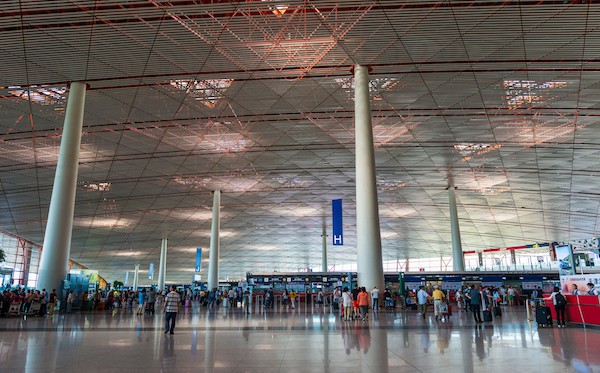
Beijing International Airport, one of the world’s largest airport in passenger traffic (Image credit: -superjoseph/iStock)
Airports in China are investing in the latest technology to manage growth and changing passenger expectations, according to the 2016 Airport IT Trends Survey.
The report, co-sponsored by SITA and Airports Council International (ACI), said that over the next three years 50% of the airports would invest in systems to predict potential disruptions before they occur.
High on the airports’ agendas to deliver a better passenger experience is investment in emerging technologies including the Internet of Things (IoT), beacons and mobile services.
China’s airports’ investments in IoT are set to overtake their global counterparts. Today, 29% of Chinese airports have fully included this technology their strategy, rising to 82% by 2019 higher than the 75% of airports globally.
The report said this was not surprising, given the high penetration of mobile devices among Chinese passengers, interest from airports for sensor technologies, including beacons, is also high with 89% of airports deploying them as part of a major programme or a trial over the next three years.
The focus of these deployments will be at the early steps in the passenger journey: bag-drop (33% of airports), check-in (28%) and security (26%), to support a better passenger experience.
“In addition, a majority of airports (68%) will have major programmes for passenger mobile applications by 2019 with a further 26% planning pilots and trials. This makes mobile the number one information technology investment initiatives in China for passenger services,” stated the survey.
The top three growth areas over the next five years for China’s airports are ‘context and location aware apps’ (61% implementing), robots (48%) and artificial intelligence (37%).
An area where Chinese airports have not seen a bigger take up is Collaborative Decision Making (CDM), a technology that SITA describes as “central to improving operations and reducing travel disruption at world-leading airports”.
While only 16% of airports in China have fully implemented CDM integrated with air traffic management (ATM) systems today, the survey noted that over the next three years a further 68% plan to implement it.
These plans are ahead of the global trend. Worldwide only 55% of airports expect to implement this technology by 2019 compared to the 84% of China’s airports.
“By this time (2019) China’s airports will also have fully embraced CDM, enabling them to effectively manage the surge in flights expected over the coming years,” said May Zhou, vice president of SITA China.
“The commitment to new technology by China’s airport operators is hugely encouraging. There is a clear acknowledgement that smart technology can support the country’s growth in air transport over the coming years.”
DESTINATIONS: Almost famous – destinations made popular as film locations

Swayambhunath in Katmandu featured in ‘Doctor Strange’ (Image credit: Wego)
Many destination marketers are encouraging filmmakers to use their countries as locations for movies/television series, as film tourism is a big draw for travellers.
A classic example is New Zealand whose natural wonders serving as the backdrop to the ‘Lord of the Rings’ and ‘Hobbit’ movies have attracted thousands of tourists.
Dean Wicks, chief flights officer for Wego, said the travel site had examined film tourism in the past and saw how movies and television have contributed directly to attracting and increasing visitors based on the location they were filmed in.
“In 2016, we’ve had an array of film releases, which have created quite a diverse range of new destination stars and I expect their unique personalities to feature in a variety of travel itineraries in the near future.”
Here are some filming locations that took centre stage in 2016 according to Wego:
- Nepal, Doctor Strange: With twists of moral crusades and Eastern mysticism the big action takes place in the Kathmandu Valley with the bustling commercial hub of Thamel and the gold-tipped stupas of Swayambhunath as a backdrop.
- Canada, The Revenant: The visceral and raw western frontier vibe comes alive among the peaks of Kananaskis Country, part of the Canadian Rockies near Calgary, with other scenes shot at the Indian reserve at Stoney Nation and the Fortress Mountain Resort near Banff ski resorts.
- New Zealand, Hunt for the Wilderpeople: Filmed mostly in the North Island volcanic plateau and the Waitakere ranges near Auckland with gushing geysers, mud pools, black sand beaches and the famed surfing spots of Te Henga and Piha as backdrop.
- Utah, Westworld: The back country featured in this sci-fi western include the breath-taking vistas of the quintessential American west – hoodoos, canyons and red-hued tabletop mountains in locations like Fisher Valley and Castle Valley.
- New England, Manchester by the Sea: Filming was in the artsy town of Gloucester and Salem, which is known for its witching history.
- Iceland, Rams: Features Iceland’s stunning countryside, with filming in the remote northern valley of Bárðardalur.
- Dublin, Love & Friendship: Donabate, a small coastal town in Fingal with its country pubs and cliff walks, was the backdrop for this 18th century romance while Newbridge Estate, with its Georgian architecture, was the primary filming location.
• Featured image credit:indukas/iStock