In the news: Airlines are continually upgrading their services or using technology solutions to improve efficiency and productivity, as well as “to enhance the traveller experience”, the often used phrase in the travel sector. Latest to introduce such measures are Malaysia Airlines, Singapore Airlines and China Airlines.
Airlines: Malaysia Airlines rebrands First Class cabin as Business Suite

(Image credit: John Rowley/Getty Images)
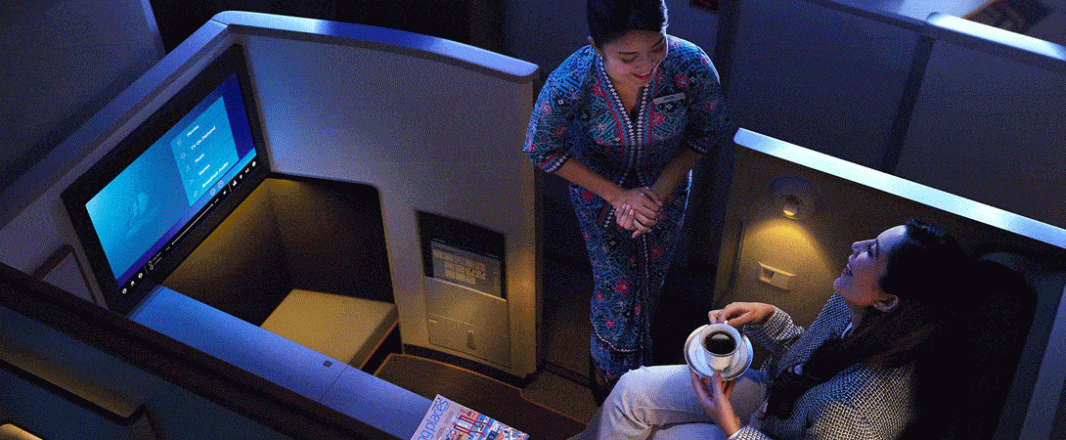
The rising number of business travellers on Malaysia Airlines has led the carrier to launch Business Suite, a rebrand of its First Class cabin, on all its Airbus A350-900 and A380-800s.
“The new Business Suite was introduced in response to the growing demand of our guests. Our target is to enable the frequent flyer, looking for enhanced comfort, to now be able to enjoy a premium experience at competitive prices,” said Malaysia Airlines group chief executive officer, Captain Izham Ismail.
Passengers in the premium class can look forward to “new levels of luxury with ample cabin space and privacy” with full flat-bed and individual IFE screen. Each seat in the A380-800 comes with its personal closet and storage for coat, luggage, laptop and personal belongings. For the A350-900 the seat has a meal and cocktail table, feature light, vanity mirror, console stowage and magazine rack.
“We are confident that our new Business Suite will change the way people travel in business class,” added Captain Izham.
The new suite is available on the London, Tokyo, Osaka route and on the Sydney and Seoul route during the winter season.
What the new Business Suite has to offer:
A380-800
- Located on the main deck with1-2-1 seat formation
- 6 seats with enclosed monument (4 individual seats and 2 double seats)
- Seat pitch of 89 inches and bed width of 40 inches
- Full flat-bed length of 87 inches
- Individual 23-inch IFE screen
A350-900
- 1-2-1 seat formation with direct aisle access
- 4 seats with enclosed monument and retractable privacy door (2 individual seats and 2 double seats)
- Seat pitch of 83 inches and width of 23 inches
- Full-flat bed length of 83 inches
- Capacitive seat control offering personalised lounge position, independent adjustable leg rest, and massage and lumbar system
- Individual 24-inch IFE with capacitive touchscreen and multi-touch gesture, video handset, widescreen, with LED backlighting
Aviation: Singapore Airlines using data to digitally transform ground operations

(Image credit: Singapore Airlines)
Singapore Airlines (SIA) has implemented the Intelligent Airline Operations (IAO) Solution, touted as “a first-of-its-kind operations management solution that will digitally transform airlines’ ground services and operations control.”
The carrier co-created the solution with Tata Consultancy Services (TCS), Mumbai-based multinational information technology service and consulting company.
IAO provides operations controllers and airport management staff with real time, on-the-go views of their passengers and operations.
“This view will enable them to make informed decisions while simultaneously providing enriched services to customers. During disruption scenarios, such as flight delays, misconnections and cancellations, the solution will help airlines mitigate the compounding effects of the disruption and quickly recover at scale,” said the companies in a joint statement.
The solution utilises TCS’ New Core, a cloud-ready high speed messaging and data processing platform with machine learning capabilities and an advanced events engine. It amalgamates data in near real time from different functional areas and systems including flight operations, airport operations, crew operations, customer services, baggage and loyalty.
SIA is the first to deploy the solution, which has been rolled out to its airport management staff – station and duty managers – across the globe.
George Wang, SIA’s SVP, information technology, said the development of the solution is part of the organisation-wide digital transformation.
“By combining near real-time operational data from various systems with mobility solutions and a user-centric modern design the solution will enable our operational staff to make more informed decisions, drive operational efficiencies and deliver a world class service experience to our customers.”
Technology: China Airlines works with Sabre to increase network efficiency

(Image credit: China Airlines)
China Airlines, Taiwan’s largest carrier and a partner of Sabre for over 20 years, is using the technology company’s solution to improve daily flight operations, continue to provide reliable service and give traveller a better experience.
Sabre AirCentre Movement Manager, a flight operations management solution, allows the airline to have nominal service disruptions, react swiftly to flight irregularities and improve on-time performance through a more comprehensive overview of flight movement.
According to Sabre, this technology will help reduce operating costs for the airline and capitalise staff productivity.
Perry Chou, vice president, system operations control of China Airlines, said: “The adoption of Sabre’s technology is instrumental to our ongoing business success, as the solution will provide our controllers with a complete overview of the status of flights and increase our network’s overall efficiency.”
• Featured image (Malaysia Airlines Business Suite) credit: Malaysia Airlines