It really doesn’t matter how good the technology is and how much better we are at navigating Zoom, Swapcard, Brella or the myriad of event platforms that have mushroomed during this time in history but let’s face it, it will never be as good as being there.
Such was the feeling when I moderated the annual WiT Europe at Phocuswright Europe this week. That’s the session when we bring a splash of Asia to the proceedings every year.
My colleagues at Phocuswright have done an outstanding job, migrating their usually-held-in-Amsterdam event online and replicating their high quality production but we all felt the physical absence of not being in Amsterdam, sitting within the historic space of the Beurs van Berlage, where there’s always some interesting art exhibition being held at the same time.
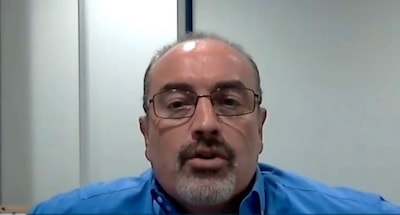
Agoda’s Timothy Hughes: “Business travel cannot be done on Zoom.”
Shaking hands with business partners, continuing with the discussions onstage to offstage, exploring opportunities and partnerships, breaking bread and drinking wine together in some of the best restaurants in the world …
As Timothy Hughes, vice president, corporate development of Agoda, said while we were preparing to go live, “You miss what happens after. You do a panel and you want to continue the discussion with your fellow panellists, and you look around and you’re all in the office, with the screen.”
Yes, after six months of running virtual panels, I can tell you it’s hard work, staring at that screen, speaking to a void and trying to project energy into the ether, without it being reciprocated except through the chats on the sidebar or on your phone.
During the panel, Hughes said, “Business travel cannot be done on Zoom.”
But he also admits that parts of it can – those quick trips, quarterly meetings, internal reviews – those will all be reviewed especially when budgets are going to be tight.
Christine Wang, head of business development Asia, Lufthansa Innovation Hub, agreed, saying in Europe, there was the other consideration of the environment. While this is not such a big issue in Asia, she said corporates were questioning the amount of business travel that happened in the past.
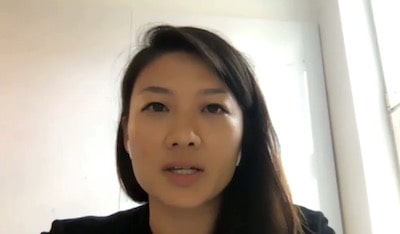
Christine Wang of Lufthansa Innovation Hub says it’s really complicated to travel right now.
Also, she said, it’s really complicated to travel right now. She herself flew from Singapore to Berlin (where she was calling in from) for business reasons but the uncertainty of what awaits her when she wishes to return to Singapore is daunting.
But again, if you look to China, where business is back to pre-2019 levels, business travel has returned as well, along with leisure travel. And the reality is, as soon as we can, we will be up and flying again. That’s just human nature.
Hughes said one thing has become apparent – as soon as there is news of opening up, demand shoots up instantly. By the same token, as soon as something bad happens, demand comes down instantly too.
As it did in Vietnam and South Korea, where Jun Shin, head of strategy, Tidesquare, said that demand has definitely softened with rising infections and the government moving to contain the new outbreaks.
But the upside is, once it’s contained, it’s as easy to turn it back on. So the reality is, even though there are pockets of recovery happening across Asia, it will be a domestic story for the rest of the year, and we hope not too far into the following year.

Hughes said wishing for safe bubbles or travel corridors, as has been talked about by governments, to happen is dangerous because it means not fixing what you can to survive 2020.
If it’s any consolation, I am reading a book called “Peddler In Paradise”, an autobiographical novel written by Al Rabin, an American travelling salesman in the early 1900s. As a teenager, he dreamt of travelling and realized the only way he could travel and explore the world is through peddling goods.
His stories are amazing, he travelled to exotic lands from Bangkok to Borneo to Manila, Shanghai gave him his first big deal, when he least expected it, but it was this one sentence which brought home to me the importance of business travel to humanity.
“A travelling salesman can hardly grow stagnant, stale. Even if he tires of the interest and adventure, he has to try and understand the people he wants as customers, and he becomes tolerant, if he is not already so. It’s a good life and one that contributes good. Get a flow of salesmen crossing the boundaries and the barriers will come down by themselves.”
So all of us who travel for business, don’t stop. Yes, do it more wisely, more judiciously but keep crossing boundaries.
Till then, let’s get through the rest of the year as best we can.
• Featured image credit: Rawpixel/Getty Images