
At the Skyview Lounge this morning at Changi, about to catch my Cathay Pacific flight (which I nearly missed but for NotiFLY which is a great service by the way, if only they included which terminal in the information), I overheard an American-accented voice saying, “We’ve got to get this investment back otherwise there will be no money to pay back our debt.”
Speaking into his earpiece and pacing up and down the lounge, he was oblivious as to who was listening in.It made me wonder if it was a travel start-up he’s thinking of pulling his funds from but I doubt it – I think he’s talking much more serious bucks than what I could possibly imagine.
Perhaps he’s in energy which is having all sorts of troubles right now from Japan’s nuclear crisis to civil war in Libya …Whatever his troubles though, I don’t think it could be as bad as the one Enercon, the German wind turbine maker, is having in India.
On the flight, I read an article that said the company “has lost its entire Indian subsidiary, a major operation with annual sales of more than 400 million Euros” and “lost control of its patents in India, which meant its technology could be appropriated by competitors”.
Ouch. Classic case of partnership gone sour – what must hurt the most is loss of its patents, the lifeblood of any technology company.
Lessons to be learnt here from all travel technology providers who are all scrambling to enter India and China. I had a conversation last week with a Singapore-based senior executive of a travel player and he said, “India, China, India, China – that’s all I have been doing.” And he’s thinking of moving to Beijing.
Another online travel executive said he may have to move to Mumbai to be closer to the centre of future growth for his company.
Well, with Japan on its knees right now, it looks like India and China will gain even more prominence on companies’ radar as they seek to grow in the region.
The crisis in Japan has had a massive impact on inbound tourism. The Peninsula Hotel in Tokyo says its occupancy is down to 20%, from the usual 70%. Shangri-La Hotels and Resorts is closing its Tokyo hotel – it says it is temporary, until end of April at the earliest, and will reassess the situation.
Airlines flying into Japan are similarly affected. IATA says Japan accounts for 10% of overall industry revenues. Delta Airlines says its revenues would be shaved by US$250 to $450 million this year due to the crisis. Japan generates $2 billion revenue a year for Delta, eight percent of the total.
A major online travel agency told WIT 70% of the calls it was getting at its call centre were from cancellations or postponements of holidays to Japan.
However, there’s no overall drop in demand – “just people going to different places instead.”
As with any crisis, there are winners and there are losers.
Which brings me to the reason I am in Hong Kong – well, part of it anyway. Other than taking part in a travel technology event, It’s also to observe the Hong Kong Rugby Sevens, the sporting event of the year for the city, and the region.
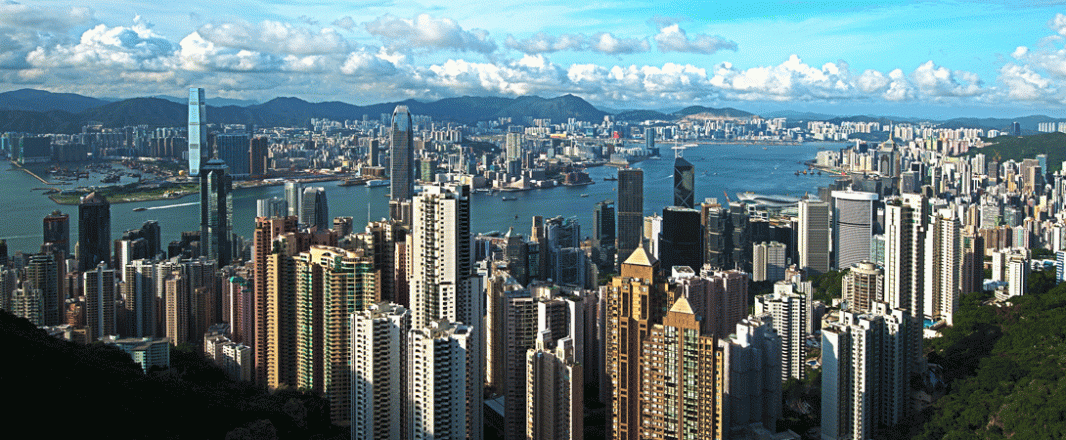
I am staying at Lanson Place, a boutique hotel in the heart of Causeway Bay – walking distance from the stadium, and lots of shops and restaurants (in order of priority). I like the Place because wireless and breakfast are included and the reception desk has an iPad which I knocked down with my handbag. Space is precious in Hong Kong. (Picture shows view from my room)
I know very little about rugby but I’ve been reading up about it so that I can at least appear to talk intelligently about it. “Wow, look at that Waikato Wonder,” I’ll say as Declan O’Donnell from the All Blacks whizzes past to score another try.
What I also know is that the Japan team will be wearing black armbands for the competition and will be observing a minute’s silence before every game they play.
Well, they do say that rugby is a gentleman’s sport. I look forward to meeting many gentlemen in Hong Kong this weekend.