
As general manager of Niseko Village from 2007 to 2009, Luke Hurford used to look after family members of YTL Hotels when they stayed at the integrated resort, then managed by Hilton.
So when YTL Hotels acquired the resort from Citigroup Principle, which in turn bought it from Prince Hotels in March 2007, it stood to reason that somehow his links to the family would continue.
And indeed it has. Except for a year when he wasn’t allowed to work directly for YTL following the acquisition and he went on to work in Intercontinental Hotels Group’s regional sales office in Japan, Hurford has been with YTL Hotels now for the past nine years running its sales and marketing strategy.
“It’s worked out very well. They wanted someone who knew about managing a ski resort in Japan, it was their first hotel in Japan, and when they asked if I would be interested, I said yes. I felt I could make more of a difference then being a cog in the wheel of a big machine.”
Hurford said that when he joined, “there was no job scope as such” except a general wish that he’d help with sales and marketing and distribution.
Today he’s senior vice president, strategy and oversees global distribution, sales and marketing and PR and branding, as well as manage industry and partner relationships. “When I joined we were 12 hotels, now we have 40.”
His first task was to organise the group’s sales and marketing and the first few months were focused on selling the group’s resorts in Malaysia as well as Niseko Village.

“It had a traditional distribution set-up, with tour operators and wholesalers. We needed to take that leap to push distribution towards digital. My main job for the last three to four years has been to shift distribution channels from offline to online.”
Public relations played a key role in that, he said. “We have so many independent hotels – Pangkor Laut, Tanjong Jara, Gaya Island – any of them could be a Ritz-Carlton but having the independence and autonomy meant we could create a more interesting experience and deliver a better business case.
“We worked on that very hard, we needed to tell our stories. At YTL, we see ourselves as purveyors of hopes and dreams, and we create and deliver dream experiences.”
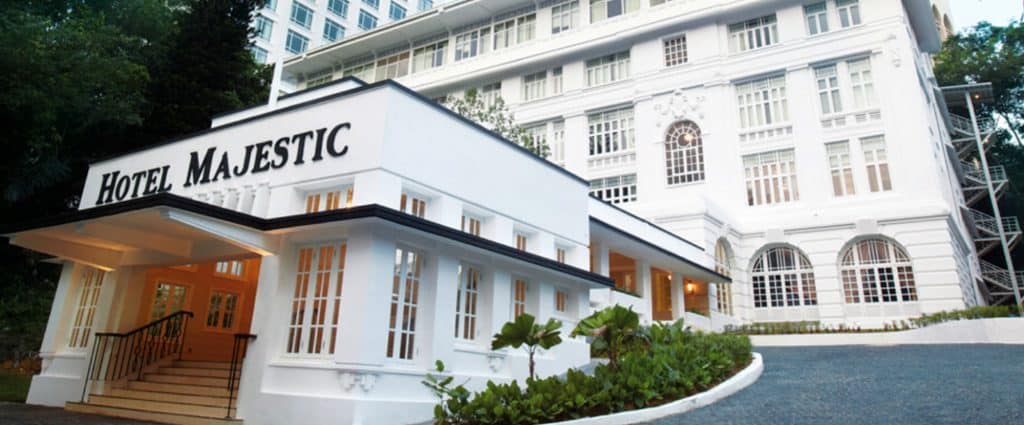
YTL Hotels has what you might call an opportunistic brand strategy. In the big cities its hotels are managed by Marriott. In Kuala Lumpur it has the JW Marriott Hotel and The Ritz-Carlton. It has also soft-branded its two other smaller hotels, The Majestic Hotel Kuala Lumpur and Hotel Stripes Kuala Lumpur, under the Autograph Collection. “We are the first hotel company to bring this unknown brand into Asia – we have a very solid relationship with Marriott.”
In Australia, it has three Marriotts – Sydney, Brisbane and Melbourne – and YTL Corp’s recent purchase in Perth, one of the biggest hotel sales in the Western Australian city at A$200m, gives it the Westin brand.
In secondary cities such as Penang, Kuantan and Kuala Lumpur, it operates under its own Vistana brand. “We feel we can deliver the right products in second tier cities and any distribution that Marriott can bring is of course very helpful. From data and searches, we see that there is a need for that product from Marriott customers.”
It also has a relationship with Small Luxury Hotels for some of its resorts.
Lately, it’s been focusing on Europe and this year it made its biggest play in the UK with the development of Monkey Island Estate, a seven-acre island in the river Thames in Bray, Berkshire. It’s a three-year restoration programme and the group says it will introduce a set of culinary concepts and floating spa. The island, accessible only by boat or on footbridge, has an 800-year history as the haunt of monarchs, writers and artists.
Said Hurford, “YTL has an affinity for the UK and Europe, as well as Australia, as a diversification from Asia. As we have grown, we can use our economies of scale to work across multiple properties. Our key brand promise is always to be authentic to the destination and where big brands can’t deliver that, we do it ourselves or find the right partner – for example in Bath, the Gainsborough Bath Spa is under Leading Hotels Of The World.
“When we acquire or build a property, we build it based on the logic of a business case, then we look at how we position it. The biggest consideration is room count – if it’s between 50 and 100 rooms, we can create our own defined story and distribute it independently.
“If it’s between 250 and 500 rooms, we are more circumspect and we might need a brand for distribution. About 150 rooms is the sweet spot where we can work with groups like LHW and SLH – they don’t have powerful distribution networks, but there’s a brand association and a seal of approval.”
Asked if from the owner’s perspective he felt some hotel groups had too many brands, he said, “I guess what the soft brands are doing – such as Marriott’s Autograph – is taking the independent hotel space. It’s up to the opportunistic owner to tap into the appropriate strategy for its hotel – we just happen to have a phenomenal relationship with Marriott.”
Meanwhile, the opportunistic owner makes sure his internal distribution, sales and marketing is set up to handle a robust online delivery of direct and indirect business.
“With your own independent hotels, you have to be more aggressive with your sales team. You can’t sit back and let Marriott do it all for you,” said Hurford.
Nine years ago, he said, wholesale business was responsible for 70% of revenues for its resort portfolio. Today it’s 30%. And direct website business is about 30% across its resort properties.
Asked for his thoughts on the Marriott and Expedia partnership on wholesale rates, Hurford said, “We will see the fruits come out the next 18 months. We certainly know Marriott is looking out for our best interest, the problem needs to be solved.
“We will see exactly how this model is received. I don’t know if we are ever going to control every touchpoint of where rates go out in the market. There will always be a bad player, the cowboy, somewhere.”
Hurford said that at YTL “we will still have static rates, there are partners who still need them. Some operators won’t work with you if you don’t have static rates.”
Having said that, he said YTL has been proactive and has cancelled distribution agreements with the big bedbanks who distribute our rates to B2B channels. “They were causing us trouble and we told them, we can’t contract with you anymore. We have no problems with good partners. We know who our good partners are – we are not going to be hamstrung because of one or two players.”
He said that with distribution becoming so dynamic “honestly keeping up with it is challenging. We need those conversations regularly, we are very open to change.”
He added, “It comes back to us as a company. We have stayed true to our ethos – great properties, great experiences, great customer feedback among our competitive set – that’s my job, we have to pay great attention to detail on the customer experience.”
He gives credit to the owner, Dato Mark Yeoh. “He never looks at me and says, reduce commissions. He says, drive direct business, have the best deal in the market, best distribution – never turn off taps that work for you, grow the pie.
“We see OTAs as great partners to expose our product. There’s a cost of business however you do the business.”
Over the last four years, with outsourcing costs ballooning across all aspects of digital distribution and communication, YTL Hotels has started building inhouse core competencies. It now has a core team of up to nine senior executives looking after websites, CRM, social media and email marketing.
“This team has been responsible for driving direct business. We now have a 24-hour turnaround in being able to create an entire marketing campaign from A-Z.”
He acknowledges the challenges of knowing which IT systems to invest in. “Where we are leaning more towards is taking best practices. We shouldn’t know it’s there – technology should be unobtrusive.”
He believes in forming strong partnerships with tech companies like Expedia and Travelclick. “There are things we cannot do ourselves.”
“Technology is so fickle. You can spend a lot of money and usually what should take 12 months becomes 36 or 48 months and by the time you roll it out, it’s almost obsolete.
“It’s one part of the journey that you cannot muck up. When u get IT right, no one knows it’s there; when u get it wrong, it ruins the entire journey.”
Looking ahead to 2020, Hurford is conscious of the uncertainties in the global economy. “There’s a lot of uncertainty around Brexit and what that will mean to inbound travel to places like Malaysia and Thailand.”
Having said that, he said that YTL, being a longterm player, is strongly positioned to handle the short-term fluctuations. “We’ve never sold an asset, we are more buyers.
“It’s a question of finding the right positioning in new markets – how do we position ourselves in the Chinese high end market, especially for ski resorts like Niseko? We have 800 rooms there. The biggest growing markets are America and Europe, and they come because of the powder snow, while the Chinese come because of the fantastic food, luxury accommodation and good snow.
“Tanjong Jara, one of our Malaysian resorts, has always resonated well with Europeans because it is unmistakably Malaysian but it doesn’t resonate well with Asians. We started a turtle project where we had 7,000 turtle hatchlings – these stories resonate well with all types of customers.
“We made a conscious decision to pivot our resorts to a more global audience and with 40 hotels worldwide, we have invested in building up new markets with sales and PR.”
Asked about the challenges of working with a family-owned hotel group, Hurford, an Australian, said, “You have to spend the initial years building the relationship and you have to prove you are not here for the short-term. You need to build exceptional trust.
“Of course, there is a level of intensity working with a family company but personally I find it inspiring. There’s a lot of pressure, intense conversations or debates but it’s always for the betterment of the company and customer, and never taken personally.”
“The best thing about it is, everything we touch, we own. We only invest in properties where we can add value. Operators work quarter to quarter, ours is a longterm story, that’s the biggest element for me.”
• Featured image credit (Pangkor Laut Resort): YTL Hotels