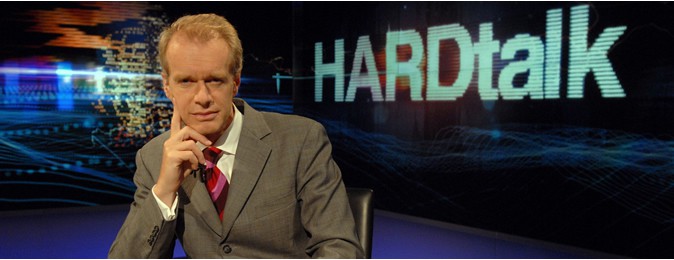
It was an invitation hard to resist – an opportunity to listen to Stephen Sackur of BBC HARDTalk share his knowledge and experience with the Foreign Correspondents Association of Singapore.
After all, how often does one get a chance to turn the tables on the man who’s grilled politicians, celebrities and interesting world figures and even had one storm out in the middle of an interview?
In an age when talk shows have become more entertainment than serious journalism and hosts have become more comedians than commentators, BBC’s HARDTalk retains its format of a live interview that asks the hard questions and gets (or tries to) the real answers.
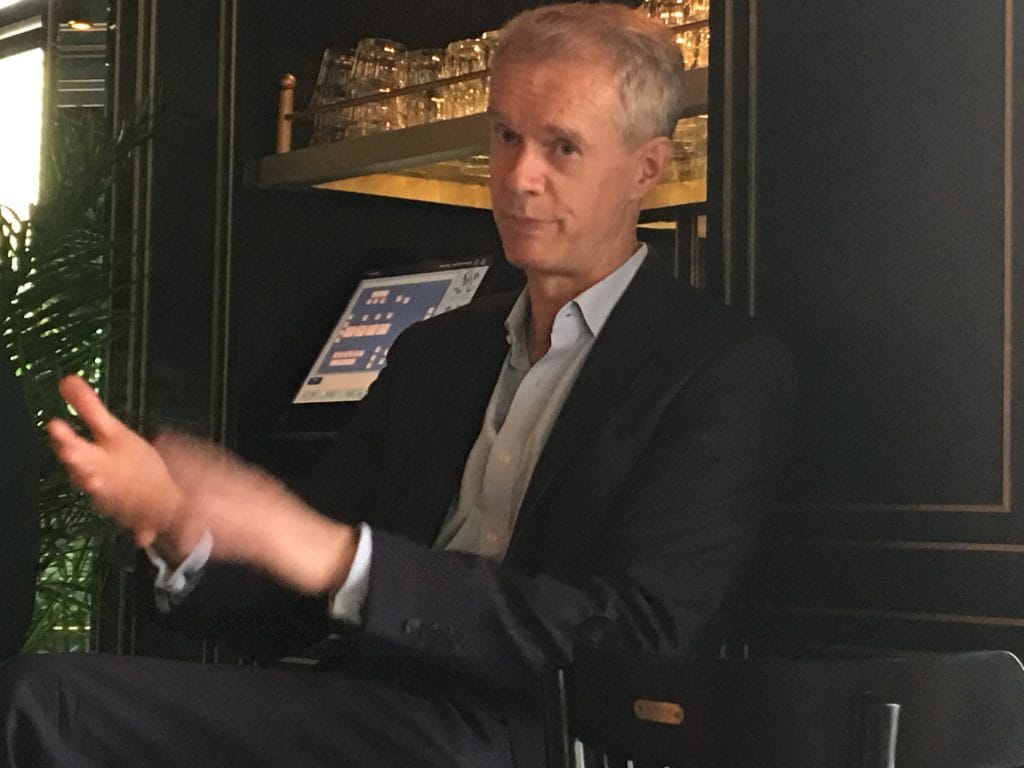
Stephen Sackur: “Chemistry is interesting, it gives you insights into the character”.
In town to interview Singapore’s Prime Minister Lee Hsien Loong for an edition airing March 1, Sackur, who’s been helming the show since 2006, cleverly turned the tables on the media attending his talk, asking them what questions they’d like him to ask the Prime Minister and of course, there was no lack of volunteers.
The 30-year veteran journalist admits that, given he’s doing an interview almost everyday, he only immerses himself in the subject the day before. All the research and prep work’s done by his producer and he crams himself on the notes. “I am only as good as the research that is done,” he said.
He told us that the interview with Prime Minister Lee (happening today) would cover the big themes – changing world, Trump in the White House, tensions in Asia, and Singapore’s relationship with the US and China.
On the surface, he said, Singapore seems to be an extraordinarily successful benign dictatorship, but how sustainable is the model for the future? What happens after the Lee family succession, he wondered? Are these topics covered in the local media, he asked?
I responded that in Singapore, like elsewhere, people get their news mainly from social media (which is full of all the issues he’s mentioned) and that there’s less trust in mainstream media than in friends’ social feeds. In the US recently, a poll showed that people trusted Trump more than they did mainstream media. I asked him how sustainable was the media model for the future?
“There are no assurances, it depends on our response.” And he argues that in this “murky landscape of unverified sources and social media, it’s even more important to have fact-based journalism” and that BBC has brand recognition.
Of course, he added, “we have to adapt to the younger generation whose attention span is shorter and doesn’t switch on the TV”. And so they create little bites of content to share on social media.
He recalled a recent interview with British pop icon of the 60s, Petula Clark, who at 84 is still singing and touring. They took questions via Facebook Live and “hundreds of thousands of people were following it”.
Podcasts is another way BBC HARDTalk reaches out to more audiences and he was delighted that BBC World Service Radio was still listened to in Asia.
He said it was important that mainstream media did not see the current accusations being hurled at them as “fake news” by the Trump administration as a battle. “It is just us doing our job. We must stick to our professional values and hope our audiences see that we are not engaged in an ideological battle but doing our job.”
And while some people might term Singapore as a “dictatorship” or “quasi-democracy” or whatever label they wish to stick on it, Sackur said there’s debate raging over how effective Western democracy is in delivering good governance and economic progress – “when fundamental issues like healthcare in the US can turn on a dime, and not through longterm planning”.
“We are facing serious questions over how effective our own democracy is” and he said leaders in Asia have legitimate reasons to say, “forget the Western lecturing and look at all the problems you have”.
On the selection of interviewees, he said “we don’t do interviews if there are too many exclusions of topics”, and that all questions asked are based on evidence, not innuendoes. “It would also be a mistake to make every question a confrontation, you need to give people space to think.”
On his style of interviewing, he said, “I frame a thread through an interview. I try to build rhythm in an interview so that it gets to a dramatic moment. So I am juggling evidence, facts and rhythm and trying to get into the character of the interviewee.”
Interviewees can be unexpected. He recalled the late President of Venezuela Hugo Chavez as charming and with a sense of humour, while he had “zero chemistry” with the former US Vice President Al Gore whom he called “unempathetic”. “Chemistry is interesting, it gives you insights into the character.”
The only interviewee who stormed out of set (10 minutes into) was Max Clifford, former British publicity agent and now convicted sex offender. In making his exit, he kicked down a wall and got a bill from BBC “in true bureaucratic fashion” for the damage.
As for what makes a successful show, beyond the ratings, Sackur said, “I am happy when I feel I got to the heart of who they were, and it wasn’t just a media performance.”
The most memorable to him was the interview with Allen Fault, former commissioner of corrections, Georgia, US, who oversaw executions and one day decided he didn’t believe in the death penalty anymore. “It was a raw and emotionally painful interview. He was so honest and engaged. Often the most memorable are not the biggest names but come from moments that are true and raw.”
And the lesson he learnt personally was to “be myself”. Sackur took over from the larger-than-life irascible Tim Sebastian who probably embodies Hard Talk more than the soft-spoken Sackur. “In the beginning, I was partly trying to be like him but I am not as in your face as him and you learn, like with everything, you learn to be yourself. People see through the pretence.”
From the one-hour session with him, it was clear he wasn’t pretending to be anyone else other than Stephen Sackur, HARDTalk personality. Now let’s hope he took the personal lessons he learnt about succession and turned that onto Prime Minister Lee.