
I recently spoke to Marla and 16-year old Kasha Slavner from The Global Sunrise Project, a Canadian mother-daughter duo currently travelling the world to understand what it truly means to be a ‘global citizen’.
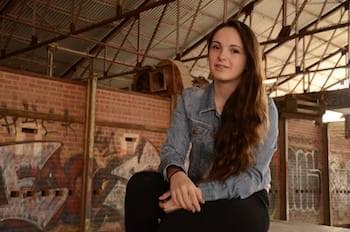
Kasha Slavner, storyteller and filmmaker (Image credit: The Global Sunrise Project Facebook page)
Taking at least six months out of school, Kasha has opted for an education beyond the classroom, setting herself the homework of creating a documentary film and accompanying book to recount her travels across four continents. Relying on a combination of crowd funding and corporate sponsorship to finance everything from airfare, accommodation and food, their journey is a definite triumph of planning and improvisation.
Their goal is simply expressed but in actuality, extremely complex. Kasha not only wanted to generate awareness of grassroots community projects around the world but use these stories as testament to how cooperation, leadership, innovation and resilience are helping change the world without us really even noticing. In Kasha’s words, she wants her documentary to showcase “the little good things”, remarking on how “the bigger organisations don’t have the space to showcase the smaller stories”.
She is focused on every kind of project imaginable from eco and sustainable tourism, to human rights efforts, to health care and the arts. Kasha focuses on the unique people running these organisations, what keeps them motivated and driven to do good and their potential to change the world.
Kasha’s approach to reporting her stories are also a reaction against the use of fear mongering and sensationalism in modern media when reporting on world affairs “We’re all really tired of the negative stories”, says Kasha, “we’re so conditioned to be fearful”.
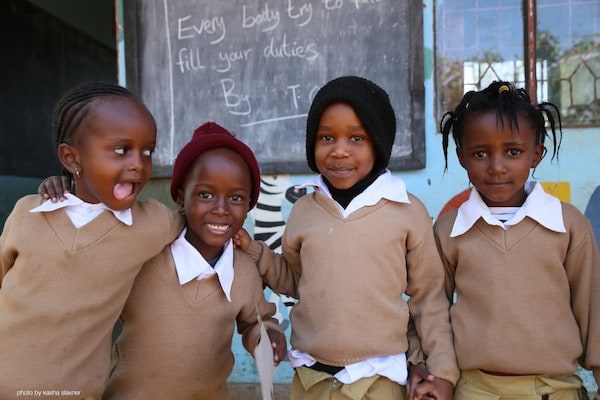
Gloryland Prep School in Arusha, Tanzania (Image credit: Kasha Slavner )
In an effort to inspire and reignite people’s faith in the world, she aims to “find the positive stories out of this adversity”. For example, having witnessed the sex industry and trafficking first hand in Chiang Mai, Kasha sought out projects that were designed to help women escape this form of exploitation to include in her documentary and to attract global awareness to their cause.
The pair travel with the philosophy, “leave a place better than when you found it” being careful to not fall into the cliché and scam of “volun-tourism” – groups falsely claiming to support local, sustainable, tourism. Instead, they choose tour companies that organise expeditions to self-sufficient villages to understand how local community projects are succeeding without international intervention. In doing so, it demonstrates how we need to be much more socially aware of our actual impact when visiting various places.
A project of this size is clearly no easy feat. Relying almost wholly on donations from corporate sponsors and various donors through online platforms, both Kasha and Marla were quick to agree that their trip would have been virtually impossible without staying ‘connected’ through a wide variety of social networks, Facebook, Twitter, Instagram, Google+, Pinterest and Youtube as well as her own blog and website.

Image credit: Kasha Slavner
Being connected also means staying accountable to their sponsors as well as being able to find new ones. Embracing the relatively new concept of crowd funding, the Global Sunrise Project varied in its degree of their success. Their first IndieGoGo campaign reached only 25% of their funding target despite keeping a strong social media presence and achieving over 5000 shares. When asked who they believed to be the major funders of their trip aside from their corporate sponsors and friends, Marla felt “the one common denominator was that most are older than Kasha and (seem) impressed with the task she was taking on at such a young age”.
However, given the length of their trip and the inevitable scarcity of internet connection in places, they found it difficult to keep up the social media buzz to stay consistently ‘trending’. Marla stressed the importance that to sustain enough support to keep going, “we [had] to stay relevant in people’s minds”.
While their second campaign was more successful, achieving 50% of their goal, its unclear how much of this was due to other exposure the project was getting in the media, through news of Kasha’s speech for The Goodlife Project in New York and her attendance at the UN as a youth delegate.
It seems that without this early recognition, Kasha may not achieved the credibility necessary for her project to succeed. “Things tend to pick up exponentially if we reach 40-50% of the goal, so the quicker we get to that mark the better!” The amount they have raised so far fuels more donations, creating a sort of positive feedback loop when rallying support. In fact, the majority of scepticism received by Kasha’s project was initially from her immediate family. However, “once they saw that other people were supporting us… and the amount of work I was actually doing, they began to hop on board”.
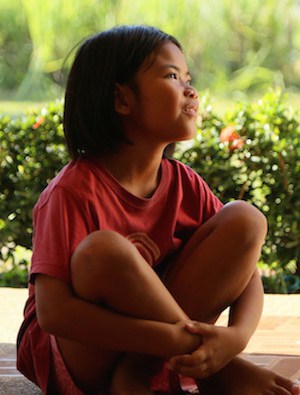
Image credit: Kasha Slavner
Sensing that she didn’t have the emotional support from people she personally cared about meant the project “felt like it was missing something”. With its aim to change social attitudes, motivate and empower others to do social good, financial support was clearly not going to be enough.
In order for her to be truly successful, people need to have faith in the project and what it is attempting to achieve. “There’s a new trend of using the media to tell stories… I’m trying to switch the scale so the positive outweighs the negative”. By telling the stories of all the people she has met thus far through powerful channels like social media, Kasha’s work has a much better chance of pushing her underlying, core message of ‘global citizenship’ forward.
Due to return home in December 2014, Marla hopes that “with new context of the world, Kasha can go back and look at the [local] community in a different way”. Having trekked across the globe to essentially show us what people around the world have managed to achieve in the face of so much hardship, the project inspires us to take a look at our own communities and to see what changes we can help to make, big or small.
Currently, Kasha and Marla are seeking funding to continue their onward journey in Asia (Thailand, Cambodia and Singapore) before planning their eventual return home to Toronto, Canada. They have launched another crowd-funding travel campaign on Trevolta, hoping to finance the remainder of their travels.
If you would like to learn more about the project, you can visit their website, The Global Sunrise Project and via their Facebook page.