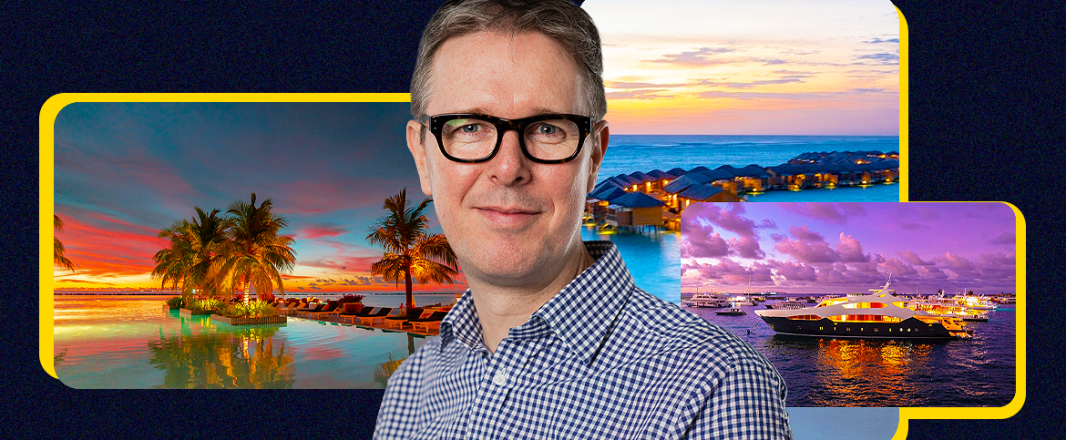
There is a particular kind of founder that the startup world doesn’t celebrate enough – not the one who disrupts an industry overnight and exits in five years, but the one who holds the line for nearly three decades on a vision that the world wasn’t quite ready for yet. Alex Cheatle, CEO and co-founder of Ten Lifestyle Group, is that founder.
When he and his brother set up Ten in 1998, Cheatle, fresh from a career in Procter & Gamble, had a thesis: digital technology was about to make hyper-personalised service possible at scale, for the first time in human history. He was right, just 28 years too early, he ruefully admits.
Chatting with me from his base in London, he laughs, “I believed that was definitely going to be possible by 2003. Of course, it only really became possible now.”
But the two brothers did not give up – they persevered, tried a couple of business models and stay focused on building – a slow, unglamourous, compounding build that most might have abandoned. And now, finally, they have proven the model and are pulling away from the field.
This is the story of Ten, one of the more successful travel companies no one’s heard of.
The invisible power behind banks
Ten operates almost entirely behind other people’s brands – the world’s leading banks, private banks and wealth managers. HSBC, Barclays, Westpac, and dozens of others pay Ten to look after their highest-value customers, offering them a lifestyle management service that covers travel, dining, entertainment and luxury retail.
It’s neither a loyalty points programme or a discount portal, but a curated, human-and-technology-powered service designed to make those customers feel that their bank truly understands and anticipates their needs.
“We work with our banks to engage their customers,” Cheatle explains. “How do you get to your destination, where do you stay, where do you eat, what do you do and sometimes, what do you buy.”
The business is global – roughly 35% Europe, 35% Americas and 30% Asia – with 1,200 staff across 25 offices worldwide, and around £70 million in net revenue. Its latest half-year results to the end of February told a compelling story: active members up 23% to 436,000, profit before tax up 60%, and, for the first time since Ten listed in 2017, the company is both cash positive and entirely debt-free.
Why it took so long – three honest reasons
If the model is so strong, I asked, why did it take Ten nearly three decades to prove it? He gives three reasons.
The first is breadth. “You’ve got to get good across all the different parts of travel. Flight only, one night in a hotel, people that want the luxury experience, people that want to buy on price — across sport, theatre, comedy, music, restaurants, sourcing Hermès Birkin bags and Rolex watches. These are all really different industries to learn.”
The second is technology. When Ten was founded, the tools to deliver hyper-personalisation at scale simply didn’t exist. Building the business meant building on top of technology that kept falling short of what the vision demanded. It required investing steadily, year after year, into a platform that would only fully come into its own when AI and data infrastructure caught up with the ambition.

The third is relationships. “You can’t just go and win business in the banking market. You need compliance, you need data security, you need to be trusted by institutions that have spent centuries building their reputations. We spend about a million pounds a year on compliance alone.”
Similarly, the supplier side of the business – the concert promoters, the five-star hotels, the Michelin-starred restaurants – only opens its best inventory to partners it knows and trusts. “If you go to Beyoncé’s producer and say, ‘I want 5,000 tickets for the next tour,’ they say, ‘We’ve never heard of you’.”
Those relationships have to be earned the hard way.
The build was painstaking. In 2003, Ten had 33 staff and less than a million pounds in revenue. Every year, except for Covid, it grew. By the time the pandemic arrived and seemingly reset everything, Ten had finally begun to feel like it was there. “We thought we’d made it in January 2020,” Cheatle says. “And then, well, we know what happened.”
The inflection point
Two years ago, something shifted. Ten achieved cash generation for the first time. A year later, it paid off its debts entirely.
The inflection point wasn’t a single event. It was the convergence of everything he had been building towards: the technology had matured, the supplier relationships had deepened, the compliance infrastructure was in place, and the banks had come to understand – especially through the turbulence of rising interest rates, scaling fintechs and geopolitical instability – just how much it mattered to hold onto their most valuable customers.
That last point is one of Ten’s most counter-intuitive strengths. “When times are difficult, banks want to invest in customer loyalty for their top customers even more than usual,” Cheatle explains. “Banks rely on their asset-rich customers in bad times. If interest rates are high, they normally make more money.” It’s a flywheel that runs in both directions: good times, bad times, volatile times, the appetite to retain the affluent and is essentially constant, and it grows with uncertainty.
He points to Ten’s performance during the 2008 financial crisis as evidence. “The biggest meltdown in the history of Ten, apart from Covid, was the Lehman Brothers collapse and the Great Recession. We grew 33% that year and 29% the year after.”
He recalled telling Rocco Forte those numbers and watching the hotelier’s politely skeptical expression. “I could just see him thinking, ‘I don’t know who you are, young man, but that sounds like bullsh*t.’”

The business model no one else has cracked
Central to Ten’s defensibility, he says, is a simple truth. “We get paid to make people happy, not to extract commissions. Essentially, 87% of our net revenue is paid for by banks and wealth managers. Only 13% is commissions.”
That inverted model unlocks something that’s hard for a traditional travel company, built on commissions, to replicate, he says.
He cites an example: Ten will book a one-night stay in the British countryside during a bank holiday weekend – a booking that generates essentially no commission and that most traditional travel agents would decline – because for a member whose niece is getting married nearby, that booking is everything. “If it’s important for them, it’s important for loyalty for the bank, and so it’s important for us.”
It means Ten can secure Beyoncé tickets at face value and sell them at face value. It means they can organise every meal on a two-week holiday, not just the flights and hotel. It means they can serve the whole journey, not just the profitable parts of it.

Alex Cheatle, CEO and co-founder of Ten Lifestyle Group
“The travel industry can’t afford to do that. Why would they want to book everybody’s lunch and supper on a two-week holiday if they’ve won the hotel and the flight and the car?”
In the early days, Cheatle tried the DTC subscription model but it didn’t become the main driver of growth. “We still have subscriptions but it’s about 1% of our revenues – less than a million pounds of revenue. It’s a very difficult business to set up and to grow a subscriber direct to consumer concierge.”
Cheatle tracks the competitive landscape with the attentiveness of a founder who has spent years watching others attempt the same climb. “We think it’s about a billion dollars of investment that has gone into lifestyle concierge since we set up. And $950 million of that has been wasted.”
Over 100 companies have started and gone bust, he claims.
He’s also been watching the forays by the giant OTAs such as Expedia, Hopper and Agoda to power banks’ loyalty programmes. “Yes, there’s a lot of interest in the loyalty space, but we own the high net worth end and that market does not want to book on Hopper and Expedia.”
The reason, he argues, is structural: you cannot build this business by acquisition, hoping that a hotel company and a restaurant booking service and an events business will play nicely together. The connected journey, he believes, has to be built from the inside out, not assembled from parts and it is built on culture, technology and trust.

Winner takes all
Now that Ten is cash-positive and debt-free, the direction from here is clear – growth, growth, growth. The target is £100 million in net revenue, at which point Cheatle expects margins of around 35%. At that scale, the supplier proposition transforms – from thousands of restaurant relationships to tens of thousands, from a reasonable flights proposition to a genuinely exceptional one. Its private travel business, currently in five markets – namely the UK, Switzerland, North America, Middle East and Brazil – should be everywhere.
And as for AI? Cheatle is sanguine rather than evangelical. The technology he has been waiting for since 1998 is finally here, quietly doing what he always knew it would, making hyper-personalisation possible at scale. “For now, the next few years, it’s just getting incrementally better in the markets, the categories, the technologies where we already have strength.”
Plus, in the age of AI, human care and contact becomes the premium service people will pay for.
Speaking like a founder who’s fought long and hard to claim his ground, Cheatle believes the market is winner-takes-all. “When people choose a concierge service, they want the people who can get the best results. You get the best results if you’ve got the best technology and the best supplier relationships, and you get those with scale.
“Scale funds the technology. Scale builds the relationships. Scale allows you to satisfy the compliance requirements of the banks. And once you have all three, the moat becomes very difficult to cross.”
Cheatle, who by his own account endured more sleepless nights between 2003 and 2020 than he cares to remember, now says he sleeps with a smile on his face – and, oh yes, Oil of Olay face cream, the brand he used to market when with P&G. Now that’s loyalty.