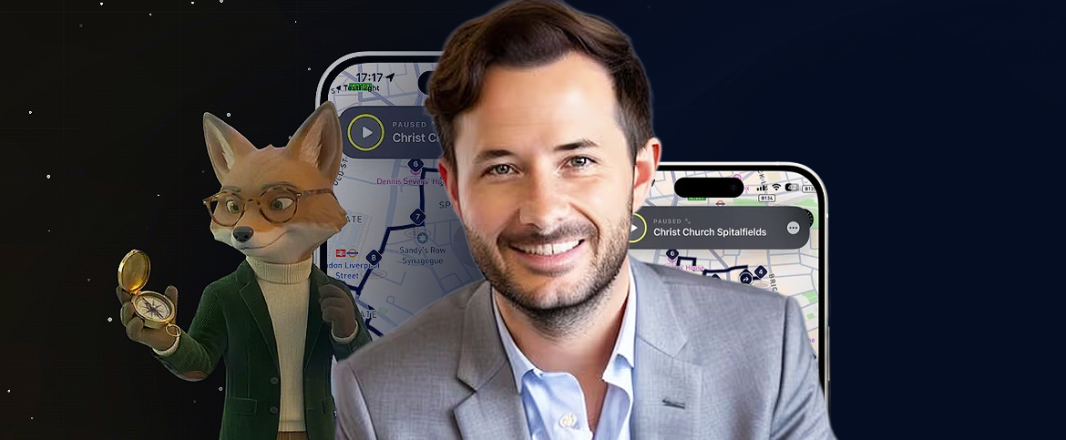
iWander co-founder and CEO Marius Nigond on building AI-guided walking tours for a generation of travelers who want spontaneity, not a fixed itinerary
Travel planning is being influenced by AI faster than almost any other part of the industry. Google just moved agentic hotel booking out of pilot mode and into a full U.S. launch inside AI Mode, with partners spanning Marriott, Hilton, Expedia and Booking.com, while flight price-tracking and points-based search roll out to 180 countries. The pitch is the same across the industry; let AI handle the logistics, so travellers can spend less time comparing tabs and more time actually going somewhere.
But booking a trip is only half the story. The other half happens after you land, when you’re standing on an unfamiliar street trying to figure out what’s worth seeing and what isn’t. That’s the problem London-based startup iWander has spent the past two years building for. Founded by brothers Marius and Antoine Nigond, the company uses generative AI to build personalised, narrated walking tours on demand with no fixed start time, no group pace, no forty strangers trailing behind a raised umbrella. iWander assembles a tour in about thirty seconds, drawing on a database of more than 6.5 million curated places and points of interest.
Since launching in 2023 as a B2B2C service and powering in-destination experiences for partners like City Sightseeing, iWander has now taken its technology direct to consumers with the recent launch of its iOS app. After two years refining the underlying tech with enterprise partners, Nigond says the company needed its own space to ship fast and learn directly from how travelers use it.
We caught up with Marius Nigond to talk about why iWander made the jump to the consumer, what building an AI travel product for the past two years has taught him, and how he sees the next wave of AI-driven travel tools unfolding.
Q: What gap in the market does iWander address?
The best way to discover a city is with a great, guided tour, yet almost nobody takes one. In our own research, just 3% of travellers joined a tour on their last trip. Travellers don’t like fixed start times, planning in advance, large groups, spending time with strangers, and private tours are increasingly expensive.
Meanwhile, most sightseeing decisions are made after travellers have arrived in-destination. iWander serves that gap with the ability to have the experience of a tour guide, without the drawbacks.
Q: You said iWander needed its own playground. What’s a product decision you couldn’t have made fast enough inside a partner app?
The honest answer is almost all of them. Inside a partner app, every change has to go through their release cycle, their brand review and their risk review. It’s totally understandable, but it means a new AI model or interface that we could ship to our own users immediately ends up being released 6-months later.
Or for instance, our character guides. We are testing more playful, more interactive guides, and changing these personalities every week based on what engages customers most. Or our onboarding flow. Since we released it as a standalone app, we’ve changed the onboarding flow 4 times, to try and understand if customers interact better with our product if we immediately offer an experience, if we ask them to plan their day first, or if we inspire them about what kinds of stories are worth exploring nearby first.
That’s what I mean about having a “playground” to ship fast, learn fast and our partners then get the upside without carrying the risk.
Q: How do you keep tour quality and accuracy consistent with character-driven tours, at scale, versus destinations with human-curated stories?
The database does the heavy lifting. We’ve spent two years curating 6.5 million points of interest, so the AI narrates from verified content. It’s not just improvising from an LLM’s memory. On top of that, our storytelling engine handles structure; which places deserve a stop, in what order, with what pacing. The characters change how the story is told, not what’s in it. And we have a benchmark of human-curated tours, against which we compare every single tour our AI generates.

iWander founders, brothers Marius (left) and Antoine Nigond (right)
Q: What does iWander’s marketing engine look like day to day, and what’s actually worked versus what hasn’t?
What’s worked best are press, the travel community (PhocusWire, Travel Massive, WiT), and our B2B distribution, which puts us in front of high-intent travellers already in-destination. And increasingly, SEO and GEO. What hasn’t… paid acquisition. It’s too expensive for a travel app with a low AOV, so we’ve kept it minimal for now.
Q: When repurposing generated tours into short-form social content, is that content AI-generated end-to-end, or is there a human editorial layer, and how do you think about brand risk there?
There’s always a human layer. One Paris tour can yield a dozen candidate clips but it’s our team which selects the best pieces of content and creates visual assets that match. I don’t see a huge amount of brand risk. We are an AI-native/AI-content company, so we need to use our product as a marketign tool. As described above, our AI narrates and sources information from our curated database, so hallucinations are dramatically reduced. That matters double for us because this not only powers our brand, but our partners too.
Q: You’re seeing data on where people go after a bus tour and what they ask the AI. What’s been the most surprising insight so far?
How many travellers trust the recommendations and our tool to shape their entire day. It’s amazing to see a traveller start the day with our “plan my day” tool, and see them wander across the city following our recommendations and guided tours.
The other surprise was appetite when embedded into other travel apps. 27% of partner app downloads engage with the iWander layer, which is much higher than the benchmarks we initially set.
Q: iWander started as B2B2C, now you’re going direct-to-consumer with the iOS app. Does that put you in tension with your existing partners?
Good question! No, because we don’t compete for their customers and because they are aware this will help make the underlying product better.
Q: In-app booking for attractions, restaurants and events puts you in a territory alongside OTAs and metasearch players. What do you think about that competitive line?
I don’t mind admitting that I see the long-term vision of this product compete with the OTAs. Ultimately, we sell the same thing, but we have different approaches to proposing that product to the end-customer. An OTA is search-first. You know what you want, you type it in, you compare, you book.
We’re experience-first. We start with content, geo proximity, and genuine recommendations … and not everything we recommend is linked to a product. The transaction comes at the end of the experience, not the start of it. The two models can absolutely co-exist and I see them converging more and more. Travellers would get better recommendations, and operators would get customers who arrive with context instead of just a confirmation code.