His gaze was intent. He was looking for support, for power to overcome bodily pain. To conquer the physical and enter the spiritual. He, was a participant at this year’s Thaipusam, a Kavadi (chariot) attached to his body, literally anchored by rods and hooks into his flesh. His cheeks were pierced with a thick metal rod, with decorations hanging on either side. Through his tongue was another rod. His forehead had small decorative needles folded into his skin. He was surrounded by family and friends, supporting him in chant and prayer as he embarked on this 5 km cleansing journey.
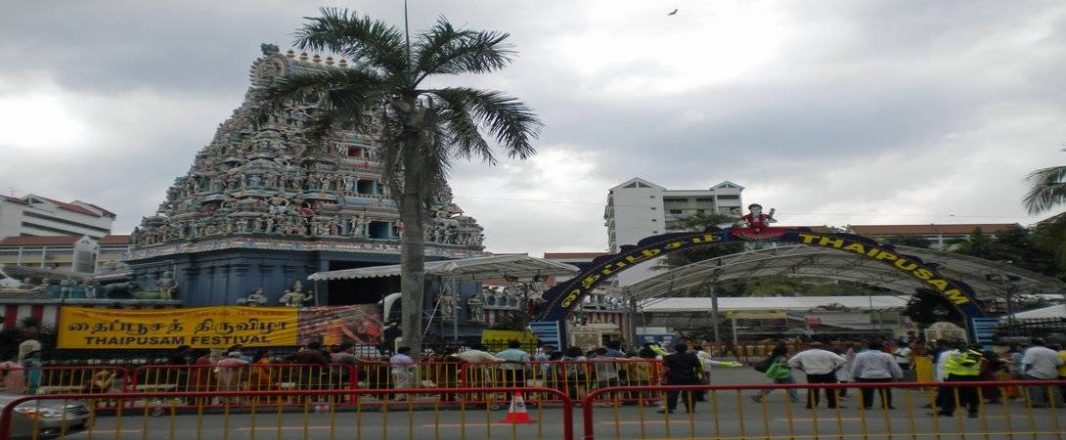
Thaipusam is a religious festival that originates in southern India, yet has for whatever reason been banned there. However, a select few countries to where this group of Indian Tamils emigrated to continue the tradition. Singapore is one of them. As is Fiji, Mauritius and some small islands in the West Indies.
Participants embark on this ritual for they are usually making a vow – perhaps an offering to prevent illness of a beloved, or something alike. They achieve this by carrying offerings for the Hindu God Murugan to his temple.
The vows are made in different ways. Some carry milk pots on their heads. Some have ornamental head-pieces that they carry above their head and are ‘attached’ to their body with hooks. Then there are other participants that pull carts with gods on them, the ropes being attached with hooks into the skin on the back. Some of the younger men will hang tens of limes on their backs, all attached by small hooks into the top layer of skin. And then there are those that do all this while walking on a shoe of nails!
The preparations for the participants start a month prior to the actual procession. One has to fast, refrain from alcohol, no sex and you even have to sleep on the floor. Worst of all, if you want the vows to be heard, you should perform this ritual at least three times. Not an easy feat when you see what this entails.
The festival always falls on a full moon. The preparation and assembling actually happens the night before at the Serangoon Road Srinivasa Perumal Temple, where the procession starts. The devotees and their supporters then walk the 5km path to the Hindu Temple in Tank Road, where the procession ends in the later afternoon, early evening.
Given the path of the procession, it’s best to head to the Little India temple in the morning and the River Valley Road temple in the evening. In the former site you will witness the hooks and rods being attached into the skin of the devotees, while at the latter temple you will observe the tranced out participants have all the ‘accessories’ removed, one hook and rod at a time, and the head pieces dismantled. Some even faint at the end. But the supportive family and loved ones are always there to ‘catch’ them and ground them to reality.
A new trend that is starting to emerge with Thaipusam is that more and more Chinese participants are starting to perform this ritual.
Perhaps I will be next!