
And the prospects are looking good. There is no doubt about it. Indonesia is definitely the Asian online sleeping giant. If you look at the changes that have occurred in the online space in the last few years in the country, you will quickly realize that the potential in this market is huge and the uptake massive.
Here are some facts: There were 30 million Internet users as of September 2009 – that’s 12.3% penetration. Indonesia has the third largest number of Facebook users – 26.8 million, just behind the UK and the US. Roughly half its population (242 million) own mobile phones. Blackberry is known to be the clear winner in terms of smartphones in Indonesia and, according to a report in Bloomberg, RIM says it has about 1.2 million subscribers in Indonesia.
Better, faster and cheaper internet access as well as smart phones like the Blackberry has enabled Indonesians to go online via their GPRS connection and thus the number of people going online to sites like Facebook over the past couple of years has been astonishing.
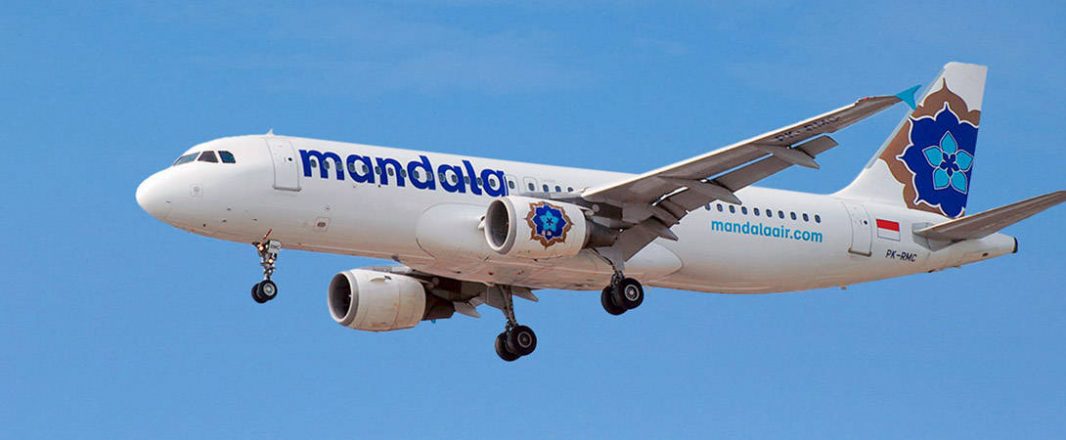
Consequently, the interest in online travel has boomed. For Mandala Airlines, currently 35% of its domestic sales and 75% of its international sales come through the internet.
Let’s not forget though, the market is very nascent. In terms of online travel, the majority of transactions are for cheap and simple individual bookings. Packages are of little interest … yet.
Adrian tells us that even though Mandala Airlines has an online hotel booking system on its homepage, it is not getting a whole deal of use right now.
So what is on the horizon for the Indonesian carrier?
Adrian, who only started with Mandala nine months ago but has worked with several airlines including Pacific Blue in New Zealand, IndoGo in India and South African Airways, says it will be using its new A320s on order for domestic expansion over the next years, as well as conquering some lucrative international markets.
It recently launched flights to Hong Kong, Macau and Singapore with China, Malaysia and Thailand on the drawing board.
As we all know, the Asian low cost airline model is booming with several very strong players already strongly entrenched in South-east Asia, such as AirAsia, Tiger Airways and Jetstar Asia and of course, Mandala Airlines will be going head-to-head with them.
But Adrian is confident it is well-prepared to do so. He says Mandala has good credentials, is building up a brand new fleet of A320/319 planes, has a new and experienced international management team and a world class safety structure in place, which doesn’t go unnoticed given that Indonesian airlines in general have often been criticised for their safety records.
I personally haven’t flown Mandala Airlines yet but will give it a shot when the opportunity arises. As far as I can see though, their business model is not dissimilar to other low cost airlines that I’ve already flown.
Like their competitors, it is also moving towards unbundling its services. Of course this means that in order to get those cheap fares we’re all lusting for, we’ll have to be charged extra for bags, food, seats and goodness knows what else. But if the fare is good, hey, why not!
Adrian confirms that over 10% of Mandala’s revenue is from ancillary services – however, global trends for low cost carriers are somewhere between 20-30% so Mandala Airlines is still slightly behind the curve in relation to other airlines.
I just had an idea. Do you know that budget airlines also make money from cargo and not just passenger traffic? I wonder if it would be cheaper if I just posted myself as cargo on my next trip to Yogyakarta?
Note: Adrian Hamilton-Manns will be speaking at WIT during the panel on “Arise The New Customers”.
Featured image credit : http://psstudios.com