
Since the media world got flattened like roti prata, and everyone can make one – you can buy them frozen at the supermarket and just lightly toss them in a hot pan and voila, you’ve got a crispy one – us journalists have been wondering where to run for cover since now everyone can write as well.
No one seems to love us anymore, or want our writings because guess what, they should pay for it. But because content is fee and wants to be free – master of the web universe declares it so – it’s hard to find people willing to pay for quality content.

Photo credit: Shutterstock
Well, maybe it’s wishful thinking on my part but I feel the tide is turning.
This interview with Financial Times’ Lionel Barber gives me hope for a new kind of future for journalists where he talks about software driving journalism.
The salmon-pink paper – differentiation by colour, how clever – is one of the traditional newspaper brands that’s having success in the digital world by smart blending of two.
Two thirds of its total paying readership of 677,000 are online subscribers and digital circulation is growing at a rate of 33 percent a year. And instead of print driving online, as it used to be in the good old days, now online’s driving print – according to the article, “the recent design update to its print paper was partly done to favor the quicker pace of its website, as the online posts will now determine what appears in the daily print edition.”
Asked when he thinks all his readers will just be online, Barber said, “I still see there’s a future in print. Print still has value. There’s millions of dollars of advertising wrapped up in that. Print is here for us for a while, and what we have to do is keep that vibrant.”
The critical element here is “vibrant” content, never mind the channel.

David Beebe: Content that drives commerce
The recent move by Marriott to set up a global creative and content studio speaks of the direction the travel world is moving. This takes content creation and marketing, hitherto limited to managing Twitter or Facebook accounts for some hotels, to another level. It’s taken an ex-Disney-ABC Television Group executive, David Beebe, to spearhead the project. “While content is just part of the overall travel experience we provide, we believe Marriott can become the world’s leading publisher of travel lifestyle content for the next generation. Our goal is to produce engaging content that builds communities of people passionate about travel that will drive commerce.”
The critical word here is “commerce”.
It does make sense for a brand like Marriott to create its own original content. If you own inventory, why don’t you own the content too? Hotel chains have lost control of their inventory to OTAs and other intermediaries, I guess they don’t want to lose control of content too.
Marriott’s the first to announce such a big and bold move but many hotel companies are on the same track.
I was having lunch with Philip Schaetz, senior vice president-sales and marketing of Dorsett Hospitality International, chatting about their new hotel in London, the Dorsett Shepherd’s Bush and how it heralds a new era for the Hong Kong-based group. It’s their first foray outside Asia but how does a niche brand like this get noticed by media and customers in an age of noise on steroids?

Philip Schaetz: People are searching by interests.
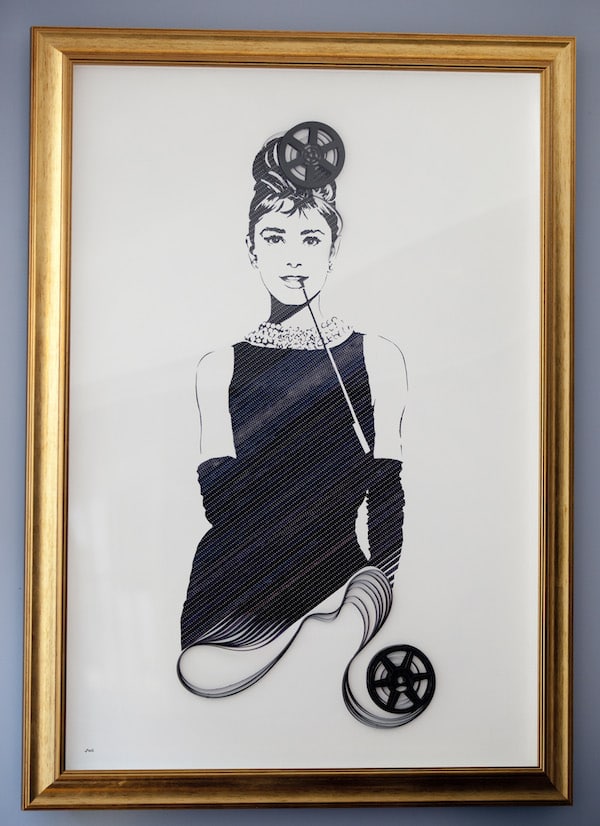
A portrait of Audrey Hepburn done with film strips is a signature feature of Dorsett Shepherd’s Bush
Well, they’re doing it with stories – the building has a rich history, it used to be a theatre called the Pavilion and in the 1920s, people used to come here to watch the news. Then during the war, it became a community hall where people got updates. Later it became a bingo hall. How fun is that? So the hotel is playing up the movie theme in its story-telling and design. A portrait of Audrey Hepburn (right) done with film strips hangs with pride in the Red Room, its private dining area.
Schaetz is also planning a complete revamp of its website. No more static content like pictures of rooms and facilities, but he wants dynamic, original destination content that’s curated around interests. “This is how people are searching, by interests,” he said.
So his idea is to create interesting, localised, relevant content around his hotels. He knows it’s a big job but it’s the only way for the four-star niche Asia-based brand to be discoverable on the web because who can compete with the OTAs in traditional search?
The Singapore Tourism Board has also launched its new YourSingapore.com website. The website, in beta, is more of a platform for content created by bloggers, media and travellers than it is about the STB voice. The social element allows travellers to share holiday snaps but the “trusted” voice belongs to bloggers and media partners. I hope they are getting paid for it in some way.
To me, the content needle is switching back to the professionals. For the last 10 years, user generated content was king and TripAdvisor became its emperor. In the next few years, I believe professionally-created and curated content will be king and the emperors will be those who are willing to pay for it.
Note: A case study on YourSingapore.com will be presented at the WIT Conference, Oct 27-29, by Lynette Pang, STB’s assistant chief executive, marketing and Paul Soon, CEO of XM Asia, its agency.