.JPG)
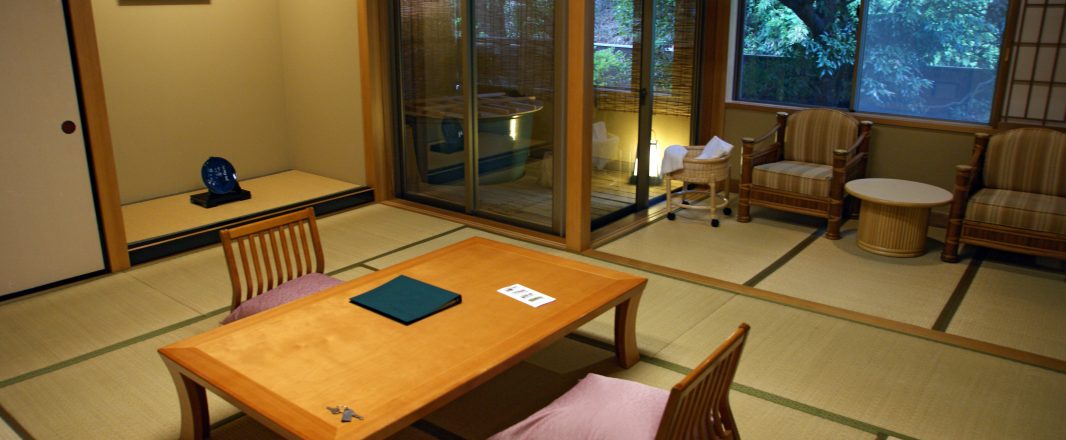
I am sitting in a ryokan (Japanese inn) by the Pacific Ocean as I write this. The sun is just rising, the birds are flitting about in the early light of dawn, the beach is deserted, a contrast from yesterday afternoon when surfers were out riding the waves.
Last night, we had an amazing dinner. In Japan, I always feel like I am eating art rather than just food. Each course is prepared and decorated so elaborately – squid sushi that comes rolled up in leaves and tied up with a string and knot, abalone that is cooked in sake in a little pot in front of you, saga beef so thinly sliced and beautifully marbled that it melts in your mouth.

After dinner, I soaked in an onsen. There’s something cleansing about a ritual that requires you to be naked with friends and strangers. And of course you also feel thoroughly clean in hot spring water that’s been directly piped down from the mountains.
I am taking a short break in Imaiso, a traditional luxury ryokan in Izu-Kawazu, a town of about 8,000 people, on the Japanese peninsula, after our WIT Japan conference on Friday. I can just about discern all seven islands on the horizon from my balcony.
Imaiso is one of thousands of ryokans that foreigners like me would love to experience but they remain largely inaccessible and elusive to travellers despite the high penetration of online travel in Japan, just under 40% according to PhoCusWright’s Japan Online Travel Overview.
 Not only are they hard to find and book online but even when you do find them, there’s very little done to accommodate foreigners – no English signs, no guidance on etiquette, etc. For instance, I walked into the male onsen (and I swear this was by mistake). Some ryokans don’t even want to have foreign guests, I am told.
To get here, we took the Shinkansen, it’s a three-hour ride. There are no signs in English at the train station and the ticket is all written in Japanese. Even for well-travelled folk, it’s hard to figure out your seat number, presuming you’ve found the right carriage on the right platform on the right train.
For a country that keeps saying it has the best hospitality – most Japanese hoteliers pride themselves on that – and its people the most polite, gracious and service-minded of any in Asia, Japan makes it hard for people to enter its shores.
Each time I visit, I have to get a visa. This time, I even got a letter from the Ministry of Tourism explaining the reason I was visiting Japan thinking I could secure a multiple entry visa. It didn’t work. I got a single entry visa, valid for 14 days.
Which is why I was the first to applaud when Shuichi Kameyama, director of international tourism promotion division, Japan Tourism Agency, announced at WIT Japan that they’d be easing visa regulations for South-east Asian nationals. My tweet about that immediately went viral among our Indonesian followers. It indicates the pent-up hunger South-east Asians have for Japan.
In 2012, Japan attracted 8.3 million visitors, down from the record high of 8.6 million in 2012. It is aiming for 10 million this year. Currently the biggest markets are South Korea, China and Taiwan but I am told by inbound operators they’re seeing huge interest from Malaysia, Indonesia and Thailand.
There is slow but growing recognition that inbound tourism can be one of the ways to help “Abenomics” work to jumpstart the economy.
Low cost airlines have opened up new gateways to new travellers. Miyuki Suzuki, CEO of Jetstar Japan, said instead of cannibalizing the market, the airline had created a new market with 30% of its customers first-time travellers.
And while the high cost structure of Japan is challenging for pure low cost models to work, the bigger issue facing these new players is, yes, regulations.
Peter Harbison, chairman of CAPA, Centre for Aviation, singled out the one thing that could open up tourism flow for Japan – if airports, airlines and regulatory authorities worked together, Japan tourism would prosper, he said, pointing to models such as Dubai and Singapore.

The Seven Falls in Kawazu
At WIT Japan, I sense a turning of the tide. The fact that we got more than 300 delegates (up from the 80 we had last year), with huge turnout from the local suppliers, indicates Japanese tourism players know they’re at a point of significant change.
Consumers everywhere are changing. In Japan, they’re going increasingly online. Rakuten Travel and Recruit (Jalan.net), the two biggest command 31% of OTA’s gross booking share in 2011, according to PhoCusWright and are taking share from traditional agents.
But the brick and mortar giants are not giving up without a fight. Japan Travel Bureau is stepping up its online play and its online subsidiary is growing 30% year on year while its brick and mortar parent had to close some offices, said Toshiyuki Imai, president & CEO, IJTB Corp.
Japanese customers are going mobile in a big way. Yosuke Maekawa, senior director Japan for comScore, said that in 2012, smartphone users increased by 53.9% and now comprised 33% of all mobile phone users. Two things to note – “mobile is now, not the future” and the “characteristic of mobile user is social”.
According to Jun Ogawa, head of travel, career & restaurant, Google Japan, there are now 33.7 million smartphones in Japan and tablets are also growing rapidly. Fifty percent of travel queries in Japan are happening on mobile vs 45% on PC and 4% tablet.
Rakuten’s CFO and Rakuten Travel’s vice chairman Yoshihisa Yamada said the ecommerce giant is seeing more than 40% of transactions happening on its Rakuten Ichiba platform on mobile + tablet, of which 27% was on smartphones.
Despite stagnation, Japan’s travel market is still the largest in Asia, worth 23.8 trillion yen, and online is on a positive trajectory. Foreign brands like booking.com, Agoda, hotels.com and Expedia are making inroads into the market, playing both inbound and outbound facilitators but obviously not able to compete that well on the domestic front as yet where they face the challenge of building local content.
Glenn Fogel, head of corporate strategy and development for Priceline Group, said the resurgence of Japan, thanks to the new economic measures being taken by the new Prime Minister, was important to the overall growth of Asia.
It is certainly good to see stronger participation in the region by Japanese online travel players. Rakuten Travel is attempting to export its model but knows it will have to find a different, creative approach to compete with the Western brands. Venture Republic, which runs meta search for flights and hotels in Japan, has set up an office in Singapore from which it will invest in start-ups in South-east Asia.
The number of entrepreneurs I met at WIT Japan talking of establishing offices in Singapore speaks of a growing trend of a new generation of travel players eager to go beyond Japanese shoes – Peatix, which handled our ticketing sales; Voyagin, one of the start-ups which pitched at our event; Trippiece, winner of our Start-Up Pitch in Singapore last year. And by the way, Relux, which won our WIT Japan Start-Up competition, is a “satisfaction-guaranteed online marketplace for Japanese inns”. Launched in English and in beta in February, it’s started by Loco Partners who have so far secured about US$600,000 funding from CyberAgent Ventures and Recruit Incubation Partners. This start-up, if it succeeds, could signal the beginning of a huge change in how foreigners get to experience Japan.
At the closing of WIT Japan, Stephan Ekbergh, CEO of Travelstart, South Africa, speaking to the theme of “No More Walls”, said the only walls we had to conquer if we wanted to expand our businesses globally were the walls around our hearts and minds. And he said that from what he’d seen of Japan on this first visit, “if you exported your values out into the world, the world would be a better place”.
From the welcome and hospitality I’ve received from the moment I stepped into the Japan Airlines aircraft to now, sitting on the balcony of Imaiso, watching life slowly unfold in this little coastal town, I can’t help but agree.
I wish more travellers like me could experience what I have in a ryokan like Imaiso the last 24 hours and, by so doing, appreciate and remember the values and traditions of courtesy, grace and respect in a rapidly urbanizing Asia.
* The Japanese mainstream media is also showing interest in Japanese inbound – watch this television coverage of WIT Japan on WBS, the country’s most popular business programme.