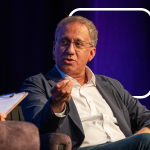

He may be the President and Chief Executive Officer, Expedia, Inc. and President, Expedia Worldwide, but at heart Dara Khosrowshahi remains a product guy. I know this because he became truly animated when he showed me the Expedia Hotels & Flights app on his iPhone.
“It’s so tactile. We take care with the transitions. We didn’t have to put images but we did. And instead of click to purchase, it’s slide to purchase,” he said, as he slides his finger over the screen.
“It’s useful and beautiful,” he finished with a flourish. .png)
And making “useful and beautiful” products and “creating experiences that delight the customer” through technology and product expertise is what will create loyalty in the online world and how Expedia will differentiate itself from the competition.
“Our competitive advantage is that we are, bar none, the best technology company in travel, that serves and delights the customer.”
His picks of beautiful products in the online world – Amazon, “unbelievably easy and dependable”; Google search product, “fast and simple proposition”; Apple products; Netflix, “it surfaces great content that I didn’t know existed” – discovery.
For Expedia, he wants its products to be able to one, answer any or all questions that a consumer has in a very direct, simple way, two, get them all the information before they make the booking, and three, make the booking fast, easy, simple.
He’s not interested in the discovery piece – “it’s very distributed, you can ask friends, read the papers, to build a product that captures that, it’s too hard”.
Said Khosrowshahi, “Our app, especially when we add air, will be the best the industry’s ever seen.”
Developed by Mobiata, a company it acquired in November 2010, the Expedia Hotels & Flights app, which was named the People’s Voice Travel App in the 17th Annual Webby Awards this month, has seen 30 million downloads and close to 20% of Expedia Inc’s volumes are coming from some sort of mobile platform, he said. The app will be launched in Asia in a couple of months’ time.
But back to the real reason why Khosrowshahi is in Singapore, his second to the city and his first visit since the joint venture came under new leadership.
 Asia Pacific the future for Expedia
“Asia Pacific is already the biggest travel market in the world, worth US$350 billion, bigger than US or Europe. If you want to be a global business, then you have to be here and build up your services here.
“It is difficult for American companies to tackle Asia. To us, it’s a word but every single market is different. There is such complexity and you need to have local management and know-how to understand the nuances, especially for Expedia which has a complex product – air, hotel, car, packages. To get really big, you need to have a local partner.”
And is that worth giving away 50% of the business?
“Hell, yes, if you’re in the leadership position, that’s 10 times the multiple of number two or three and to get a percentage of that $350 billion …”
“How aggressively local do we have to be?”
He concedes the AirAsia Expedia joint venture is “not where we want it to be yet” but he’s confident the new leadership, which combines AirAsia’s marketing know-how and local expertise and Expedia’s technology and product expertise, will propel it forward.
“We have a strong service in Japan that’s driving the rest of the business. We are building brands in Singapore, Hong Kong, Korea and India. We are well along the way – it’s already a $100 million business – we didn’t enter this JV for a two-year project. Everything is always slower than what Tony (Fernandes) and I want but we have a great asset base now.”
As for any cultural difference, he says there are strong personal relationships between Barry Diller and Tony Fernandes and between himself and the AirAsia founder.
Asked if he’d also be developing a strong personal relationship with Kathleen Tan, AirAsia Expedia’s new CEO, he said, “Yes, I will be working with Kathleen more than with Tony and I am pleasantly surprised. She grew up on Air Asia, she was successful with AirAsia and she’s come to Expedia and she’s learning. She’s not saying, this is how things work in Asia, she wants to learn the business and is asking questions.”
And is he asking questions as well? “The questions I have – is the Asian consumer fundamentally different to the consumer in US or Europe, how aggressively do we have to localize? On the supply side, we have a terrific footprint for the international traveller but do we have to build for the local Asian traveller?
“The Singaporean has been to Bangkok and Bali – they want to go to other destinations and want different things from the international traveller. We see where AirAsia is going and we will follow AirAsia demand and build in concert.”
Investing to become the first pan-Asian full service OTA brand
Acknowledging that Expedia is facing serious competition in the region from brands such as Agoda.com and booking.com, he said, “We are keen to invest heavily in the joint venture. Our marketing and brand spend has been increasing year on year. We have better package promotions – this is an advantage we have. We will make significant investment in product.”
He’s got his eye on the main prize – to build the first pan-Asian full service OTA brand. “There is no “Expedia” of Asia, you have Opodo in Europe, no one is trying it in Asia. It tells us how difficult it is but the potential for that is fantastic.”
Whatever the competition from other online players, Khosrowshahi said, “We’re all taking share from the offline agencies – all of us can grow.”
 What about China and other potential conflicts?
He’s particularly pleased with the progress eLong has been making in China. “Historically, it stands at number two but is growing much faster than Ctrip and has a chance to reach Ctrip’s size in hotel sales in two years.”
Asked if he’d consider building an Expedia in China, he said, “The Chinese market is so different, you need real local management that’s obsessed with China. Building an Expedia in China would be a significant challenge – for more immediate returns, let’s build Expedia in South-east Asia.”
Saying however that he’s not closed to the idea, cognizant as he is of Tan’s success in building the AirAsia brand in China, he added, “AirAsiaGo in China though has enormous potential.”
Asked if conflicts could arise within the joint venture – given that its other brands, Expedia Affiliate Network (EAN) which supports other OTAs and Hotels.com, compete with the JV – he said, “We have that competition around the world. I believe in an open marketplace and we want to build the best supplier base. If we open that supply to others, we deliver real value to our hotel partners.
“So tactically EAN may be competitive with the JV but strategically, it makes sense and we feed off each other.”
Trivago and Egencia to expand to Asia, making a tech play for activities
On Expedia’s acquisition of 61.6% stake in hotel search website Trivago for 434 million Euros in March, he said, “The closer you are to the customer on the Internet, the more value you can pull out of the value chain. Meta is going to get larger, is stealing share from Google and has been successful in building brands in Europe and US.”
Trivago would be expanding in Asia and would make some investments, he said. Asked if this would involve acquisitions, he said, “We want to grow organically but we could make opportunistic acquisitions – we have $2 billion in cash.”
Another Expedia brand that will be expanding further into Asia is Egencia, its managed corporate solution, with hints at acquisitions in this space. “This area is very interesting, we are the fifth largest corporate travel agency in the world and the beauty is we have built and optimized an online solution with high touch service with a very efficient cost structure.”
Activities is another area that Expedia’s attempting to crack. “It’s difficult to build scale because the supply base is so fragmented and connectivity to supply base is very fragmented but we have invested in a new technology platform for activities and we will be rolling that out aggressively.”
Building repeat customer base is critical
On the rising costs of customer acquisition, he said that building a brand that’s differentiated and that makes the customer come back to you, and having service and supply to back that up, was critical.
And while having the right price is important – “the Internet is too transparent to get away with premium pricing and we can get better at that” – building a repeat customer base is key.
“Our repeat customer rate on hotels.com and expedia.com in Asia is higher than I expected – usually in immature markets, repeat is low and builds over time. This tells me the customer in Asia likes our product.”
Which brings him back to his passion – product. “We want to create experiences that delight the customer and not offer utilitarian kind of experiences. This creates customer loyalty.”
Once a revolutionary, always a revolutionary
And even though Expedia is now more than 10 years old, a senior citizen in the Internet world, he said, “We want to keep disrupting travel. Our mission is to revolutionise travel through the power of technology. We want to keep revolutionizing. Once you get big and you defend, you die. If we have to destroy ourselves doing it, we will.”
As for other disruptors, he’s keeping his eye on AirBnB which has secured “totally new inventory on the travel side and displaying it to customers in an organized, scalable way with calendars”.
“We will offer that kind of inventory at some point,” he added.
Google too keeps him awake and one thing that concerns him is Google favouring its own search terms not only in travel but other industries. “They are pushing their own content and this hurts consumers. It is difficult for new players to innovate on the web, no one can find them. Innovators need audiences.”
He is confident though that “focused players usually win over longer period of time”.
He also believes there will be more social innovations but rather than new entrants, it will be players such as Expedia using social more effectively to create social services. He cites TripAdvisor using Facebook connections to build credibility around reviews as a brilliant example.
Saying Expedia was experimenting with social, he noted, “I wish social could become a new demand vane but we haven’t found the right magic yet.”