To introduce Serko’s co-founder and CEO, Darrin Grafton, in a way that would summarise this Kiwi entrepreneur’s nearly-four-decade journey to trying to solve corporate travel’s pain points, I prompted AI.
The result – that he runs Serko “like a jazz band,” part CEO, part roadie, “100% convinced the future of business travel isn’t about spreadsheets, it’s about flow”.
Grafton’s response, “Not too bad”, then proceeded to tell the story of how a company built by two guys in New Zealand – Grafton himself a farm boy – became one of the leading names in corporate travel, a space that’s still without a single clear market leader chasing it down.
Forty years, two words
Asked to sum up nearly four decades in one word, Grafton, despite the company’s all-in investments in technology, specifically AI recently, said, “Culture and people. It’s been everything.”
Serko’s founding principle, set with co-founder Bob Shaw, was simple: be a good human first, build relationships that are honest and trusting, and stay genuinely innovative. “That’s what has held true – it’s the people that built the business.”
Asked for the word that defines the next 40 years, his answer shifted register entirely: responsibility. “We’ve built this massive community – partnerships, suppliers, travel management companies – and how you actually handle the data behind that responsibly is going to be the difference between consumer and business technology going forward.”
The hardest decade was the first one
Of everything Serko has weathered, Grafton pointed not to COVID but to the beginning.
“The first decade was the hardest,” he said, citing the GFC, terrorism and a string of early-2000s crises that forced the company to build resilience before it had scale to fall back on. That resilience got tested again properly in COVID: multiple capital raises, and a company-wide commitment to come out the other side stronger rather than smaller.
“We said we were going to be thicker coming out of it. We’re six times bigger now.”
The next decade, by contrast, he called simply “exciting” – Grafton had been building conversational AI agents as far back as 2017, and sees the current moment as one he’s genuinely built for rather than reacting to. “I love AI. I’m entering an era that I love, and it excites me every day to get out of bed.”
Giants circling, and a bet on staying human
Grafton didn’t shy from naming the pressure directly: “It’s open season right now on corporate travel,” with large OTAs bringing serious technology resources into a category Serko has spent decades building. His read on how the field settles isn’t about who has the biggest AI model — it’s about who stays closest to the traveller.
“It’s the company that really focuses on the traveller. If you’re building technology focused on true human problems – that actually removes friction, actually does it differently – you’re going to win. Building technology that enables you to be there at that meeting and not miss the recital, not miss that important event — those things matter.”
I raised the comment made by Trip.com Group’s COO Xing Xiong that AI has opened up the corporate travel market to OTAs, and that Trip.com Group has set its sights on becoming among the world’s top three players.
Grafton said he saw the shift as an opportunity rather than a threat, since it validates the direction the company has already committed to.
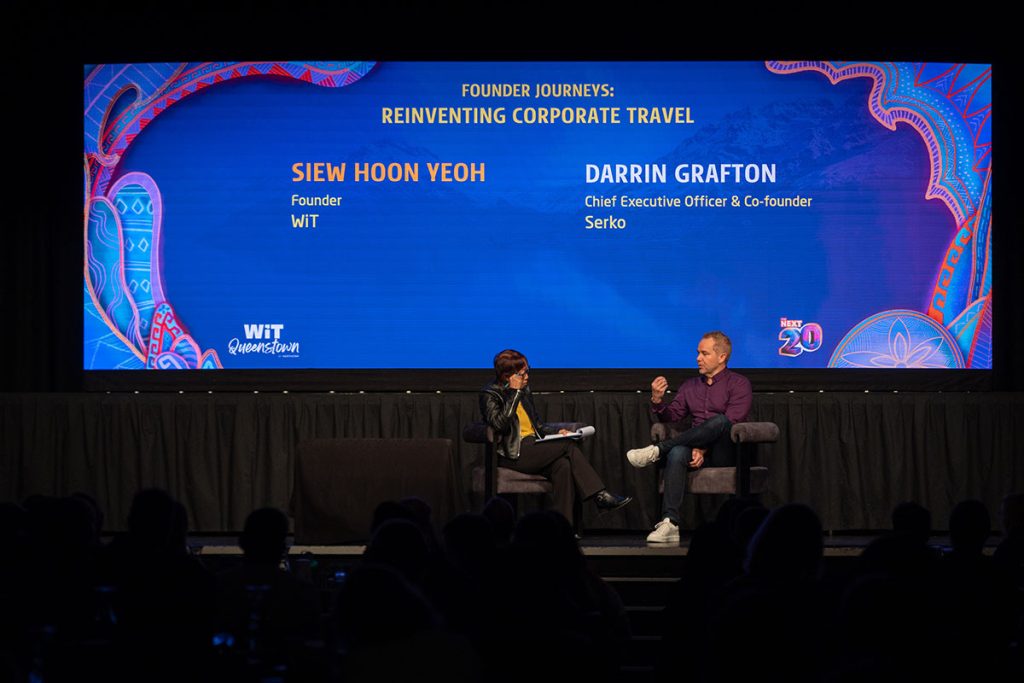
Disrupting a business that was already winning
Serko’s clearest act of self-disruption came in 2022, when the company set out to build the technology that would destroy its own market-leading online booking tool. “We decided to build the technology that would disrupt our current business, which was already number one,” Grafton said.
Making that shift stick meant getting the entire company, not just the product team, fluent in the change: “We set about getting 100% of the company to prompt engineer, because if you’re going to go through that transition, everybody has to understand the why.”
The underlying logic, he clarified, isn’t Serko disrupting the industry for its own sake – it’s AI disrupting travel management wholesale, with Serko racing to build the technology that lets TMCs be part of that shift rather than displaced by it.
The static, forced-compliance booking tool of the last two decades, he said, is giving way to something dynamic – a system that actually knows the traveller, rather than one they’re required to click through.
Scaling culture across five time zones
Serko’s roughly 420-person team now spans New Zealand, Australia, China, India and the US, and Grafton was frank that keeping people aligned through repeated waves of change is a genuine management challenge, not a solved problem.
“Every time someone feels comfortable, I try to push to the next thing,” he admitted, but the mechanism for bringing people along, rather than losing them, has been deliberately over-communicating the “why.”
Serko’s leadership ran workshops in every office to walk staff through the strategy and where it leads by 2030. “If people opt out because they don’t want to learn, that’s a choice. But if they stand up and do it, it’s a really exciting place to be.”
The same transparency, he said, extends to investors. Following the US$12 million acquisition of GetThere, which made Serko the second-largest corporate online booking provider in North America, and a committed US$100 million build-out over three years toward what Grafton calls “the travel platform of the future,” Serko has run dedicated investor days showing its technology roadmap before anyone outside the company had seen it.
“We commit that when we say we’re going to release something, we release it on that day.”
He connected the moment to what he called the “SaaS-ocalypse”, the reckoning facing software businesses built on tools like Xero, Confluence and Microsoft Office as AI turns SaaS products from applications into underlying infrastructure.
Serko’s single-platform strategy, unifying GetThere, its Zeno product and its Booking.com for Business partnership onto one technology base, is a direct response to that shift.
Building global from the edge of the map
Asked how a company runs meaningfully complex AI development across five countries without spreading itself too thin, Grafton described a deliberate centres-of-excellence model: the heaviest AI and machine learning work sits in North America, an AI centre of excellence for the platform sits in India, China manages more technical, legacy-systems work built on years of supplier connections, and New Zealand owns the front-end interface, together running what he described as a genuine 24/7 global workforce.
China, he added, brings a level of commitment that stood out even against that backdrop: heavy compliance overhead, but a workforce that “will never let you down” – long hours, weekends, whatever it takes.
Asked what China is doing in AI that the West hasn’t caught onto yet, Grafton cited robotics and manufacturing automation coming out of companies like BYD – innovation he expects to eventually reshape how travel infrastructure itself gets built.
Being based in New Zealand, he argued, has never been the handicap outsiders assume. “No one gives you the right to be a global company. You take that right because you’re so far away from the rest of the world and the market’s so small, you have to think global.”
He tied that instinct directly back to his own love of travel, and to why he thinks New Zealand companies in general punch above their geography.
On Technology Queenstown’s ambitions to build a genuine tech cluster at “the edge of the world,” his endorsement was unreserved: “Tech loves that alternate lifestyle – the decompressing, the mountain biking, the clean air. Queenstown has a huge opportunity to pick up the mindshare of some of the most talented people, who like to move around but also love that kind of environment. There’s nothing like it in the world.”
The Concur killer, still without a Goliath to slay
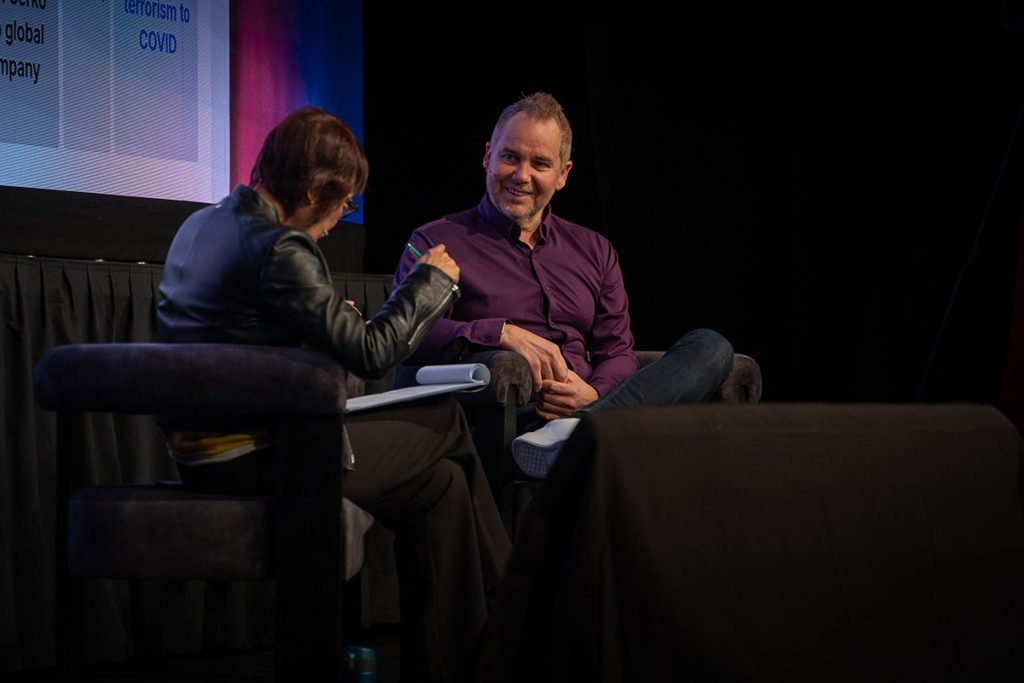
Serko’s early nickname – “the Concur killer from down under” – still clearly amuses Grafton, and he leaned into the David-and-Goliath framing when asked who the company is chasing now. The honest answer: nobody, currently.
“I don’t think there is a number one at the moment in that space. Isn’t that great?” With competitors spending, by his estimate, half a billion dollars on R&D against Serko’s leaner budget, he framed the company’s edge as forced efficiency: “We have to do so much smarter with every dollar to get that point of difference.”
Rather than a single rival to dethrone, he described a wide-open field and a growing set of partnerships the company hasn’t had access to before, with partners reportedly telling Serko its new approach is “incredible… for this next evolution” of business travel.
Rapid fire: Cancelled meetings and delegated decisions
Closing on a set of quickfire questions, Grafton’s advice to a 25-year-old travel tech founder: “Focus on the customer problem you’re solving. Build something they’ll wish they always had — something that feels magical. Solve that and stay focused on it.”
Asked what a Gen Z-run version of Serko would cancel in its first week, he didn’t hesitate: “Fifty percent of the meetings and they’d be right.”
And asked to picture 2035, he predicted the strangeness wouldn’t be in where people go, but in who’s deciding: “They’re going to delegate their decision to an AI assistant – something that reroutes them automatically around weather, around chaos, and just gets them there. That seamlessness, that’s everything we’re about.”