.jpg)
It is hard to believe that, just less than two hours away by flight, is a city in flames – a city we all know and love, a city of angels, a land of smiles.
Gone are those images.
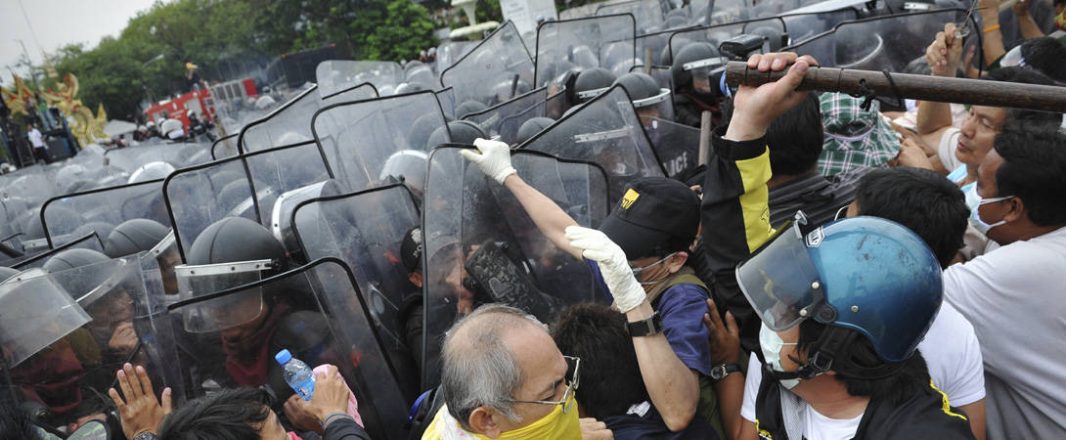
Replacing them are those of a man who was shot in the head, buildings up in smoke, people lying dead and wounded on the streets and frightened residents closing up shop and fleeing for their lives. There’s wall-to-wall media coverage of the conflict as well as in social media networks such as Twitter.
I am reading the latest dispatch from International Herald Tribune’s Thomas Fuller who wrote his column while “wearing a set of ill-fitting body armour and a ballistic helmet”.
He talks of a city that he thought always looked better in the dark. “But not tonight. The darkness is terrifying. Explosions boom across Lumpini Park, and bursts of gunfire carry through the small alleys across the street.”
He’s not talking about some remote area in the Afghan mountains or some village in Pakistan. He’s talking about a section of a city we all know and whose streets we have walked on countless times.
I remember my first time staying at the Erawan Hotel (before it was a Grand Hyatt) and there was a notice behind the door that said I shouldn’t bring in any strangers to my room.
I recall my last stay at the Four Seasons when I left without paying my bill and the well-trained staff handled it so politely and efficiently. And remember that courtyard with the beautiful gallery? I go in there and admire pieces I’d like for my home but do not have the space nor budget for.
I love visiting the Asia Books store at Peninsula Plaza and having coffee in the lobby. There’s always a guard there who greets you when you enter.
There’s a chicken rice stall I love that’s in the area – the owners are Hainanese and they’ve been in the same spot for a couple of generations. Chicken rice – kao mun kai – in Thailand tastes different from the one in Singapore and Malaysia; the chilli sauce is tangier.
And which Asian tourist doesn’t know the shrine, known for its fertility powers, at the Erawan and that’s been responsible for so many babies being brought into the world?
The last image I saw of the Four Seasons was its signboard being used as a clothes hanger.
Just over a week ago, I met with many of my Thai travel industry friends in Siem Reap and all of them looked shell-shocked, as though in disbelief at what’s happening to their city and country.
“I’ve lived there 40 years and I’ve never seen anything like this,” said Don Ross, travel trade editor and publisher of TTR.
“Business has died,” said Luzi Matzig, CEO of Asian Trails, when I asked him how his business was faring. “Thank goodness, we are in 10 countries.”
At that time, Matzig said his office, which was in the affected area, was still open. “We are still going about business as usual.”
I guess that’s not true anymore.
Bill Black, managing director of Ativa Hospitality, who used to be general manager of Four Seasons, is working on a project just behind his old hotel. “I guess we have to put in on hold.”
“I don’t know what’s happening anymore,” said a woman executive. “We don’t even dare to talk about the situation with friends and colleagues because we don’t know who’s on which side.”
I try and imagine what I’d feel like if I was sitting here in Tanjong Rhu and Orchard Road was in flames. Or if I was living in Kuala Lumpur and the Bukit Bintang area had been taken over by terrorists who call themselves protestors.
There was a time during the Sarajevo conflict when those in Europe could not believe that was happening there was just about an hour away from their cities.
Now it’s happening in our midst in South-east Asia. In my lifetime, I remember the May 13, 1969 racial riots in Malaysia. I vaguely recall the Confrontation period in Indonesia but that was mainly from history books, not living through it.
And now we have to live through Thailand’s year of living dangerously.
Those who think that what’s happening in Bangkok will not impact us in South-east Asia are mistaken. Not only is Thailand’s South-east Asia’s biggest tourism destination, it is a key part of the ASEAN economy and a vital player in our region.
Already I hear of flights from Bangkok to cities in the Mekong region that are cancelled because there are not enough passengers. Countless businesses in Thailand that rely on tourism will suffer – from the big companies to the small to the man on the street.
So as we go about our daily lives in South-east Asia, let’s think about our friends in Bangkok – as someone messaged me last weekend, “We need all the positive energy we can get.”
Note:Click here for a map of where the trouble spots are.
Featured image credit (Anti-Government Rally in Bangkok): Ockra/iStock