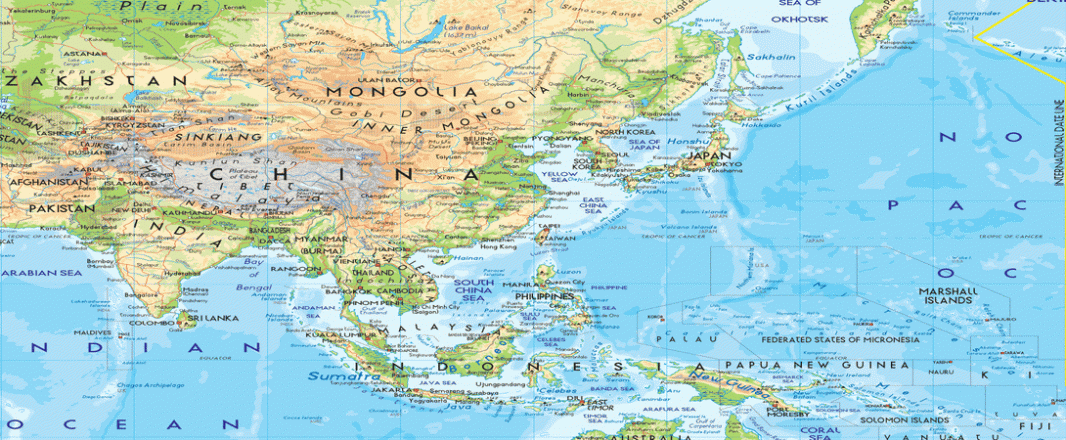

I’ve been covering Asia’s travel and tourism industry for more years than I care to remember and I can honestly say this is the most intense time of change.
It seems all the forces are converging and, in some way, uniting a very diverse part of the world through technology and globalization and yet splintering them into distinct, disparate pieces that make up a puzzle both intriguing and exciting for smart companies to solve.
Technology adoption by customers is happening at an accelerated pace – you don’t need statistics to tell you that people in Asia are adopting smartphones and tablets faster than their counterparts in Europe and the US.
Let’s not talk only about urban Asia where most of the world’s mega cities are located – huge population bases constantly on the go and online (Kunming, China pictured) – but it’s rural Asia that could have the most impact on how travel will change in the region. Here are huge communities that have suddenly had the world open up to them and their appetite for discovery whetted by the images and messages from outside, in the palm of their hand.
Kathleen Tan, Group Commercial Head for AirAsia, was telling me the other day that she got a message on her Weibo account from someone who thanked her. “Because of you, I can now see my family after 44 years.”
An airline like AirAsia is flying new routes traditional carriers can’t or don’t wish to operate and, in the process, enabling people from remote Asia to connect with each other in profound and meaningful ways.
And while some in the West might lament at the slow speed of regulatory change in China, the recent partial deregulation of GDS which allows foreign airlines to sell their tickets through foreign GDS from October 1 is a big step in the context of history. As Chinese philosopher Lao Tze said, “A journey of a thousand miles begins with one small step.”
As a country, China is used to taking small steps. Its people though are taking huge steps – and the vibrancy and intense competition of the Chinese online travel market was evident at the recent Travel Distribution Summit in Shanghai in September.
Everyone’s got a travel start-up and the two big OTAs – Ctrip and eLong – are engaged in a price war that can only mean the death of those caught in the middle.
North Asia is where most of the action’s going to take place next year, I believe. Japan with its low cost airlines promising to revive a stagnant market, Korea whose pop culture is sweeping the world Gangnam-style and whose incumbent low cost carriers, Jeju Airand Air Busan, are facing competition from outside, Hong Kong about to get its first locally-based low cost entity, and Macau with its larger-than-life hotels and casinos surely needing more access to fill up those rooms and tables.
China’s Spring Airlines, after laying an impressive foundation at home – its successes in using social media to build a brand are worth studying – is expanding overseas and is laying out a social media strategy to stretch its brand outside Chinese shores.
I just returned from Taiwan last week, possibly the last market (outside China) where low cost airlines have yet to make a big impact. It’s a pretty traditional market still – airlines and consolidators have complex relationships that are hard to unravel – but foreign low cost airlines are flying in and once customer behaviour starts to shift, we will see the trade follow, as we’ve seen elsewhere.
That’s not saying South-east Asia will lag behind in action – ASEAN is where 300 million people live. There’s the promise of ASEAN Open Skies by 2015, although no one’s holding their breath on that.
But low cost airlines continue to drive change, with AirAsia leading the transformation. Its regional headquarters is now in Jakarta, the hottest ecommerce market right now. There’s a reason.
I had lunch with T Fuad, the co-founder of Travelmob, the social stay marketplace, just to find out how the Airbnb of Asia was doing since its launch in July. It’s raised US$1 million in seed funding, small but good for a start, especially in a risk-averse market where investors are still not sure how the regulatory environment will adapt to this new disruptive model of accommodation.
It’s seeing good traction – from savvy customers in Asia who can smell value and a change coming and from property owners who want to earn income from their investments. This is where Travelmob may hit the jackpot – plenty of content out there from owners with second or third or fourth homes in an increasingly affluent Asia and where property play is as second nature as the roll of a dice.
At the inaugural Singapore Summit recently, Prime Minister Lee Hsien Loong said Singapore’s survival depends on how its people connect with Asia and the world. “Global and Asian forces are constantly at play here, and the country’s survival depends on the Global Asia story,” he said.
I think his words are as applicable to travel and tourism. Asia’s travel and tourism industry needs to plug into the Global Asia story just as the world outside needs to plug into the same story that’s unfolding. A previously one-way flow of information and knowledge has become two-way and the balance of power is now, well, balanced.
It’s no longer enough that Asia’s travel and tourism industry just remain relevant but it must also lead. No more, let’s watch what happens over there and see what happens over here. It’s time to say, let’s make something happen over here first and connect with the world.
It’s going to be hard for us to unplug the Global Asia story in three days at the WIT Conference but we will give it our best shot. With Tnooz, we are running THack@WIT and we hope to see some creative solutions from developers who will be given a platform to showcase their work in front of our audience.
We have nine start-ups pitching at our Start-Up Competition at the Bootcamp and we’ve never had such a global spread of companies – from US, Europe, Japan, India, Indonesia, Singapore, China and Australia – pitching to a very diverse panel of investors.
At the WIT Conference, we are blending voices of experience with new ones, global with Asia, Asia with local, scientists with creators, marketers with money men. We hope the end result will be a magical combustion of all that’s intriguing and exciting about the Global Asia story.
See you in Singapore.
* See programme and look who’s coming to speak