This is a first hand account by Chris Sweeting, who was touring Kathmandu when the earthquake happened. Sweeting, who worked as publisher for several travel trade titles including TTG Asia and TravelAsia, is a frequent visitor to Nepal, having written a book of his travels there.
Saturday April 26
Today, our last day in Nepal, intent on seeing the sites of Kathmandu: we arose early, around 4.30am, showered, dressed and met together in the foyer; Olga, her first time to Nepal, Tat Leong and myself – we’d lived here some 15 years ago.
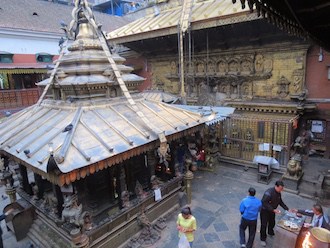
Golden Temple, Patan
Mohan’s driver was waiting – a rough looking, older guy with limited English. He’d provided us with a new 4-wheel drive, probably a Toyota made under local licence. Olga sat in the front while TL and I had the back seats. The streets were empty. We made our way from the quaint but imposing Shanker Hotel to Patan some 20 minutes later, we jumped out on the outskirts of the ‘city’ and followed our directions to the Durbar Square. Straight on, the Golden Temple is on the left, it’s not far.
Surprisingly there were many people already out and about. A crowd had gathered by an enormous “mobile temple” with people praying and seeking the offerings of holy water and white petals sprayed on them by their priests, apparently a two month Hindu festival which only occurs every 12 years.
We squeezed past and continued on our search for the Durbar Square; a friendly guy, apparently an international banker, gave us directions and insisted on walking us to the Square, indicating on the way the lane for the golden temple. He continued his morning walk as we strolled around the beautiful old building, at 6am, too early for tourist fees, the best time to visit as it’s relatively quiet, little traffic and plenty of well-fed pigeons
We found our way through the side streets to the beautiful temple. Worshippers were already in attendance, coming and going through the main entrance to the inner courtyard. We followed, then edged our way to a flight of stairs and clambered up, reaching a balcony overlooking the courtyard – watching the proceedings, the wheel spinning, the supplications, the blessings by the priest. Everyday people going through their daily rituals; we wandered around, staying on the periphery, inspired by the simplicity and spirituality of it all.
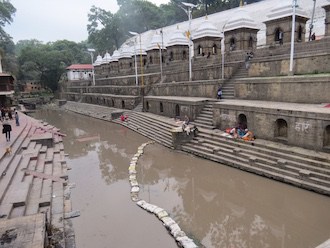
Pashupati, Bagmati River
We had to drag ourselves away as time was short, there were many sites to see. Retracing our steps we found Dipendra, recovered our vehicle from a makeshift carpark and made our way across Kathmandu to Pashupati, situated on the sacred Bagmati River which wends its way through the city to India and the renowned Ganges.
The entrance and surrounding buildings were all new, built in a style to match the authenticity of the temples. Paying the tourist fee we wandered alongside the river, wondering how much nicer it must be in the wet season with water lapping the banks, rather than the dark waters trickling past the long stretches of sand banks and mud.
The plinths for the cremations were dotted along the far bank, with royalty and well-to-do at one end and the ‘commoners’ at the other. We clambered up a steep-stairway so that we could get a better view, seeing the masses circulating around the impressive, colourful, Pashupatinath Temple and watching the preparations for the day’s cremations; a body was brought by stretcher from the hospice, wrapped in a brightly coloured shawl.
Wandering back to our vehicle we received peace bracelets and blessings from one of the boy priests, and photographed one of the famous sages, known for their unusual feats when in a self-induced trance.
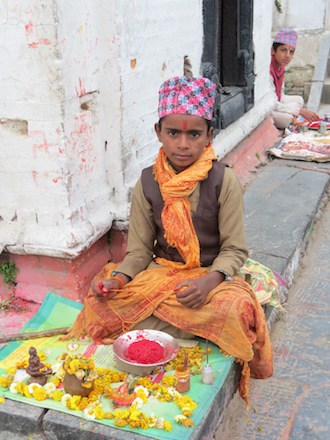
Boy priest
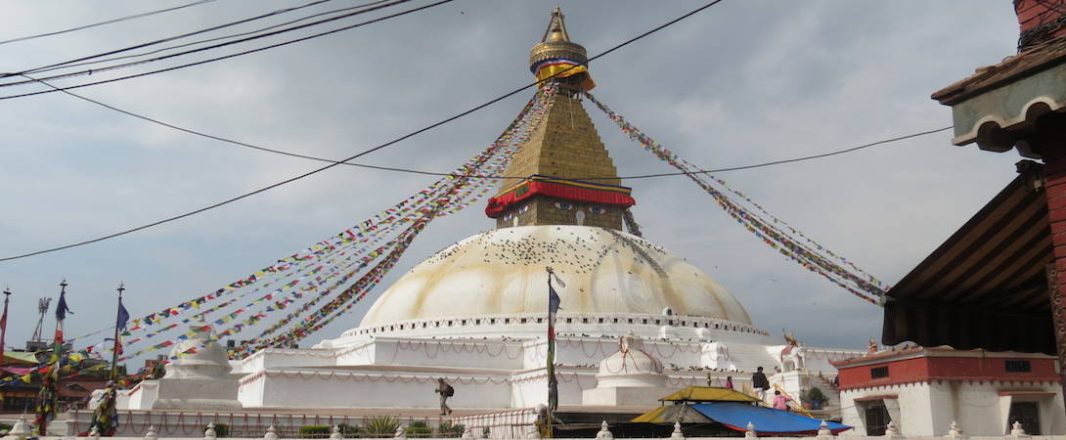
It was a short journey to our favourite site, the Boudhanath Stupa, full of so much spirituality and peace. We followed the masses, slowly walking in a clockwise directions, spinning the wheels. Clambering up the stairs to the lower section of the stupa there were views of the surrounding shops, the masses of people, the monks praying and performing their perambulations.
Finding an outdoor coffee shop (with good coffee!), we chatted to a couple of “local’ tourists” (both Tibetans, one living in New York). Having walked the full circuit, we wandered back through the entrance to find our driver. Back at our hotel, we had the buffet breakfast, we packed our bags – our flight was at midnight – and handed them to the persistent bell boys, each “expecting” a tip – we left them in the foyer as we were returning in a couple of hours.
Setting off across Kathmandu to collect Mohan and his wife and daughter, Ashiyana, we wanted to view another property, the Himalayan Heights at Hataaban, a hill top resort in the south west.
At Pharping; wending our way across town we soon hit the “compulsory” bumpy road, the start of a long slow climb. Stuck behind a local bus, determined not to let us pass, but crammed full, with its black fumes belching over us. We hit a traffic jam on the narrow road, another bus coming downhill. Crowds of people had gathered – there was a lot of excitement as the valley was covered by a sweeping blanket of red cloud. We then joined the excited onlookers, wondering about this strange phenomenon. Someone shouted “earthquake:. but we’d heard and felt nothing.
The traffic moved and we continued climbing, arriving at the delightful Himalayan Heights Resort; the place was overbooked as 500 enthusiasts were expected for a weekend music festival – the standard hippy look with dreadlocks, baggy clothes and heavy backpacks.
Entering the complex we met Kim, the general manager, and discovered, to our horror, that there had been an earthquake, a severe one which had damaged buildings across Kathmandu. It hit at 12.03pm.The resort’s kitchen was inoperable, and everyone was standing outside in open spaces – another shock wave shook the ground, lasting for some 20 seconds. There was a stunned silence followed by nervous chatter. Ashiyana hugged her mother, Mohan tried to calm them both. Images of damage were being exchanged on mobiles but we couldn’t make phone calls. We decided to immediately depart, to return to Mohan’s house, to ensure that his invalid dad was alright.
We noticed little damage, a few small houses and brick walls had collapsed – Mohan’s house was in good order, but all the neighbours were nervously waiting outside, in the side street. His dad was warmly covered, sitting in his wheel chair, accompanied by a young carer – they were indoors when the earthquake struck, the whole house had swayed from side to side for about a minute.
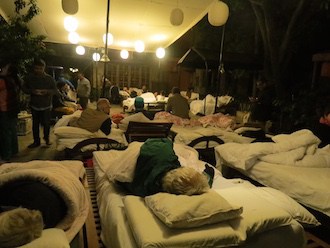
Dwarika’s
When it subsided they struggled into the rear courtyard and there they had stayed. Their retriever dog was nervously barking, seeking reassurance. We joined them. A few minor tremors struck, tea was prepared and we waited. After an hour or so we decided to collect our bags from the Shanker Hotel, bade our farewells and drove through side streets and main roads – all eerily quiet.
On arrival, the security guard stopped our vehicle, ordering us to drive ‘the wrong way’ around the gardens to the front of the hotel. We soon understood why: the lobby area was a mess and the hotel was in disarray. The shaken guests were spread throughout the gardens. We hurried through a side entrance, through the morning’s restaurant and groped our way in the dark and up the stairs to the lobby. Dirt, dust and rubble were everywhere. Amazingly our luggage was intact, in the same place that we’d left it, several hours earlier.
There was no one around. We grabbed our bags and scurried through the lobby and down the stairs to safety. “Where to?” – “Let’s go to Dwarika’s – we’ve booked a table and it’s near the airport.” And so off we went again, through the quietened city, the odd wall fallen here and there.
Arriving at the traditional, deluxe hotel 20 minutes later, we unloaded our bags and were invited in. Sangita, the unflappable owner, welcomed us to join her guests, camped in the courtyard. Superficial damage could be seen in the outer buildings, and the coffee shop – hit by a deluge of water from the swimming pool.
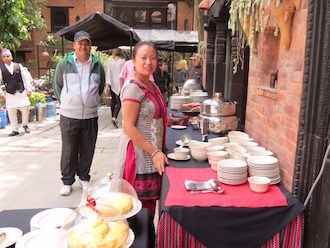
Dwarika’s staff cooking on outside burners.
Our bags were taken into storage; we found spare seats and swapped stories with other “survivors”. Mobile phones worked, Mohan was contacted and the driver was sent home – apparently his family were all ok. Shikher, our friend and local business partner, was busy, tracing his clients and staff. Text messages were sent and received from Hong Kong, notifying everyone that we were alive and well.
Our midnight flight was postponed, delayed till the following day. The incoming Dragonair plane would arrive, probably in the afternoon. We settled into a “waiting routine”, reading, playing cards, chatting, working; soup was rustled up, cooked on outside burners and served with homemade bread – all this while minor tremors broke the silence. Bedding was brought out, sun-loungers appeared and preparations made for a disturbed night’s sleep; a couple of heavy tremors were felt, jolting people awake.
Sunday April 27
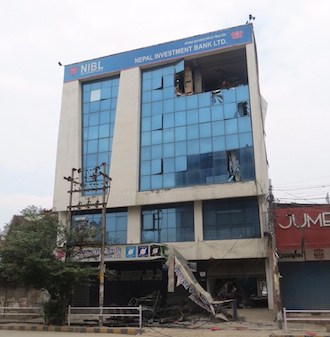
Nepal Bank
The morning approached, breakfast was prepared; tooth paste and brushes were distributed – just amazing. Venturing outside, the streets were quiet, people mingled around. Nearby a group were participating in a religious festival and their chanting could be heard from the distant tented community; 100 meters away a modern “glass” building for Nepal Bank was badly damaged; another was guarded by armed soldiers, presumably owned by someone of importance.
Returning to “our hotel” news from Hong Kong arrived, our plane was on the way. We gave our profuse thanks to Sangita and her wonderful staff and took the minibus with other lucky guests to the airport. Bedlam reigned. We squeezed through the crowds, showed our flight tickets, passed through security and waited for the Dragonair check-in counter to open.
An hour later we passed through immigration; another strong tremor rocked the airport. Shouts of “Don’t panic!” but no directions were given, no obvious escape routes to outdoors – the emergency door was bolted closed…the tremor passed; everyone calmed down.
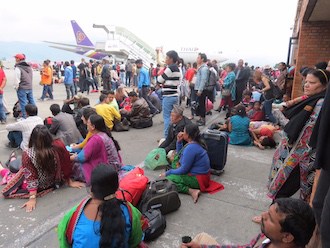
The long wait for transport
Back to normality, to the insane normality of waiting to pass through security – no urgency for us to get us through. Anxious faces and nervous tension – an announcement to “leave the airport” but in reverse, from where we’d come, not through security. We held our ground and soon continued to the departure lounge, and through the doors to fresh air – a thousand of us, standing, waiting watching.
A succession of emergency relief planes, primarily from India and Pakistan. The occasional commercial flight arrived and departed – Thai International, Turkish Airways, Qatar, SilkAir. News came through that Dragonair was circling, waiting for landing space – if none could be found within 90 minutes it would divert to Dhaka. Waiting and waiting, literally hundreds waiting on the tarmac.

Orderly queue home
Indian nationals airlifted to safety; and then Dragonair landed, our route to safety; the plane parked well out of the way, waiting to unload their passengers, primarily media from around the world. Free water was distributed, Dragonair taxied to a landing bay, a queue formed across the tarmac and we were soon boarded, and airborne. Relief was mingled with guilt – those poor, beautiful smiling people; the trapped visitors. How lucky we were. Arriving home, exhausted, we contacted friends and family, ensuring them of our safety. Then and only then did we realise the extent of the damage, the absolute disaster from which we’d escaped.
How could those historic buildings be no more? How could so many people have died or been injured? How could this happen to such a poor country? Life is so unfair.
• Images credit: Chris Sweeting