Ever heard of an airport that’s acting like a start-up and incubator? Well, meet Vancouver International Airport (YVR), which invented BorderXpress, described by its CEO Craig Richmond as “the iPad of the airport world”.
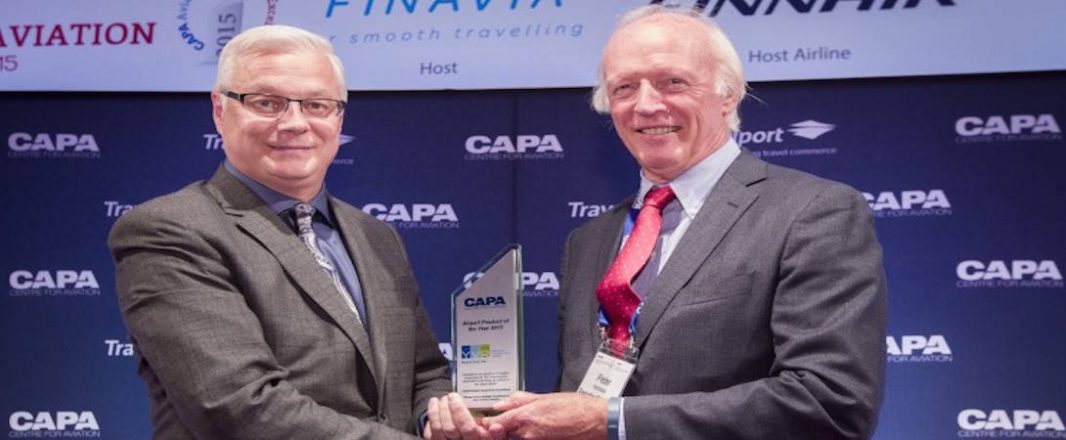
Craig Richmond (left) receiving Airport Product Of The Year award from Peter Harbison, CAPA executive chairman.
BorderXPress is the world’s first self-service border control solution that accepts all passports and doesn’t require pre-registration or fees. Winner of the Airport Product Of The Year award from CAPA during its Aviation Awards in Helsinki, it was developed by Innovative Travel Solutions, an independent business unit within YVR.
YVR CEO Craig Richmond said, “We did it for ourselves, we were trying to solve our own pain. Then we realised it was a sellable product – we’ve sold over 700 kiosks in the US, Caribbean and Canada.” Now it’s taking it international to Europe and Asia.
“We have several models – for Canadian, US and international immigration. It allows passengers to scan passports and it speeds the process up hugely, we have seen improvements of up to four times processing time.”
In the US, up to 36 countries can use BorderXPress.
Immigration is a big headache for the travel industry – how to avoid long queues at airports and to do it in a safe manner that it doesn’t risk a country’s security.
“I believe one of the reasons we were successful is that we’re not an IT company breaking into airports, we’re an airport breaking into IT. We have the trust and security of the agencies – there’s a subtle difference, they trust us with the data. We installed the first kiosk in the US in May 2013 and within days we got requests from other American airports.”
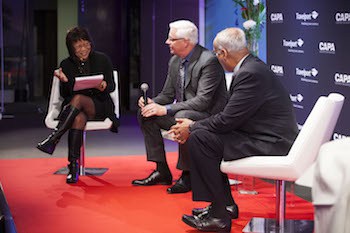
Yeoh Siew Hoon interviewing Craig Richmond (centre) and Rajiv Shah, CEO, IBS Group, which won Airline Product of the Year for IBS iCargo
Will it be a harder challenge rolling it out in Europe and Asia where it may not necessarily have the trust yet? “It’s not been a problem. We are eyeing major airports in Europe and Asia, with huge peaking arrivals of international passengers. Our latest product has facial recognition which is surprisingly good.
“There is no reason why it shouldn’t work in Singapore.”
Beyond giving YVR a new healthy revenue stream, Border Xpress has given the airport encouragement to innovate further. “Innovation has always been one of our four core values but this is a whole new level of innovation. It takes us into manufacturing and sales and we had to build a separate team of build to work faster than normal.
“What was encouraging was people putting their hands up. Linda Shucroft, our finance manager, said, ‘I am interested’ and she ran with it. It takes a certain kind of person to build a start-up.”
Now that it’s solved the pain of border crossing, it’s asking other questions such as how to use technology to solve check-in or bag drops. “We have prototypes working, we will have some surprises,” said Richmond.
Perhaps one reason why YVR has been able to innovate faster is that it’s a not-for-profit enterprise. It has no shareholders, it runs like a business but the profit stays within the airport.
BorderXpress is described as “the iPad of the airport world”.
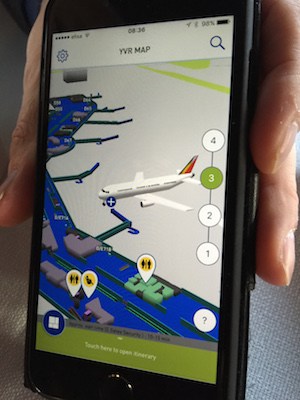
Its YVR app is developed with a gaming company, Koolhouse. “It’s highly visual and fun to use,” said Richmond, demonstrating the app which when you click on a gate, shows an image of the actual aircraft waiting there. “People don’t believe it’s there until they see it.”
He said, “We always try to be questioning and we decided to go to game developers. It’s interesting the perspective they have. Our app is modelled on the Xbox – there’s the main part of the app, then a game engine where we can just add to the games. So it doesn’t get stale – every three to four months, we add something new.”
It’s also started an internal “Kickstarter”. “We are willing to spend money on new ideas and we give staff $50 to vote on their favourite idea. We have 16 projects underway. Failure’s okay, we are willing to make mistakes,” said Richmond.
A former air force pilot and who’s run airports in Bahamas, Liverpool and Cyprus, Richmond said running an airport is like running any business. “It comes down to one thing – it’s about people, having the right kind of people who are curious, smart and can work as a team. The airport business is so interconnected – you have to work with other cultures.”
The airport, which employs 450 staff, is growing by 1m pax a year and will exceed 20 million pax this year. Domestic markets have been strong and Asia has been a big performer with 135 flights a week to Asia.
“It helps to have a big airport behind our start-up. We get the power of purchasing power, finance and cash flow. We can incubate without letting go,” said Richmond.