People tell me I have the attention span of a gnat. These days, I think it’s down to that of a mini-gnat. Our minds flit from thing to thing as fast as our hands flick from devices to devices.
Yet, I surprised myself last Saturday when I managed to sit through at least 20 Powerpoint presentations, one after the other, over five hours and paid attention to well, not all of them, but most of them.
The speakers that lost me were the ones who rambled or became self-indulgent. But I put that down to passion – when people get carried away with something they’re obsessed about and forget everything.
And there was certainly no lack of passion among the speakers Humaneity had assembled for its first “Humaneity Inspires” event. That, and determination.
As I listened to their stories of how each of them was trying to make the world a better place, I realized that with passion and determination, you can achieve almost anything.
Take Louis Ng of ACRES, a Singapore-based charity which fights for animal rights, whose life was changed after he saw sun bears being milked for their bile. He dumped his career and now is the highest-paid employee at ACRES earning S$2,100 a month. “We come to work not to make money but to make a difference.”
Bridget Tan founded HOME (Humanitarian Organisation for Migration Economics) to fight for the rights of migrant workers. Her stories of maid abuse in Singapore – a Burmese maid who lived in a cage just like the sun bear – left many squirming in the room.
Masami Soto, founder of Singapore-based social enterprise Buy1GIVE1 (B1G1), decided to leave her country in her 20s when she realized “we spend all the time getting, and when we have, we re not happy”.
So she travelled in search of meaning and learnt one thing. “We are all the same.” She returned to Japan and asked herself, what if I stopped buying, what if I became self-sufficient? She moved to the countryside and lived in a village.
“There was a big sense of trust for the future and I knew if I got into trouble, people would help. I could live there forever, have my own rice field, then I thought what about my friends and family?”
That’s when she realized humans cannot be self-sufficient, “we need each other”.
Learning from bees which pollinate flowers – they give back not because they are guilty but because it’s part of their life, she wondered how she could create something that would allow people to give back everyday.
“Imagine if you bought a coffee and it made a difference,” she said. B1G1, set up in 2007, is based on a simple idea – “why not, we thought, make business giving a habit by making it possible for every business transaction to give back in some well-defined and impactful way. So, powered by that simple thought, we developed systems and processes for SMEs to give back effectively and easily.”
Today, there are 600 businesses on its platform.
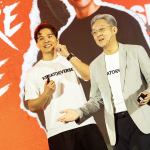
 When Gregory Burns (left) was five, he contracted polio and lost motor skills in both legs. He was told by doctors, you’ll never walk again and don’t get fat. “Polio gave me limitations but also possibilities,” he said.
And he’s certainly done all that’s possible and more. He’s a Paralympic athlete. As a member of the USA Swim Team, during the 1992 Barcelona, 1996 Atlanta and 2000 Sydney Paralympics, Gregory set World Records in the 100m breastroke, 100m backstroke, 200m medley relay and 200m freestyle relay.
He’s a painter. He moved to Taiwan to study Chinese painting, calligraphy and Mandarin and spent 18 months traveling through China, Tibet, Nepal, India and Pakistan painting diverse landscapes and peoples of the region.
He backpacks, scuba dives and surfs. “I use my arms to do what you do with your legs. Because I had a disability, I always had a passion for movement, getting from A to B without fuel.”
When I caught up with Gregory during a break, he said, “The travel industry is missing a huge opportunity in catering to disabled travellers. All those beautiful villas, they don’t have handicapped facilities.”
Yes, there doesn’t seem to have been much headway made in the area of accessible tourism since that last Accessible Tourism conference held in Singapore a few years ago.
The afternoon flew by with more inspiring stories. I liked the message from Tong Yee, director of The Thought Collective. Speaking on “The Emotion of Innovation“, Tong Yee said that in Singapore, it’s mainly fear that’s driving innovation – because one has to – and not love.
“When you say you have to, you lose the ability to create. Love gives you energy. My wife loves me when I am in love.”
 The last speaker – to my pleasant surprise – was Jassriet Mahal of Issu.e.rasers, the organisation we’ve been working with for the last three years to raise funds at our annual conference. Jassriet ended the day by telling a story about a young girl’s journey through life.
I was pleased to see a slide she shared – the painting created at WIT 2009 when the theme was “‘Tough Love” (left).
Rather fitting, I thought. Other than passion and determination, it also takes tough love to make the world a better place.