
Hundreds of attendees packed themselves into the venue of this year’s WIT Japan & North Asia Bootcamp. With ears pricked, all attention was tuned into uncovering the ‘secret sauce’ of what it takes to be successful as a travel startup.
The opening panel discussion was led by a group of headstrong, seasoned entrepreneurs – Fritz Demopoulos (Co-founder of Qunar; CEO of Queen’s Road Capital), Kei Shibata (CEO of Venture Republic), Rod Cuthbert (Founder & Chairman Emeritus, Viator; CEO, Rome2rio.com) and Morris Sim (CEO and Co-founder of Brand Karma) – telling their personal accounts of the victories, but more importantly the pitfalls of starting their own businesses.
Cuthbert recounted being fired from a previous job back in 1995 before going on to start Viator, Shibata felt the effects of the dotcom bubble crash first-hand when starting Venture Republic, and Sim daringly quit a promising job at Microsoft to work on his own terms.
While each career history is undoubtedly diverse, the common element tying them together is the understanding that adversity brings opportunity. And while opportunity is aplenty, success only comes to those willing to take risks and truly work for it.
In short, while anyone can start a business, few do so successfully. In Demopoulos’ words “If the path to success was clear, everyone would be doing it.”
Starting a business is dark and scary, with no guarantee of success
“The most difficult challenge we have is we enter a business without actually knowing whether we’re actually going to be successful,” reflected Demopoulos, as he pondered on the adversities he faced when starting out as an entrepreneur.
Robbing the idiom of the ‘light at the end of the tunnel’ of being able to provide any comfort, Demopoulos said there is in fact no guiding light at all. What makes starting a business so scary is not knowing whether success will ever come.
It is frankly a daunting reality, but no reason not to step into the dark. To combat the ‘darkness’, Demopoulos said that having a touch of blind faith and a whole lot of self-belief could take you quite a long way.
“You need to have faith that what you’re doing is actually going to work, and that you haven’t wasted years of your life… You just have to believe [in] your intuition and capabilities… It really requires a lot of internal strength and discipline.”
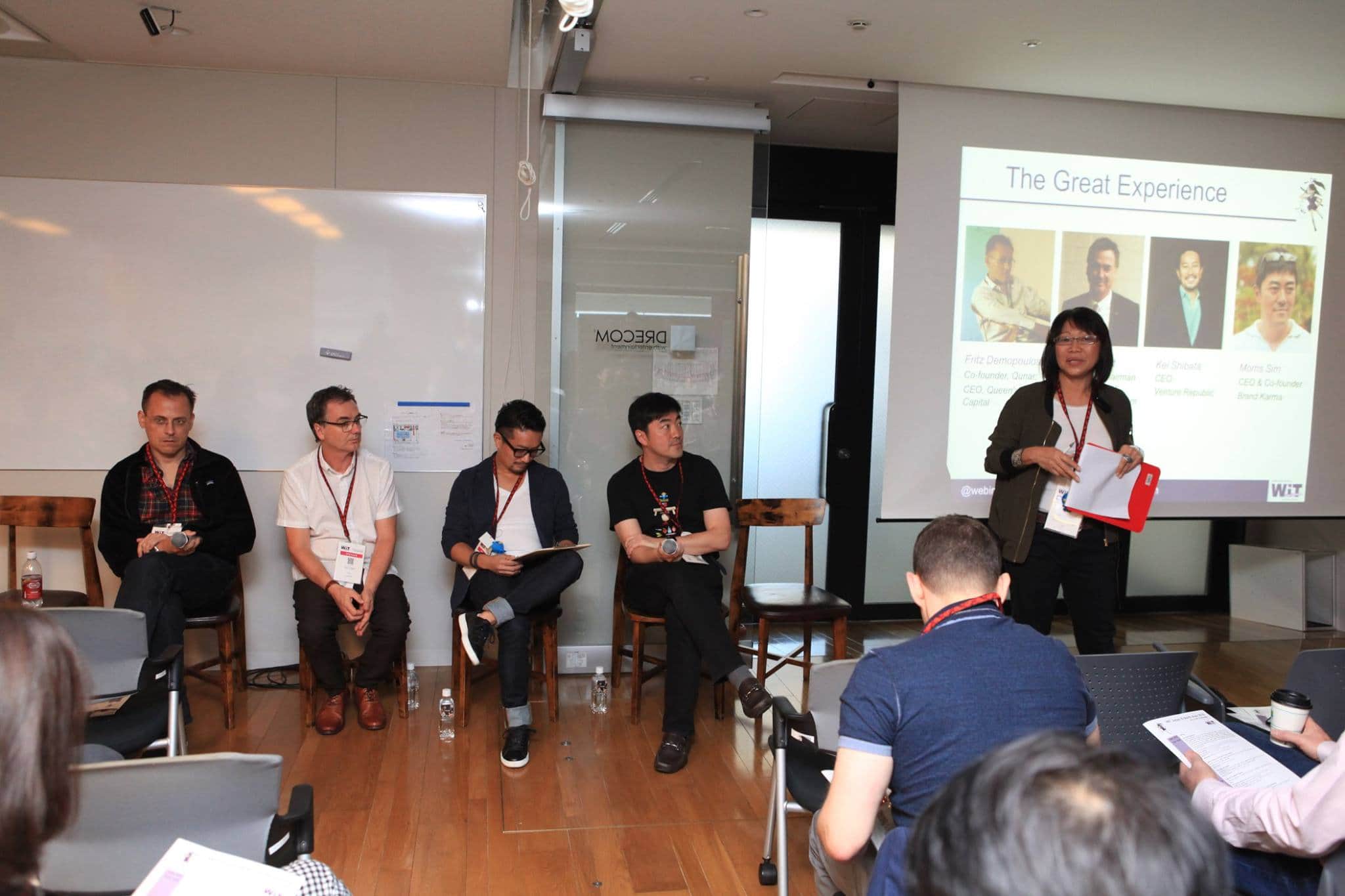
Panelists of the opening segment of WIT Japan & North Asia Bootcamp
Not everyone is cut out for the startup game
There is no shadow of doubt that times will be tough and it isn’t a world for the faint of heart. If you’re serious about making your idea work, your commitment to the ‘start-up game’ must be unwavering. After all, it is essentially your life’s work.
Sim declared, “People who aren’t going to make a startup a part of their identity should not do a startup.”
However your commitment must go far deeper than simply wanting your idea to be successful. As more time, energy and resources are used and as your team grows, “you begin to have responsibilities, staff, and users. You can’t turn your back on them because things go badly,” said Cuthbert.
You must be willing to take full ownership and personal responsibility for whatever and whomever is involved in trying to make your business idea a success.
Don’t give up, but don’t hesitate to alter your method
Indicators that you’re heading in the right direction may be few and far between, but clear signs that your original idea isn’t working shouldn’t be ignored. While self-belief and confidence is crucial, they shouldn’t take over practical reasoning.
Sim applies a simple rule of thumb. “Don’t be afraid to fail, but fail fast,” denoting that failure is far from uncommon, but to move forward constructively, you have to learn to recognise it and adapt quickly. If things simply aren’t working out, “be committed to shutting it down… and move onto the next thing.”
And while the proverbial ‘light at the end of the tunnel’ may not be the guiding beacon you so hoped for, Cuthbert advocated harnessing data science to identify where something is going wrong and what to change in a strategic manner.
Cuthbert reminded the audience, “no battle plan survives even on the first day of battle.” Be prepared to modify, refine or even totally pivot from your original plan, if it helps keep you in the game.
Ultimately, encountering stumbling blocks won’t mean the death of your startup dream. Refusing to adapt to changing circumstances almost certainly will.
Profit isn’t the only reward
Despite all the risks, responsibilities and threat of the unknown, the panel was adamant that taking a measured, strategic approach to starting a business could yield great rewards.
Long-term goals of earning profit, IPO and acquisition aside, they spoke volumes of the perks of working on your own terms.
While you probably won’t draw in any fast cash, working for yourself can give you a certain something that working for a larger corporation simply cannot.
Being able to work on something you are genuinely passionate about can be considered its own reward.