Two years after Oracle bought Micros Systems in June 2014, the buyer is finally ready to launch what it calls its game-changing Oracle Hospitality suite of solutions, revolving around a new dedicated Oracle Hospitality Cloud, within the Oracle V2 Infrastructure.
It’s clear the integration of MICROS Systems, which provided enterprise-wide applications, services and hardware for the hospitality and retail industries, has been arduous. “Transition from vision to execution is all that matters,” said Mike Webster (above), SVP and general manager, retail and hospitality, for Oracle who’s been travelling through the region to unveil the new solutions.
Speaking at the Oracle Hospitality Day in Singapore, he said, “Execution has not met expectations, both yours and ours, and we want to get better. It’s been a hard transition. Thank you for your patience.”
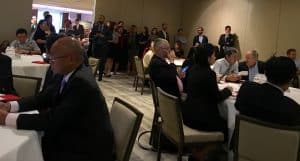
Standing room at Oracle Hospitality Day
For the last two years, hotel customers of Micros have been frustrated by the slowness of the company to respond as well as being tied to a legacy system that prevented them from taking full advantage of the promise of the new web. And the packed room – they had to pull in extra chairs – is indicative of the curiosity and interest in what Oracle had to show after two years of integration.
Setting the premise for Oracle Hospitality’s new strategy, Webster said global hospitality was in a “generational transition” – from guest experience to the technology being used by guests and needed by hoteliers. “Barriers of entry have never been higher. It needs huge companies to invest aggressively in it.”
He didn’t specify the full amount Oracle has invested the last two years – but it did buy Micros for US$5.3 billion – and the migration and overhaul it has had to do to move the legacy Micros cloud to the Oracle infrastructure must have cost a pretty sum. And it will spend another US$100 million in R&D to “accelerate your ability to harness the cloud”, he told the customers in the room.
He said that technology had rewritten the laws of supply and demand and intermediaries have leveraged that to disintermediate hoteliers and their guests. Citing companies like Amazon, Uber and Netflix that have changed entire industries, he said the same thing was happening in hospitality with companies like Expedia, Booking.com and Airbnb.
“They all have two things in common – they are tech and data companies and they deliver their services through the cloud.”
He said currently 85% of IT spend was on maintenance, the rest on innovation. Oracle’s intention is to reverse that so that hoteliers can focus on innovation.
Hospitality is an experience business focused on individuals, said Webster and in a world of total guest experience and increasingly dominated by Millennials, “we don’t want loyalty, we want connections with brands”.
“Customers want us to anticipate their needs, simplify their journey and inspire their staff to deliver good service,” he said, adding, “We have to shift the focus to be profile-centric.”
Webster said hotel staff were at a unique disadvantage in that guests today have more information than they do and that technology had to be able to deliver actual insights to staff.
In a survey it did, staff said they could realise 16% estimated new revenue generation if they offered highly individualised experiences. Staff needed advanced collaborative tools, data analytics, remote access and self-service options from the device of choice.
Grahame Tate, VP of Hotel Sales, JAPAC, said the company now has one single vision and went through what it’s done the last two years out of sight from the industry.
He said the new solutions covering four areas – Operational, Technology, People, Customer – will give hoteliers a one-stop solution to deliver the total guest experience expected today by customers. “This is game changing, Oracle did not just buy Micros to get into hospitality, this is why it did it.”
The idea is to make these solutions available and accessible to all hoteliers, not just the Tier 1 and Tier 2 brands, but local and regional hotel groups.
For now, the priority is to speed up cloud adoption. The intention is to make Opera and Simphony more accessible to more markets, improve technology adoption and uniformity among different brands within global chains, and provide world class tools for individual and chain migrations.
Above all, Tate said, “we want to make doing business with us easier”.
Speaking to hoteliers at the event, the reaction was excitement but tempered with caution and realism. Said one, “They have to walk the talk now. We’ve waited two years and meanwhile, we’ve had to run our businesses because business does not stop.”