Fresh innovation in the airport space has been long overdue. And it shows. Visiting an airport is probably one of the most strenuous parts of any journey involving air travel. Long queues, heavy bags and vigorous security are enough to disenchant even the most romantic of travellers.
Fortunately, efforts in the airport space are being made to evolve the entire experience from a gruelling but necessary part of travel, to maybe even enjoyable.
Showcasing their latest technology at The Future Travel Experience Asia Expo 2016 in Singapore last week, communications and IT solutions provider, SITA unveiled some of their latest efforts in modernising airport technology.
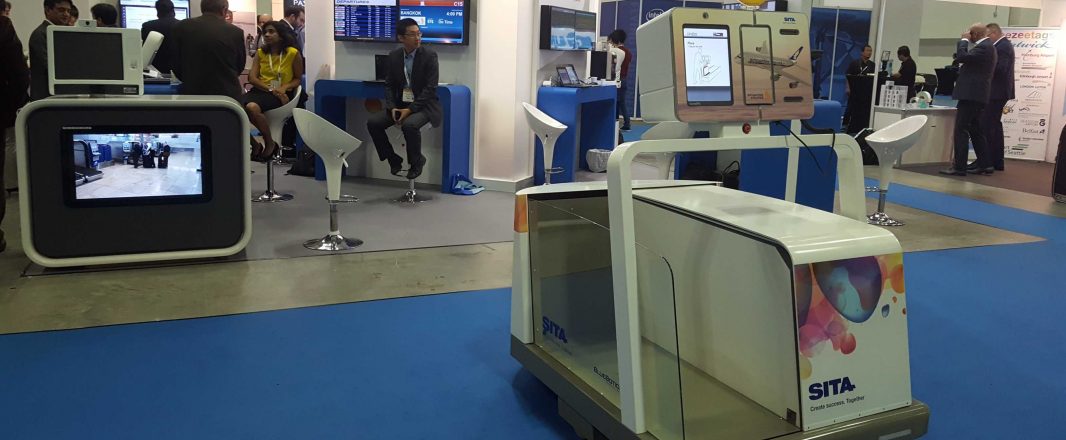
The clear star of the show was the SITA Baggage Robot (or “Leo” as it is more affectionately known) – a fully autonomous, self-propelled baggage vehicle that is currently being trialled as possibly the next generation of airport baggage service.
Resembling a small-scale Zamboni machine, the vehicle prototype has a carrying capacity of two hefty suitcases that can be loaded and secured into two separated compartments. On top, a touchscreen allows travellers to scan their boarding passes and manage their own baggage drop, without the assistance of any airport ground staff.
While the top half of the machine resembles nothing new – essentially a self-check in baggage service – it is the tech that lies beneath that makes Leo unique and interesting.
Developed by a Swiss robotics company out of Lausanne, Leo is able to navigate its way around the airport and can rapidly detect any obstruction in its path (human or otherwise), preventing any accidents and collisions.
The intention behind Leo is to eliminate the brief but sometimes physically strenuous mission of lugging baggage from the curb to the flight check-in desk.
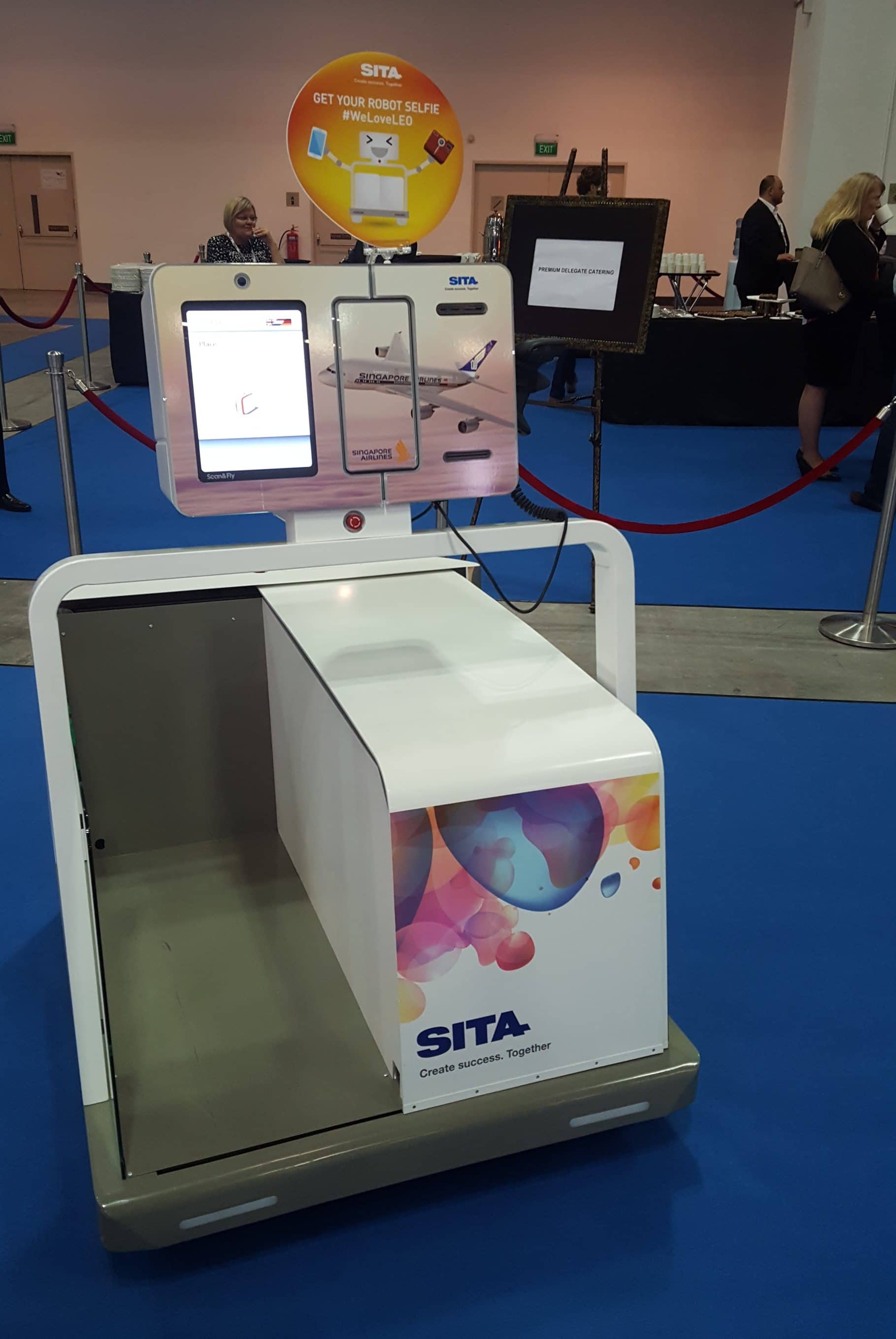
Leo the SITA Baggage Robot made an appearance at the Future Travel Experience Asia Expo 2016 in Singapore
A brief chat with Ilya Gutlin (SITA President APAC) reveals SITA’s ambitions to address airports’ attempts to “ramp up everything around passenger and customer experience… especially on the operational side.” It is also coupled with SITA’s insatiable desire to innovate.
“Maybe it’ll make people think about whether we can take a fairly common process that’s been done millions of times and put it on its head,” Gutlin commented, “instead of people going to the bag drop, the [baggage] belt comes to them.”
Nevertheless, SITA has been careful in their approach to releasing essentially a free-range robot into the often densely crowded airports of the world. So far, Leo has only been trialled in Geneva in May and is now touring Asia.
The baggage robot made ‘his’ debut at The Future Travel Experience Asia Expo 2016 and will soon head to Hong Kong airport for the HKIA Technovation Conference and Exhibition.
So far, reception has been positive. Gutlin remarked, “People were actually curious to see what Leo does, which was wonderful. They would entrust him with the bags, they could just walk away without seeing where Leo was going… We feel that something like Leo is a nice friendly way for passengers to get to that idea that they’re basically putting bags on the belt without another person. It’s a way to get people more familiar with the experience.”
“[We] look at passengers and see whether they like robots. That’s why we did live trials; we didn’t do it in a lab. We see what passengers feel, do they trust it and how we need to change the model,” added Derek Quek (Technology Evangelist, SITA Lab).
Strangely, it has indeed made the baggage drop experience seem more personal, despite it largely being a self-service operation. While the robot lacks any anthropomorphic quality, perhaps the simple, approachable name like Leo has helped make the entire experience more consumer-friendly.
But there is still work to be done, at least on the tech front. As of yet, Leo still does not possess an incorporated payment system to address issues like overweight baggage charges or any other activities surrounding a typical bag drop.
“Our aim here is to experiment with a lot of technologies and figure out where it can take us in the future. One of the big focuses for us was the autonomous platform. This is completely new in airports. One of the very big challenges is navigation indoors. You don’t have GPS or location services indoors and this is the first product we’ve seen that can navigate very, very well indoors and around tight spaces.”
Leo is just one example of the many products the SITA Lab is currently developing in the airport space. It is just one more step towards their ultimate goal of automating the entire passenger journey. “Our vision is to have digital impact on the journey from the time you buy your ticket right through to the time you get home,” said Gutlin.
But has there been any hesitancy to adopt these new technologies? Air travel is notoriously slow to develop and adapt to changing consumer needs, so it is worth asking what makes this any different.
Gutlin agrees, “It’s a mission in a critical environment… it’s been a slow trickle effect because a lot of airports were going through pilots and seeing how they deal with this process change.”
But he remains hopeful about SITA’s method of providing readily accessible tech. “The way we do most of our solutions is really common use. That’s how we started in the airport space in 1984; it was to enable any airline to use any piece of equipment within check-in or boarding… it will be up to the airline and what they’d like to invest in and how they see the passenger experience.”
Beyond baggage, SITA is also attempting to tackle the other elements standing in the way between travellers and the seemingly unattainable ‘seamless travel experience’.
Also on their development radar is AirportPulse, a dashboard and video input that can track passenger flow and queue information. But more interestingly, SITA is also working on SITA Smart Path, a system that would identify travellers via their biometric data (facial recognition; thumbprints), therefore enabling passengers to move freely through their journey without ever needing to reach for their passports.