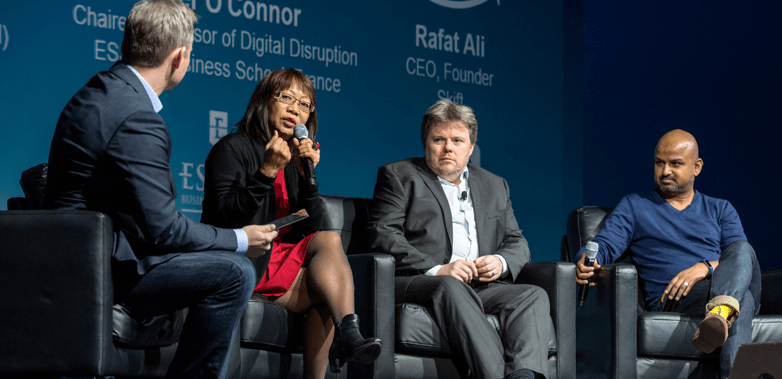
Expedia Inc marked its 20th anniversary with the annual Expedia Partner Conference in Las Vegas last week.
A crowd 4,000 delegates strong, representing many of Expedia’s brands as well as delegates across global travel markets, had their ears pricked and tuned towards finding out what the multi-billion dollar corporation has up its sleeve for the near future.
To get a much-needed outward perspective, an international panel – comprising Yeoh Siew Hoon (founder, Web In Travel, Singapore), Peter O’ Connor (chaired professor of digital disruption, ESSEC Business School, France) and Rafat Ali (CEO and founder, Skift, USA) and moderated by Mark Okerstrom (executive VP operations CFO, Expedia, Inc.) – sat to discuss the future of travel, both within Expedia and beyond.
The Sharing Economy: Hoteliers’ newest enemy or opportunity?
Exploring the notion that home-sharing and private accommodation would threaten hotels, O’Connor commented that companies like HomeAway and Airbnb were simply the latest enemy for hoteliers.
“For a long time, the enemy was the OTAs, then they woke up and smelled the coffee and realised that it’s good for the industry to help them distribute.” Now, as consumer tastes and behaviours change, hotels find themselves being outpaced by sharing platforms that have adapted more rapidly.
Yeoh pointed out that principles of the sharing economy are not new in Asia – “we share our food for example.” Pointing out the growth of the sharing economy in the region, from home-sharing to ride-sharing to co-working, she noted that Airbnb had launched in China and in Singapore, its brand awareness is so high that it doesn’t have to do much consumer branding work anymore. In Japan, in particular, it is seeing phenomenal growth because of the boom in Japanese inbound and also due to the accommodation shortage. Leading up to the 2020 Japan Olympics, this shortage would create huge opportunities for the private accommodation market.
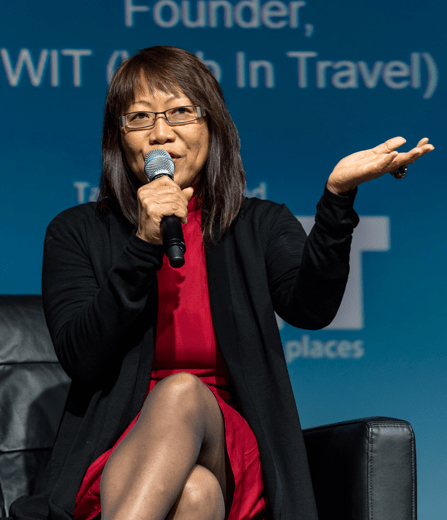
Yeoh Siew Hoon: “When you’re that big and you want to make the world a better place, you also need to protect the little guys.”
“Private accommodation has been great for Asia because there is a lot of inter-generational family travel and hotels aren’t catering for that, so it has created a lot of new travellers.”
Following the same thread, Ali remarked that hotels have long since ignored a lot of traveller niches. “A very large subset of consumers is asking for something beyond the consistency that the hotel industry has grown with… the needs of families and groups, those needs are being met by other players and being disrupted by other services.”
The real question that needs to be asked is “how can we all take part in this phenomenon?” said Yeoh, for example “could hotel room service be delivered by Uber Eats?”
O’Connor commented that these sharing services “have worked on eliminating customers’ pain points” while hotels have continued to do things the way they’ve always been done, failing to address changing needs.
To give credit where it’s due, some hotels are changing the way they look at their space and how it can be better used to appeal to guests particularly in playing to their original role as centres for communities, said Yeoh. Groups like Accor Hotels and Ascott are launching new brands that embrace co-working and community concepts.
She noted there’s been a huge growth of co-working spaces in Singapore and across Asia and how these were not only reshaping work culture but also rethinking how to make a space a service.
There are new opportunities for hotels to monetise and reap a few benefits of the sharing economy for themselves by adopting this mindset. For example, hotels may strike a deal with property owners by allowing guests to pick up their keys from the reception desk or perhaps even use the hotel facilities at additional cost.
Consolidation: Using influence for good
Expedia, Inc. is no stranger to the world of consolidation. The corporation carries an impressive portfolio of leading companies across virtually all travel verticals, including Hotels.com, HomeAway, Orbitz, Travelocity and eLong. While acquisitions have certainly helped Expedia’s exponential growth, what does consolidation mean for the future of the travel industry?
Yeoh made a strong point that was met with a resounding applause from the audience, as she spoke out for protecting smaller players in a world of big fish that are perfectly happy to keep feeding themselves.
“I think [consolidation] is good in that it could bring quality and standardisation and get more people on board, which is the overall objective… but when you’re that big and you want to make the world a better place, then I think you also need to spend on protecting the diversity of the tourism experience, which means really protecting the little guys.”
“Travel is about the little things… we should support [people like] the boatmen in Borneo.”
While Expedia has impressive ambitions to become the first $100b travel company, it was a reminder that such progress should come with a responsibility to better the industry (and world) in some way.

Peter O’Connor remarked that mobile is powerful, but no one has figured out how to use it properly yet
Mobile: First steps and new behaviours
If companies are not currently mobile-first, they’re talking about mobile-first, said Okerstrom, but can it be even bigger than it already is?
“It’s only the beginning. Businesses aren’t using them effectively… everybody’s talking about it but no one is doing it really well,” said O’Connor. Nevertheless, progress will be seen in a combination of voice, chat and machine learning.
Ali concurred but tacked on that the importance of mobile lies in how it has the power to change how humans fundamentally interact with technology.
Ali predicted that apps will no longer exist in five to ten years but we can expect new behaviours to emerge, for example through voice-activated commands and search.
Regardless of how quickly mobile advances in its own right, it does indeed have the power to accelerate the development of other travel markets, particularly for those who have skipped over the desktop phase.
Yeoh noted the example of Myanmar, “that used to have South-east Asia’s busiest airport in the 60s but then they went to sleep, almost like the Sleeping Beauty of Asia… but mobile has allowed them to catch up again.”
Social: A meaningful marketing channel?
Views were divided on the panel as the impact of social media as a business tool in the USA differs greatly from how well it has taken off in Asia.
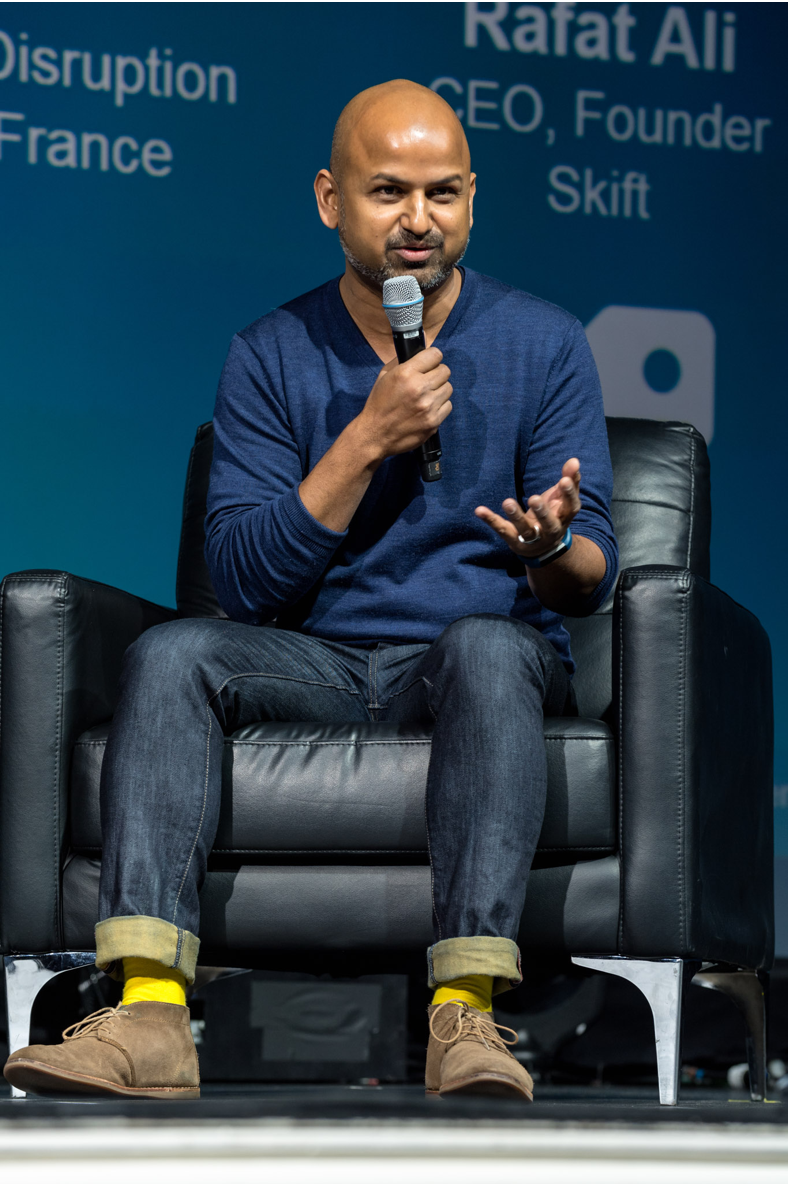
Rafat Ali had little faith in social media as a core platform to run a business
Ali argued that ultimately social media marketing limited brands to being a “simple post in a feed” and that companies would be wise to figure out what their core channel to reach consumers is. Social media presence alone, he believed, is not enough.
A study at the Expedia Media Solutions Lab identified that only 11% use social media in travel planning in North America. Surely Asia’s statistics would be much higher, Yeoh said, adding, “in Asia, social is a business.”
“If you look at the fact that Facebook is not in China and a new distribution system [exists in] messaging apps – Line, Kakao, WeChat… – there are companies in China now that conduct their entire marketing [strategy] and people can pay within the WeChat ecosystem.
When it comes to boosting the role of social in the West, O’Connor felt that many companies don’t actually have a very clear objective of how they can leverage it, to help it really take off globally.
“They know it’s a buzzword but they don’t have a clear objective… social is really important at the inspiration and search phase of the customer phase but many companies are targeting people at the ‘choice’ and ‘buy’ stages.”
Companies therefore need to be warier of matching their marketing messages according to the channel they are adopting, if they hope to use social as a cost-effective platform for their business.
Agreement wasn’t exactly unanimous on the panel as each respective representative of Asia, Europe and North America held very different outlooks on how current trends would manifest in the not so distant future.
Nevertheless, what could be agreed upon was how technology would ultimately thrust the industry forward by the potential it has to encourage new travellers but more importantly, to give smaller players a much louder voice in the world.