
Human behaviour may be predictable but it would be a mistake to assume it is consistent. Our needs and preferences are in a perpetual state of flux. We often even confuse the two, resulting in far too much of what we thought we wanted and too little of what we truly need.
The same goes for the online traveller. The integration of technology into what is essentially an ‘in-the-moment’ experience in a real, physical destination presents a new world of seemingly contradictory desires.
Brands must now work to be able to deliver the best ‘brand experience’ they can offer by juggling the often conflicting needs of their consumers.
Intercontinental Hotels Group’s recent report, “The Uncompromising Customer: Addressing the Paradoxes in the Age of I” attempts to identify four of these key ‘conflicting needs’ that pose as challenges to brands in the coming year.
One of the report’s boldest statements is that compromise is no longer an acceptable solution. It states that to compromise is to sacrifice some or part of one need/desire over the other. Instead, brands must work to find new ways to deliver every need simultaneously.
Specifically, it identifies: getting consumers to feel separate but connected; the changing definition of luxury; fostering ‘responsible individualism’; and rethinking consumer control.
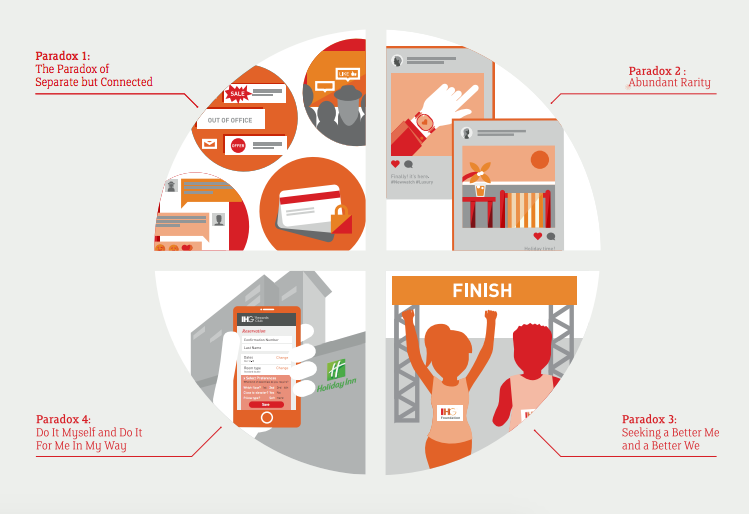
The IHG Trend Report 2017 outlined 4 key paradoxes that brands must address in the coming year
Know when to connect (and disconnect)
It argues that consumers want connectivity but are fatigued by the constant bombardment of content on a daily basis. The result: a shortening attention span and therefore a smaller window of time for brands to leave an impression and arguably and even shorter time to establish trust.
Brands must therefore understand when, where and how the best times to connect with their customers are. At the same time, brands can leverage their network of customers to cultivate as sort of common ‘social identity’ between peers.
This can work to build a brand beyond a single identifier. Presenting a brand as a multi-dimensional whole can foster loyalty, if consumers begin to associate it with part of their identity. This brand-associated ‘social identity’ can work to reinforce the brand’s power and significance.
Creating a single and influential brand message that resonates with consumers could have a positively reinforcing effect as it is shared amongst peers. It reduces the need to constantly push overt marketing campaigns, allowing the message to carry itself.
Luxury is an evolving concept
The second paradox is the notion that luxury must evolve to become both “scarce and available”. More clearly put, the IHG report posits that luxury is not defined by price but rather it is a multi-dimensional concept that can mean both “expensive availability” (i.e. widely available but affordable to few) and “affordable exclusivity” (i.e. harder to attain).
The report therefore suggests that brands do not have to be high-end to deliver a ‘luxury experience’ so long as it first identifies how luxury is defined and perceived by its customers and build on that. For example, across age cohorts, millennials and Gen Z may perceive luxury as experiences that “celebrate uniqueness” while markets like China perceive traditional luxury brands as more valuable.
However, it is also argued that now luxury can be experienced without being owned, therefore it is crucial that brands deliver an element of luxury within the entirety of a ‘brand experience’.
One specific example cited is the notion of privacy as a “vanishing luxury” within the realm of technology. Brands that can protect customers’ privacy whilst delivering a highly personalised service are best positioned to deliver a better quality experience.
When it comes to data, brands must understand both its level of sensitivity and relevance to a particular consumer, to know how to strategically use it.
In hotels, for instance, understanding and delivering upon guest’s unique tastes and preferences (e.g. gifting their favourite wine on arrival, based on an order made from a previous stay) can achieve ‘luxury’, without the use of their information being regarded as a privacy violation.
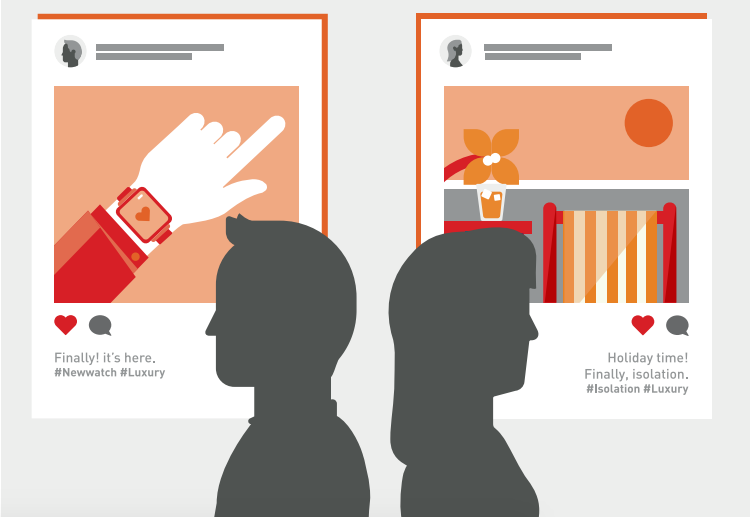
Luxury can mean either ‘available but expensive’ or ‘affordable but rare’
“A Better Me, A Better We”
The third trend identified is the concept of “Responsible Individualism”. People’s quest for self-improvement and self-gain is now inseparable from the desire to have a positive impact on the world.
Consumers are seeking more reassurance that their purchasing decisions are not creating any negative impact. The notion of “belief-based buying” puts forth the idea that consumers are more actively trying to create positive impact and achieve social good through everyday consumption behaviours – a sort of ‘volunteering by proxy’.
Brands that associate the purchase of their products with a positive social mission (for example, a school-building initiative) can cultivate stronger loyalty amongst both new and old customers, otherwise known as “Trust Capital”. It can heighten brand integrity, credibility and public perception, also yielding benefits for recruitment.
In travel, the rise of sustainable tourism, eco-lodges and even volunteering trips are direct examples of how consumers to couple leisure with a more noble pursuit. While not all ‘eco-travel’ pursuits are not equal, positive intent is often enough to sway customers away from less sustainable options.
Simply, consumers want to enjoy something with the reassurance that they are also doing some good.
Personal but person-less services
Finally, brands must do a better job of understanding the best way to offer maximal convenience while still allowing the customer to feel in control of their decision-making.
It argues with the development of predictive technology, anticipating what a customer will want (whether through an algorithm or self-learning software) carries the risk of losing the sense of human ‘connectedness’ associated with a brand.
However, it can present opportunities. For example, the digitisation of self check-ins, boarding passes, ordering via food and transport apps etc. demonstrate how ‘invisible technologies’ can allow individuals to take advantage of services in their own way, without need for any external assistance.
Fundamentally, brands must work to integrate automated technologies with the quintessential ‘human experience’ associated with quality service. Customers should feel that they can use technologies in precisely their own way – achieving a “personal but person-less” level of service.
However, not all brands can enjoy the same levels of tech integration as others. Younger generations are demonstrably more comfortably with digital relationships (e.g. mobile banking and even person-less financial advisory) while older cohorts may still prefer personal assistance.
Hospitality brands in particular must be careful to cater for the specific types of travellers they encounter and the services they come to expect from a particular brand of hotel or airline.
Inevitably as technologies get smarter and greater automation does in fact take place, brands must work hard to build customers’ trust and faith that automated systems are built well enough to have each their unique needs handled properly.