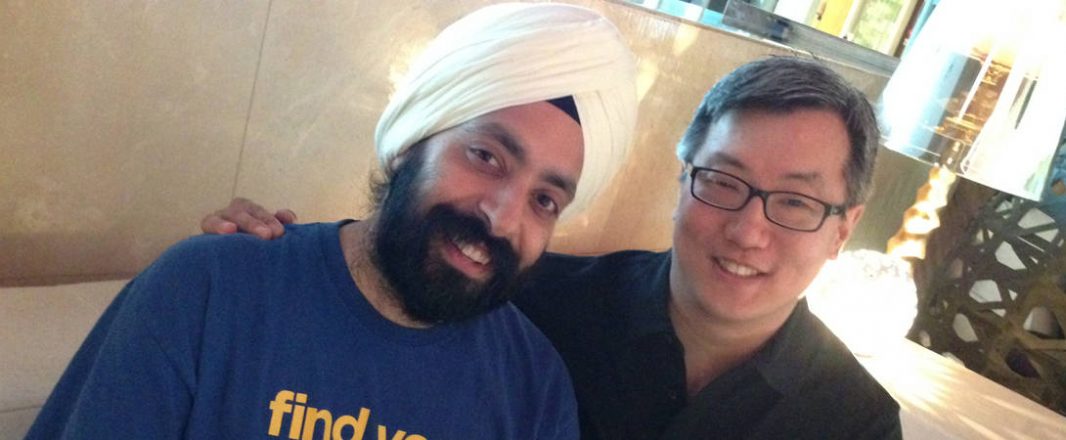

It may seem weird but these collaborations came to mind when I met Aman Bhutani (left), senior vice president, Expedia worldwide engineering, and John Kim, chief product officer at Expedia Worldwide one rainy Sunday at the W Singapore last week.
Both were at the Expedia global management meeting, the first high-level gathering in the region since the joint venture was signed between AirAsia and Expedia.
These two men are as scientific as they come. Their minds are driven by math and logic. They operate in a world where “we want to capture every bit of data” and “move everything to real-time”.
Hardly the kind of lyrics you’d put to a song but there’s something about the interplay and chemistry between these two Asian-Americans that make you feel that together, they make a powerful and formidable duo that could reinvent travel with the power of technology (which is Expedia’s mission), if they were allowed their canvas.
When one speaks, the other listens intently, and then extends the conversation with his own perspective. Sometimes, they disagree and they don’t allow the conversation to end until they find common ground. Heck, they even complete each other’s sentences.
Bhutani joined Expedia more than four years ago. He was working in San Francisco for JP Morgan Chase and had been approached by Expedia several times. “Everyone was against my moving. Who leaves banking for travel? At that time, the state of technology at Expedia was a disaster.”
Nevertheless, he went to Bellevue for a day, went through a series of interviews, the last of which was an hour with CEO Dara Khosrowshahi. “Dara nailed it for me.”
And for Kim, who came onboard two years ago, it was Bhutani who nailed it for him. “We just clicked,” said Kim, who’s worked with Pellago, Medio and Yahoo! and was advisory commissioner to the White House on Asian American and Pacific Islander affairs. “I came to Expedia because of Aman because I sense a kindred spirit and we see the world the same way.”
Here’s how the duo sees travel changing.
From websites to devices, pull to push
“We are moving from websites to devices – it’s all about access, we’re going to be there so that you can experience through different devices, with or without HTML.
.gif) “We are moving from pull to push – the searching doesn’t stop just because you have closed your computer – the Internet should keep looking for you, learn things about you and make it easier for you next time.
“We are moving from pull to push – the searching doesn’t stop just because you have closed your computer – the Internet should keep looking for you, learn things about you and make it easier for you next time.
“We are moving everything to real-time – you shouldn’t wait, we should get you that data right now.”
One example is the ScratchPad project, which was rolled out in January in the US. This feature stores and organizes a customer’s search queries for easy retrieval. Clicking on the Scratchpad button on theExpedia.com homepage expands the search history and refreshes the data, showing the latest prices and inventory. In addition, for travelers signed in to the Expedia.com mobile app, Scratchpad will remember those searches and save them for viewing on desktop.
“Technology’s finally ready to take large data sets and aggregate them in sub seconds – every click connects you to large data sets.
“It remembers everything you’re doing and plays it back to you – gets a sense of your history so it’s easier for you to find the thing you’re looking for – easier to share, easier to compare, easier to take notes.”
One surprise since its roll-out – “In the US, it takes people 48 searches before they book, we thought it would take weeks before people buy but what we found is people use it intensely and then book within a day. So they spend snatches of time but get one experience across devices – this allows them to make faster decisions.
“What we are doing is aggregating information and converting that to knowledge.”
A world of data, not interfaces
Bhutani and Kim admit that even the biggest companies in the world are struggling in the new world where the web has become a set of data products, not interfaces.
“There’s so much at stake, so many trends. You can make the wrong moves. Everything is being disruptive, everything is designed to make consumers’ life easier but harder for companies.”
Last year, Expedia spent US$500 million on R+D in technology and it intends to keep up that level of investment to make sure it lives up to its mission of reinventing travel through technology.
Mobile is a big area of testing. It has an agreement with Apple where it picks apps that it likes, tests those and if they are popular with travellers, then provides those apps for free. “It saves the pain of consumers of having to pay for those apps and then being disappointed.”
Mobile has also given OTAs the opportunity to shift last-minute business online. “In the past, almost all last minute was walk in and most of that business was offline. Now with mobile devices, you can shift that online.”
Said Bhutani, “We talked mobile for 20 years and it happened gradually, gradually and then suddenly. This happens with all technology usually – you know it’s coming and then boom – the generation that can design it builds it and expects it.”
It’s also working with partners such as Samsung and Google to answer the question, “Can you build a mobile app on a wearable device?”
Another area it is experimenting with is real-time reviews. “On flights, when you land, we send you questions and we are getting answers and we think we are onto something. Real-time interaction and feedback – everyone wants to do it now, the delay loop kills it, we now have to figure out a way to give that to suppliers.”
Asked if Amazon could be the gold standard for travel retail, Bhutani said, “Our journey is different, they are not dealing with perishable inventory. One of Amazon’s biggest innovations is the one-click buy. In travel, the idea of shopping is different, the product is disparate.
“We want to be the gold standard in ease of use.”
For Kim, the company he admires is Dropbox. “How unsexy is storage but they’ve nailed it for millions of people. I use Dropbox throughout my entire life, it reminds me, puts my friends on it, rewards me and scientifically measures every response.
“You don’t have to be a sexy brand, you just have to be focused, disciplined and relentless.
“Travel is an opportunity that’s not cracked totally. We want to focus on one problem at a time and do it super well. Our job is not to find the cheapest hotel, our job is to create the best experience and that experience should extend beyond transactions.”
Asia is the spice for Expedia
Having its management meeting in Singapore is indicative of the commitment Expedia is placing on its joint venture in the region and the duo are keen to build up teams in Asia that can provide tailor-made solutions for the region.
.gif) In the last 18 months, Kim and Bhutani have hired up to 600 people in India and are now hiring in Singapore. “We want to build product offices, not tech offices. We want to bring the full might of the global platform to make better decisions for Asia.
In the last 18 months, Kim and Bhutani have hired up to 600 people in India and are now hiring in Singapore. “We want to build product offices, not tech offices. We want to bring the full might of the global platform to make better decisions for Asia.
“Asia is the spice for us. Kathleen Tan (CEO of AAE Travel) plays a big role, who better than her who knows Asia so deeply. That’s our competitive advantage.”
That both are Asian-Americans can also be seen as a competitive advantage in a region where many global travel companies are looking to for their next growth trajectory.
“We both get Asia,” they said.
Data powers creativity, Math drives Mad
And while both men are ruled by science, it doesn’t stop them from understanding that travel is an industry driven by emotion. “There is no tyranny between math and logic, Mad Men and Math Men – they have always worked together and will work together in the Internet.
“There is nothing that will power someone to be more creative than data – data is powerful and it brings science to emotion. We scientifically measure happiness – we put sensors on people’s faces and measure if they are happy or stressed when looking at a screen.”
For Bhutani and Kim, technology and product have to go together. “You need technies who understand product and product people who understand technology – that’s the combination that’s needed today. The ability to integrate disciplines into one thing is the huge differentiator for companies.”
Said Bhutani, “Look at Apple – the first time I saw the iPhone version 1 and people said it’s not going to work, there’s no keyboard, but the dopamine hit on me was bigtime and I told people, the keyboard will be a thing of the past, Corporations will have to change. Consumers win, not brands.”
Said Kim, “We are working in travel which we know will change the world, because it helps people to understand another culture, it plays such an important role in human identity. So many people don’t travel because it’s too hard. They go to the same place, not expanding boundaries, that’s a shame.”
Asked what he does for relaxation, Kim said, “The Internet relaxes me. Every morning I black out an hour to explore the world – no agenda, just to understand the Internet – and I realise no one is getting it right.”