
Most founders, asked how they feel about what they’ve built, say proud. Or exhausted. Richard Valtr says disappointed.
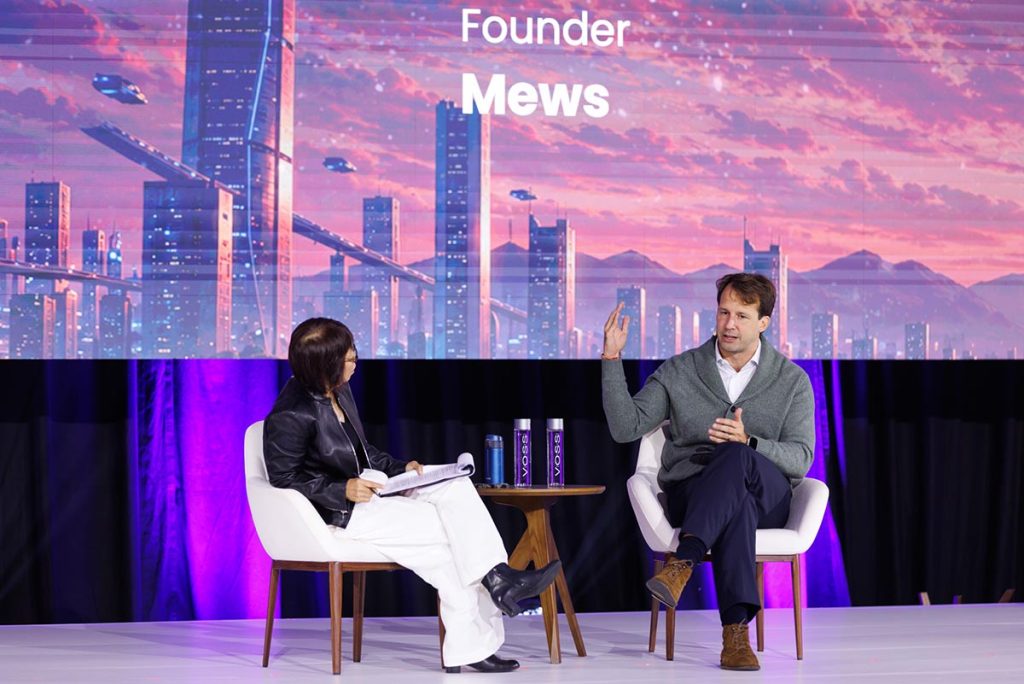
Not because Mews hasn’t grown. It has, from a Prague start-up in 2012 into one of hospitality’s most talked-about operating systems. But because, in his view, it should be far bigger. “I have this perpetual optimism,” the founder told WiT’s Yeoh Siew Hoon on stage in Singapore. “There’s this phrase most founders have: if we knew it would be this hard, we would never do it. I think we should be much bigger than what we are, because the scale of our ambition is a net positive for this industry.”
How much bigger? “Twenty times.”
From art galleries to Oracle revenge
The Mews origin story is well told: a hotelier fed up with legacy Oracle software decides to build something better. Less known is who that hotelier was before.
In his twenties, Valtr wasn’t, by his own admission, “really serious”. He opened art galleries, wrote guidebooks in El Salvador and worked for a film producer. His father, a programmer, held him to exacting standards and told him he had to get serious by 30. His mother, “the entrepreneur of the family”, was the creative force.
He started Mews at 29. Just in time.
The people most surprised by what he’s become, he says, are his friends. “Anyone who knows me from who I was before.”
Hoteliers have lost their mojo
Where does he want to surprise next? With hoteliers themselves.
“I feel that hoteliers over the last 20 or 30 years have lost their mojo,” he said. Hotels have spent decades under “this yoke of centralisation” that treats them as standard objects. “Hospitality has become smaller in its ambition.”
Two forces, he believes, will deliver back that mojo. The rise in boutique, independent hotels who extend stays into experiences and AI and agentic disruption of disruption. It will let hotels monetise more of the stay and sell services well beyond the room.
Prune, then prune again
Growth brings its own disease. Valtr calls it ossification. Rules multiply, meetings need invitations, approvals stack up, and power drifts away from the people closest to the problem.
His reference point is an unlikely one. “The most resilient and, in some ways, interesting organisation on the planet is the Catholic Church. There are only four layers of management. I’m not saying it’s the most innovative space, but it’s really important for leaders to constantly think about the layers that tend to creep in.”
So Mews pruned. In the past year it scrapped the separate roles of product manager, designer and engineer and merged them into one: the product builder. Engineers who wanted to stay “in their little hut” and never speak to a customer could leave.
Those who stayed got an internal AI harness. It pulls in sales calls and customer service questions so engineers can, in effect, hold conversations with the products they are building. The result, he says, is an eight-fold productivity boost.
“I look at other companies using AI to get 10 or 15% efficiency. We really leaned into it.”
Go-to-market teams are next.

A bank, of sorts
In August, Mews was granted an Electronic Money Institution licence by the Dutch central bank. It is the first vertical hospitality operating system to hold one.
For Valtr, a property management system has always been about two things: productivity and credit. “If you build a great hotel, you should be able to operate more of them, build more, offer more experiences.” Real estate grows slowly, he says, largely because of the incumbent pressures of banking.
“From an engineering perspective, I don’t think banking is that hard.” A pause. “I’m about to find out.”
Payments also open the door to fraud protection, which he calls “a huge part of what stifles this industry today”. Horizontal players, he argues, simply don’t understand travel well enough to fix it.
Neither walled garden nor open bazaar
On the perennial debate of all-in-one versus best-of-breed, Valtr reaches for the iPhone.
“No customer wants an iPhone that’s just a marketplace of apps. But you also don’t want one with only Apple’s apps. You want both.” Hotels want the freedom to expand, he says, “but you don’t want a system where you have to open 40 browser windows to do the job you’re supposed to do.”
Hotels can buy the whole Mews stack or individual modules. If they find something better, Mews will make it easy to plug in. “Then it’s incumbent on us to do better.”
Three chiefs of staff
Valtr is, by his own description, a heavy AI user. He has built three personal chief-of-staff agents, one for each aspect of his personality. “Maybe people won’t be as weird as me, but they will start to embrace this, because there’s so much convenience locked up in it.”
The long-promised personal CRM, he believes, will finally become real. In that world, a hotel must be ready to hold 20,000 rich conversations at once, with guests and with their agents. When an agent comes asking for a price, the hotel should answer with its best price and best package.
His timeline: about five years.
Asia, humbly
Mews names North America and Europe as priority markets. But Asia came early. After the Czech Republic and Germany, Japan was its third country, after a Japanese group found Mews and the company flew a team out to onboard them.
Today Asia Pacific, including Australia and New Zealand, is about 6% of the business. Valtr sees a split region. “On the consumer side, Asia is far in advance of most of the Western world. On business tooling, there’s still a lot of innovation to happen, and a huge hunger for it.”
The approach, he insists, is humility. “We don’t want to come in and say we’ve figured it out everywhere, so we’ll come to Asia and take over.”
Growth will come organically and through partners or acquisitions, judged on opportunity cost. Can Mews buy the trust that local teams have built, and give them resources they never had? The real constraint, he says, isn’t cash. It’s “the cognitive load of so many of these things”.
What could stop Mews?
“Us thinking we’re better than we are,” he said. “Us caring more about how great we are than about what we’re doing for our customers.”
The test is speed. As long as no five-person start-up can move faster than Mews, he’s comfortable. And the goal is concrete: every hotel able to say, here is 20% more profit I could not have made on my own.
As for fundraising, it gets easier. The Series D was the least stressful round. “People just come to you and say, we’d like to give you more money to do the thing you’re doing.”
And what would 14-year-old Richard make of it all? “He thinks we’re going too slowly.”
Welcome, not check-in
The last question went to the industry, not the founder. What is hospitality’s most embarrassing teenage habit, the one it has never outgrown?
Valtr didn’t hesitate. “Check-in. The fact that we call it a check-in and not a welcome. We call it a checkout and not a goodbye.”
It is, he says, a symptom of an industry that fell in love with process. Standard operating procedures, over substance. “Rather than asking: is this guest quantifiably having a great stay? Are we creating memories?” That, he believes, is what AI finally makes possible.
Siew Hoon had the last word. Mews has been around since 2012, she noted. “It’s embarrassing you haven’t been able to solve this, Richard.”
“I know,” he laughed. “Sorry.”
Watch the full session here: