Over Korean barbecue with real beef (my Korean hosts insist on using the adjective, which makes me wonder if there’s a lot of fake beef going round like news), I asked my friends, “How do you think living in a place that’s always in the middle of tensions and threats of nuclear bombs shape you as people?”
Unlike Korean food which comes with lots of appetisers, I believe in cutting straight to the chase, and I am genuinely curious to know their answer because I want to know what it feels like to live in a place that’s caught between the devil and deep blue sea especially now, when we have a man in the White House who’s reputed to be as trigger-happy as the man in the north.
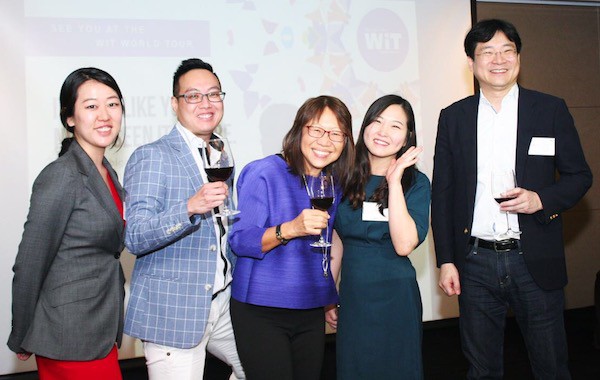
All smiles in Seoul (L-R): Sunny Chang, WIT’s Gerry Pang & Yeoh Siew Hoon, Jyeong Ji Ye and TideSquare’s Min Yoon
“Actually we don’t care much about it anymore, I mean, we hear it all the time,” said one. “We just get on with life.”
“Resilient,” said another. “And aggressive. Because you never know …”
Perhaps I am oversimplifying it but I wonder if that’s the reason why, in just one year away from Seoul, I feel the competition in the travel market has gotten downright aggressive – not just among existing travel players but new ones that have burst onto the scene almost overnight.
And it seems to me that everyone’s in a hurry to stake their claim on the growing travel market – both inbound and outbound – because right now, there are no clear leaders that have emerged in online travel.
Traditional travel, yes – the giants still rule but for how long?
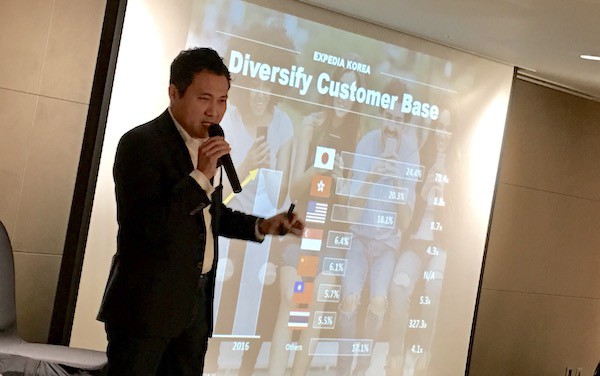
Expedia’s Denny Jeon: “Mobile is not the future, it is the only future”.
For if there’s one clear trend that was shared at WIT Seoul held on April 27, it’s that the dominance of mobile in the home of Samsung has given rise to the generalists – the marketplaces such as Ticket Monster (TMON), Coupang and G-Market that have moved into travel and are expanding their reach.
TMON, which now sees almost 30% of revenues, from travel is moving into hospitality and has acquired Zari, a B2B hotel tech solution provider for independent hotels. These marketplaces have serious funds to scale and they are powered by technology.
Naver, the dominant search engine, has increased its penetration in travel. Skyscanner and Hotelscombined are two foreign brands that are showing traction in the local market but local search players are snapping at the heels.
 Traditional travel giant Hanatour is in the midst of a digital transformation, said Charlie Park, General Manager/Hotel General Team (pictured left), to keep up with changing customer behavior and expectations. It is investing heavily in technology and has aspirations to be like a Ctrip, he said.
 The rise of on-demand services has taught consumers what they should expect from online brands and Ryan Kangjoon Lee, Head of Travel Business, TMON (pictured right), said that this was something Tmon would be exploring.
In terms of inbound, brands like Booking.com and Expedia are seeing strong growth among Asian travellers who, influenced by popular Korean culture, flock to Seoul for a brush with K-pop and K-drama-induced fantasies.
Current tensions between China and South Korea means there’s now a ban on Chinese tour groups to South Korea but on the streets, you still see plenty of individual Chinese tourists, snapping, sharing, streaming – whatever it is they do these days.
 JejuAir’s Hyuk Park (pictured left) said the ban has had some impact on the airline’s business but is an opportunity for it to diversify its markets as it expands its network aif
“We like that there is more competition in travel now,” he said, referring to more competitive customer acquisition costs using meta-search and OTAs.
Expedia South Korea which has largely seen China-driven growth is also diversifying its markets and South-east Asia is largely ignored by most Korean companies. Expedia, said Denny Jeon, director, market management for Expedia Korea and Taiwan, is seeing strong growth from markets in ASEAN. It is also introducing air in South Korea.
 Startups are powering up. Past WIT Japan Startup winner MyRealTrip, which started out in 2012 as a “Local Expert” with a P2P tour guiding platform, has expanded into tours and selling attractions and activities and in 2016, moved into accommodation. Founder & CEO Donggun Lee (pictured right) said it would move into flights soon.
The site now covers 350 destinations, offers 9,300 experiences and gets 1,000 bookings per day with a monthly GMV of US$2.8m. Lee said revenues grew seven-fold in 2016.
The well-funded Daily Hotel (it’s raised US$10 million to date), which started out as a last minute hotel booking app, is now moving into restaurants with co-founder Ryan Shin (pictured below left) reasoning that people eat more than they stay in hotels.
 It is clear that in South Korea, mobile is where it is at. Expedia’s Jeon said that “mobile is not the future, it is the only future”.
Min Yoon, CEO of TideSquare who’s himself invested in meta-search and tours & activities, said he is looking to acquire or invest in mobile technology companies.
Certainly the next battle is in mobile and while it is unclear right now who will be the winners, it’s looking like the global brands are winning in the inbound sector – like Japan, few Korean brands have been able to expand successfully outside their home market – and it’s in the domestic and inbound sector that competition will get even more aggressive.
Whoever the winner is, said Min, “I hope they will be friendly.”
He could be talking about the man in the White House and the man up North.
Note: Want to learn more about the South Korean market? Attend WIT Japan & North Asia, June 8-9, which will have Korean translation services for the first time.
• Featured image credit (Myeongdong, Seoul): f11photo/iStock