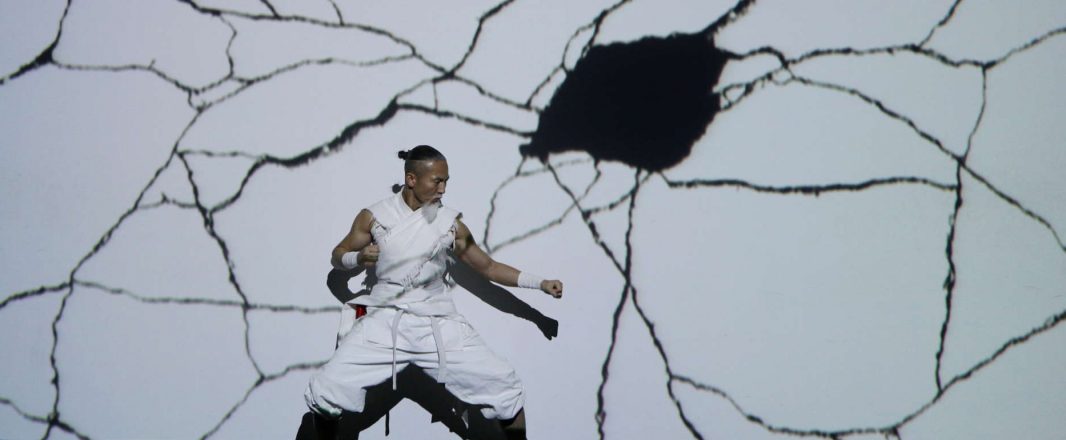
It was two days before Katsumi Sakakura was due to perform at the opening of WIT Japan & North Asia 2017 in Tokyo and I was curious to meet the artist who had captured my imagination with his performances which blend, as he calls it, “screen power with human power”.
In dress and look, he was as I had expected – fit and wiry, and stylish in an outfit designed by himself and sewn by his wife . In every other way, though, he was unexpected. This is the story of how he “conquered himself” after a long journey of failure, rejections, experimentation and self-discovery and how he wants to share his version of “Japanese cool” with the world.

Katsumi’s “mushin” performance is a true blend of elements
In his “mushin” (a mental state into which trained martial artists are said to enter during combat) performances, Japanese artist Katsumi Sakakura performs against a projection of light and sound. Every movement is perfectly timed and synchronised to the sounds and images on the screen.
His performance is a true blend of elements – east and west, martial arts and dance, tradition and technology, strength and grace and creativity and discipline – and towards the end, he battles with his own shadow, and conquers it.
Katsumi, he tells me, means “conquer yourself”. It was a name given him by his father. “I am honoured to have it,” he says.
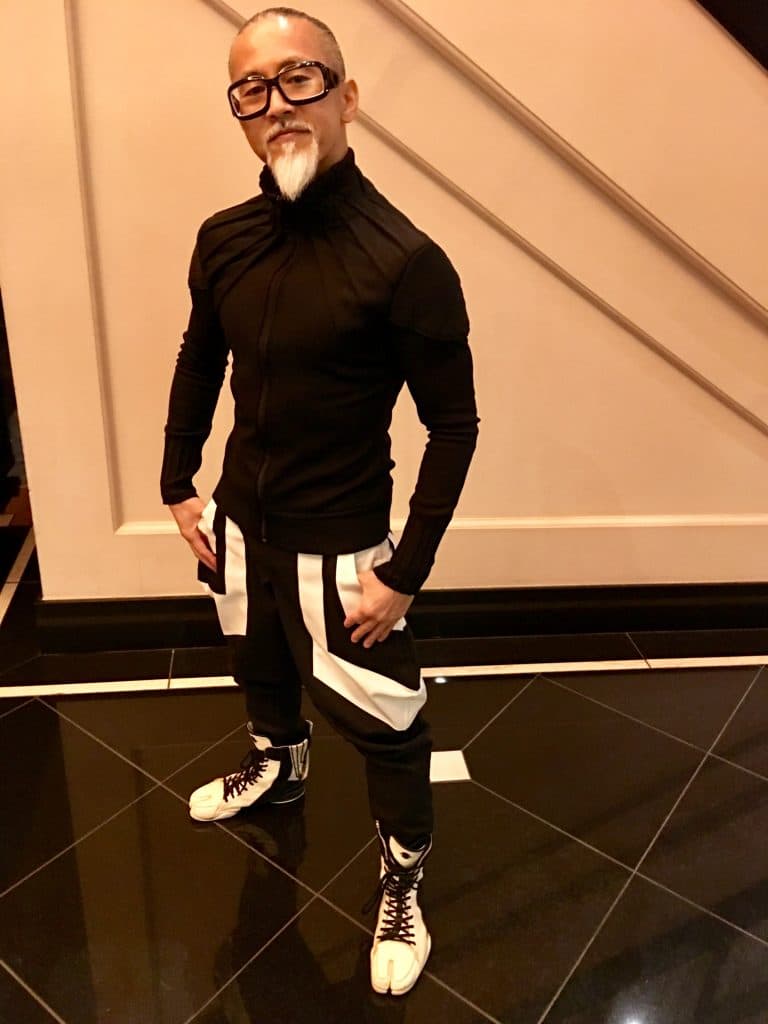
Katsumi in an outfit designed by himself and sewn by his wife: He wants to bring Japanese cool to the world.
And if you hold the belief that your name forms you, then Katsumi, who now runs Orientarhythm, a dance workshop and studio, has spent his entire life conquering himself to find his calling in dance and artistry and through his art, his purpose in life.
Born in Nagoya, he was five when he was taught karate by his father. “I was not good at studying, and I hated sports. However I loved to make things by hand and I was good at art and craft. But my father told me, you can’t study or do anything so you’d better learn self-defence to survive.”
He was 10 when he found out that his father had learnt karate from a book and they decided that for him to make better progress, he should go for professional classes.
“People think karate is a way of fighting, but the real meaning of karate is self-defence. The most important thing is strength of spirit,” says Katsumi. Even though there was an interpreter during our conversation, Katsumi would switch from Japanese to English when he felt the interpreter wasn’t conveying his sentiments correctly.
He also learnt about the principles of “bushido” – the way of the samurai. “In other sports, when you win, you are happy and you celebrate. But bushido is not about winning, it’s samurai spirit not to show happiness because if you win, someone loses. And remember a long time ago, people fought with real swords and if someone dies, you should not be happy because you have killed someone.”
But those lessons only dawned on him later in life as he went through his struggles to find his identity.
“Be happy switching jobs until you find what you love”
In university, being of small build, he was bullied and got into fights and even though in karate, there’s the saying “even small bodies can win against big bodies”, he found himself disappointed with the martial art form because he was losing fights.
“My father told me, don’t pick a fight but if someone attacks you, then you have to accept the fight. At that time, I didn’t really understand the true meaning of karate and thought it was about body size. Now I know but then I was young and I wanted to fight.”
He quit karate and took up boxing. For his thesis, he explored the differences between the two sports. “You use your knuckle and the purpose is the same, to knock someone down but the difference is in the method.”
Interestingly, writing the thesis opened his eyes to the beauty of karate and he went back to his fighting roots.
After graduating from Nagoka Gakuin University with a Bachelor in Economics, a degree which baffles him to this day “because I never studied economics, only boxed”, he tried more than 10 jobs. “I worked in fashion, was a car mechanic, cook, housekeeper, I changed jobs all the time.”
Today, when Katsumi speaks to university students in Japan, he tells them, “You don’t have to be stuck to one job. You can be happy switching jobs until you find what you love.”
From MC Hammer to Japanese cool
He found what he loved when he was aged 25 – about 30 years ago – when he discovered dance in a gym he frequented. “I was amazed by hip-hop, I copied moves I had seen on television. I was so in love with Western culture and hated anything Japanese.”
He impersonated MC Hammer, coloured his skin and did his hair to look like the American hip-hop artist.
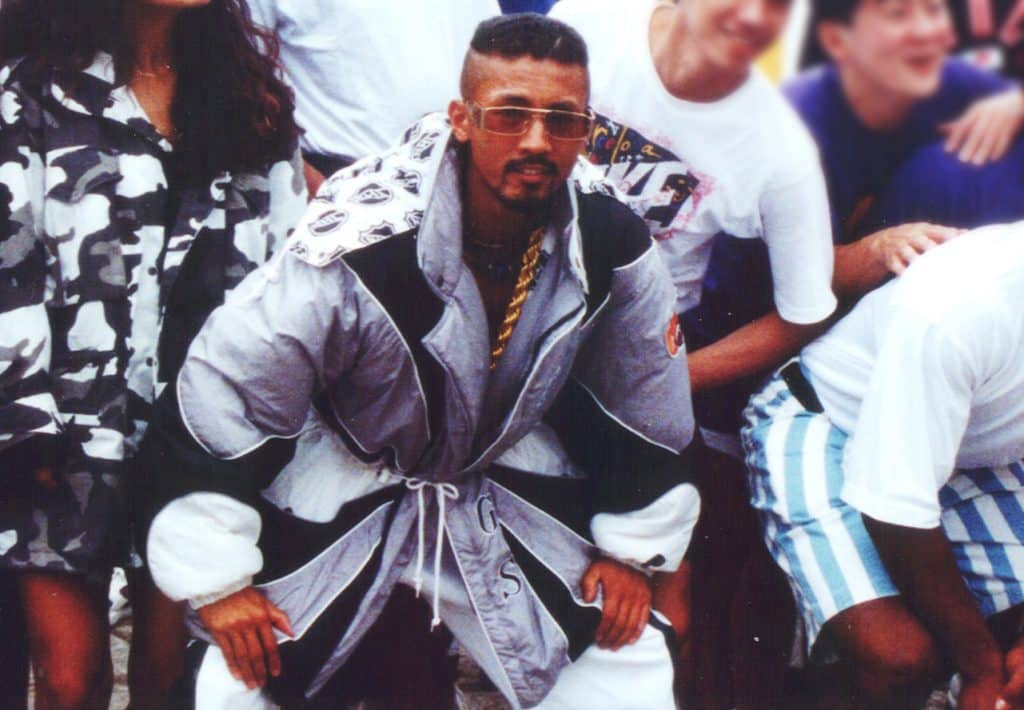
Katsumi as MC Hammer: A moment that changed his life.
One day, an American dancer from Hollywood came to watch his MC Hammer impersonation. “I thought she would compliment me but instead, she said I was doing it all wrong and I was insulting her people by colouring my skin and waving my hair.
“’Don’t you know our history, she asked me. We face troubles because of our skin colour. We love Asian, your straight black hair, why do you want to change yourself? Japan has such cool culture, why don’t you do that rather than copy our culture?’
“That surprised me. I thought Japan was not cool. I wanted to be American, I loved hip-hop. But my life changed at that moment.”
From then on, Katsumi investigated Japanese culture and experimented. “I didn’t understand what was Japanese cool – was it calligraphy, side kicks, samurai style? And then I wondered if there was something secret in the movements of karate – maybe Japanese cool is to be found inside karate.”
He went back to his karate roots – blending simple, controlled body movements with dance – but still he wasn’t satisfied and wanted to learn more about dance and so he travelled to Los Angeles.
In the meantime, to pay the bills, he continued giving dancing classes, something he did till he was aged 47.
The breakthrough moment that would give rise to the idea behind his current “mushin” performance happened in 2004 in Los Angeles.
“One of the directors of the show asked me to put my name on the screen behind me but because the screen was so big, I thought only showing my name was boring so I started to think about showing other things.”
He started to think about “blending screen power with human power” on stage and so his unique style of performance was created.
How YouTube changed his life
But it took at least another five years before he was discovered and he had social media to thank for that. “YouTube changed my life. I could put my videos out there and promote myself and people started discovering me on YouTube.”
Before that, it was pounding the pavements with his videos, knocking on producers’ doors and being rejected. He recalled one meeting in which the agent in Los Angeles threw his video into the trash can in front of him.
“That was the saddest moment. I cried. I had no money and he put my work into the rubbish,” says Katsumi.
He thought he had gotten a break when he was asked to perform at a show in Broadway in 2007 but not much happened after that.
But he never gave up. “I don’t give up easily.”
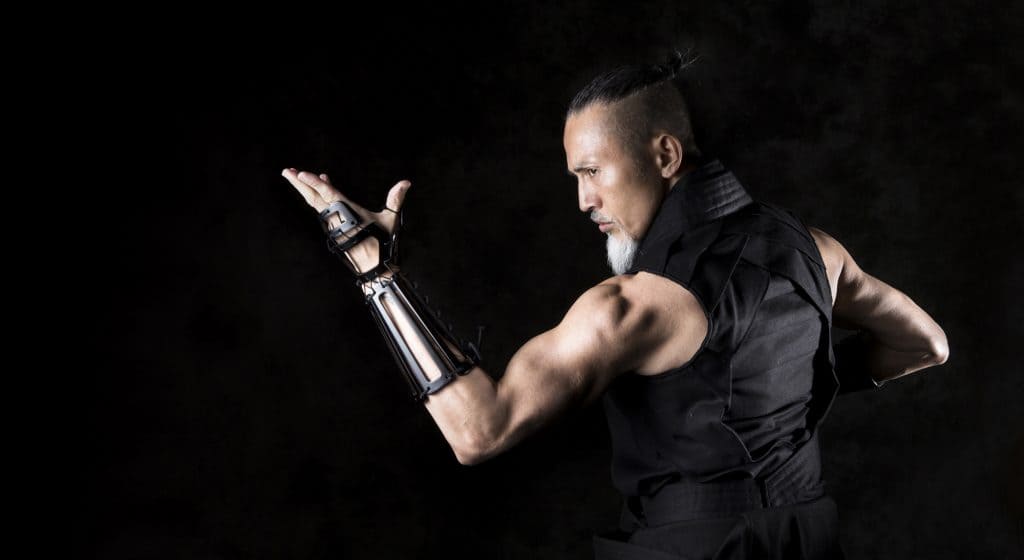
“My performance embodies part of Japanese culture. It’s not just about the external movements, it’s about the internal spirit.”
Today, he’s performed in 39 countries. He says the perfect audience was in India, “they understand entertainment”, but the most special was in London “because they understood the spiritual intent of the performance”.
“I am happy people find it cool and exciting but I am happier when people are more thoughtful of the meaning of the dance. Even Japanese people find it hard to understand the meaning.”
So five decades later, Katsumi, the boy who learnt karate at five and then abandoned it for Western boxing and hip-hop, has conquered himself and rediscovered his Japanese roots. To put together his CG-infused performance, Katsumi learnt all about the technology himself and created the routine himself.
“It’s funny. When I was young, I don’t like Japan. Now I love Japan. I want to tell the world what is Japanese cool. My performance embodies part of Japanese culture. It’s not just about the external movements, it’s about the internal spirit.
“That spirit came to the fore during the tsunami – when we saw Japanese people be patient, queuing for their water, in times of crisis. When the Western media saw it, they made big news about it but for Japanese, this is normal behavior. Everyone is thinking, we are in the same situation, let’s just form one line.
“This is the original thought of karate – never insist on winning, think of the other person. That’s Japanese cool.”
Son of his father and the legacy of the name
While some might say his has been a life of struggle – it took him nearly three decades to find his footing – Katsumi says, “I haven’t found it difficult myself. In fact, I would like other Japanese to change – most go to the office everyday even though they don’t like it. Monday to Friday, not happy, Friday night and Saturday happy, then Sunday, they think of Monday and they become blue.
“That’s not real life.”
As for his father who is now 80, Katsumi finally invited him and his mother to watch him perform last year. “I was nervous because I thought I’d lose focus if my parents are in the audience. But I finally got the courage to do it at a big show last year.”
His eyes tearing, he said, “My father said, you have become the greatest performer, I am very proud of you. That was the first time he said it.”
And it reminded him of the first time his father told him why he’d given him the name Katsumi. “When I was 10, I started entering karate competitions and I’d lose everytime. Everyone could do 50 pushups but I could only do 29 so I came home to practice so I could do 50.
“He said, why compete with others? If you keep competing with others, you will always lose because there will always be bigger bodies, stronger fighters. You have to compete with yourself. Is 29 your limit? The right way is conquer yourself, that’s your name.”
Watch his opening performance at WIT Japan & North Asia 2017 here.