
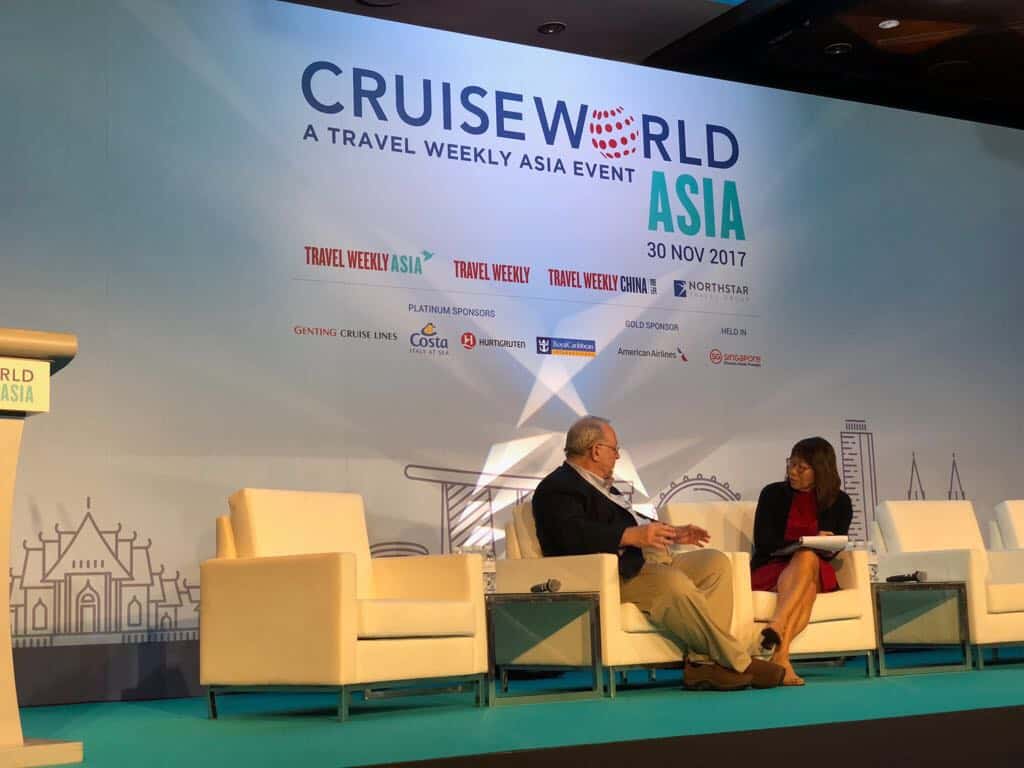
At the inaugural CruiseWorld Asia held in Singapore on November 30, Bob Guy (Managing Director of Singapore & Malaysia, Destination Asia) tapped into the main opportunities and challenges that face the growth of cruises in Asia, during an interview with Yeoh Siew Hoon (Editorial Director, Northstar Travel Media).
As an American that has lived in Singapore for the past 40 years, Bob Guy shared a fairly unique perspective on not just the cruise industry but tourism in the region more generally.
After spending time in the military and travelling throughout Fiji, Australia, and then USA, Guy returned to Singapore as a tour operator. He described having to carry a map under his arm when selling Singapore as a destination because people simply weren’t aware of where it was on a map.
Guy recounted his early years on the island city-state when it was still in its infancy. “You see different things at different times… back then, Singapore was in its infancy and you think ‘what is this and what could it be?’”
He fondly remembers this era as “the golden years of tourism”. Now, with the rapid growth of online travel and the emergence of travellers within the region, he said, “today has to be the platinum era… it’s become a broader buffet table of activities.”
Part of this platinum era is attributed to the rise of cruises in Asia – evolving from a simple “importation of American brands” – starting with Star Cruise and Royal Caribbean – to an “embryonic growth of development.”

Credit: iStock
Guy said that it was these early entrants opened opportunities for an abundance of other brands to follow suit in their wake.
Over time, it became clear that cruise companies would have to do more if they truly want to succeed in Asia. More specifically, to capture the potential of the Asian travel market, they must localise their brands to cater to their unique needs.
“Royal Caribbean has gone the farthest,” Guy said, describing how cruise-goers coming from Miami favoured it for its all-Westem menus. “Now it has almost completely adopted local cuisines” of the areas its ships are operating in.
While Royal Caribbean might stand out, Guy applauded everyone for doing very well in their abilities to tap into markets “from Japan to India” by meeting a broad menu of requirements, from multi-lingual menu translations to entertainment offerings on-board.
When it comes to the off-board experience, Guy said there is room for a lot of improvement – especially in the realm of port developments (a theme echoed throughout the conference) – but once you’re on the ships, “everything’s great.”
Singapore, he notes, is halfway to becoming a global cruise hub, as well as the rest of the region. However, there are critical obstacles standing in its way.
First, Guy argued that despite the breadth of geography covered by cruises is expanding; there is still a deep crevasse when it comes to general understanding of what cruise operators actually offer in terms of travel experiences.
He said that travel agents must get more involved in marketing cruises to consumers. But first, they must enhance their knowledge of the products available “so they can make a consultative contribution to the customer sale.”
There is still plenty of room for improvement in this arena as Guy described the cruise industry as “still an alien product to many”. The industry’s potential for growth is stunted by a lack of awareness of what is actually on offer, which ultimately trickles down to weak consumer understanding of the product too.
When asked if online distribution and marketing could perhaps fill this gap in understanding on the consumer side, Guy argued that “its very hard, on a website, to give a customer the substance of what a cruise is.” And with the bombardment of emails and special offers people receive in their inboxes daily, it will be even more difficult to get that message across.
This fundamental lack of knowledge, Guy states, is the industry’s “biggest competitor” and biggest hindrance to growth, despite the potential being there for the taking.
People have natural hesitations when it comes to cruises that must be addressed to challenge people’s pre-conceived notions of what a cruise is and what to expect during both off- and on-board experiences. The industry must find innovative ways to build consumer confidence in the diversity of products and experiences available.
This, Guy concluded, presents Asia as one of the cruise industry’s biggest untapped markets.
Operators must devote more time to actually getting people on their ships first, before they can expect greater levels of support from travel agents. For example, the development of dedicated cruise divisions in travel agencies or even cruise-only agents is something that exists in the USA, but not yet in Asia.
But a little like the ‘chicken and egg’ paradox, it will be precisely those agents who would be able to help get those people aboard in the first place.