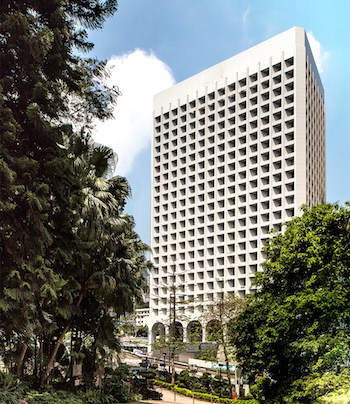
I must have passed the Hong Kong Government building countless times when I was living in the city. You couldn’t help but do so, located as it is midway between Pacific Place and Central. But the Murray Building was a structure you hardly noticed in a city of super structures – it was nondescript, very closed-looking and had a ring of car parks encircling it.
It used to house various government departments so I suppose its function was not to stand out, but to blend.
Until now.

Duncan Palmer: “I like to evolve hotels and take them to the next stage.”
Earlier this year, The Murray soft-opened, part of the Niccolo brand of hotels by Wharf Hotels, and the new 336-room hotel is certainly attracting a lot of media and local attention for various reasons.
One, a lot of people wanted the building and site – there were 18 bids in all – but Wharf Holdings beat them off by paying HK$4.4 billion for the building and site and then spent HK$3.4 billion on converting it, so per key, it is probably one of the most expensive hotel developments in the world.
Said managing director Duncan Palmer, “Ultimately they paid the most. Wharf wanted the building and leave a legacy to giving back to Hong Kong. From the start, Peter Woo, the chairman, took that responsible stance.
“As an architect too, the arches of the building and orientation of the windows got his attention – what a chance this is, it’s been eight years since a luxury hotel of this size opened in Hong Kong – and there are early signs that this building will be successful,” said Palmer, with the quiet smile of someone who knows the 18 months he and his team have spent on the project are about to pay off when The Murray fully opens by this month.
Two, it’s preserved a sense of history and place at a time when Hong Kong probably needs reminders of its proud history when it was once the only gateway between the West and an emerging China.
The Murray Building, built in 1969 and the tallest building at the time, sits between Hong Kong Park and Botanical Park and staying there, you are reminded by how, despite its super steel structures, Hong Kong is a green city and yes, along with its 7.3 million population, there’s lots of birdlife still around.
“Wharf wanted the building and leave a legacy to giving back to Hong Kong.”
Walking through the two parks to get to either Pacific Place or Central, I saw signs advertising bird-watching get-togethers and heard the tweeting of birds, happy as they should be because spring has sprung. Looking out from my room which overlooks the park, I see not only kestrels, but cockatoos flying through the sky.
It’s a little known fact but Hong Kong Island is home to a 10th of the global population of yellow-crested cockatoos, a critically endangered bird whose numbers have rapidly declined in South-east Asia due to poaching and the pet trade.
It is stories such as these and the Murray’s unique history as the first of a series of buildings to be conserved under the Hong Kong Government’s Conserving Central programme, that underpin the narrative of The Murray.
To ensure the building stayed true to its roots, Palmer tracked down the original architect, Ron Phillips, who played a key role in the conversion and conservation project. “There are many architectural elements that only he knew about and we wanted to protect the integrity of the original architecture.”
Palmer is known for his track record in running luxury hotels – he worked for the Mandarin Oriental Hotel Group and The Savoy in London – as well as conversion and conservation projects. He worked on the Oriental Bangkok in the 80s, Savoy in the mid-90s, the Connaught in the late 90s as well as the Sukhothai in Bangkok.
He recalled how he went to Phillips’ apartment in England to spend time with him to understand his design thinking. “The building was very closed in, very secure and it was called the Murray car park because all the open areas were occupied by cars. The windows were quite small, the sills quite high – so we brought the sills down but kept the angle of the windows so that the sun never shines directly into the bedroom. This building won the award for energy efficiency in 1994.
“The impact on the bedrooms is a good working environment, there’s enough light and you get park views.
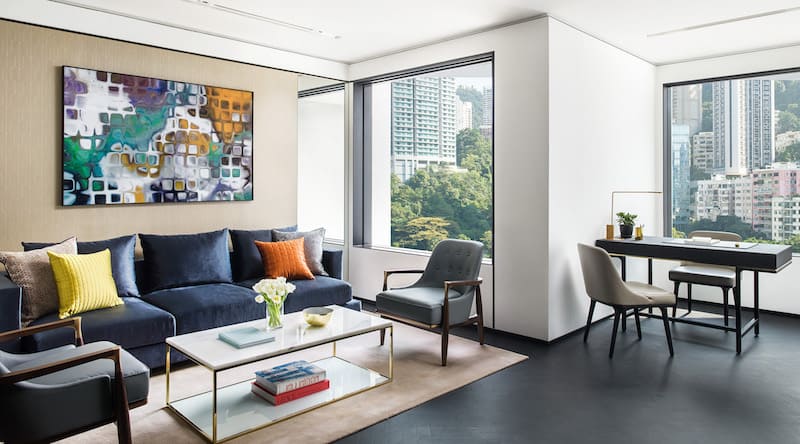
“The impact of the bedrooms is a good working environment, there’s enough light and you get park views.”
“Wharf has also kept the privacy of the site. Even though it is surrounded by buildings, there are no shops in the hotel so you don’t get a lot of foot traffic as you would with most other hotels in Hong Kong. Mr Woo saw the location as an opportunity to build a landmark iconic space where people could use the space to relax and not be too distracted by traffic,” said Palmer.
A century-old tree, known lovingly as the OVT (Old and Valuable Tree), was kept and its roots uprooted and cared for in the nursery. It sits in the middle of the private courtyard, surrounded by 11.5-metre arches.
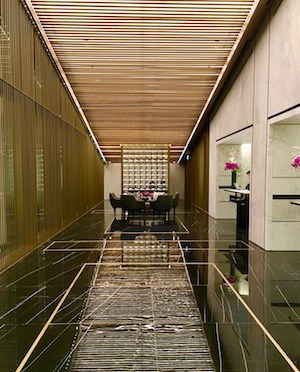
“Our mission is to give Hong Kong a unique hotel – to translate the architectural straight lines into the interior of the hotel.”
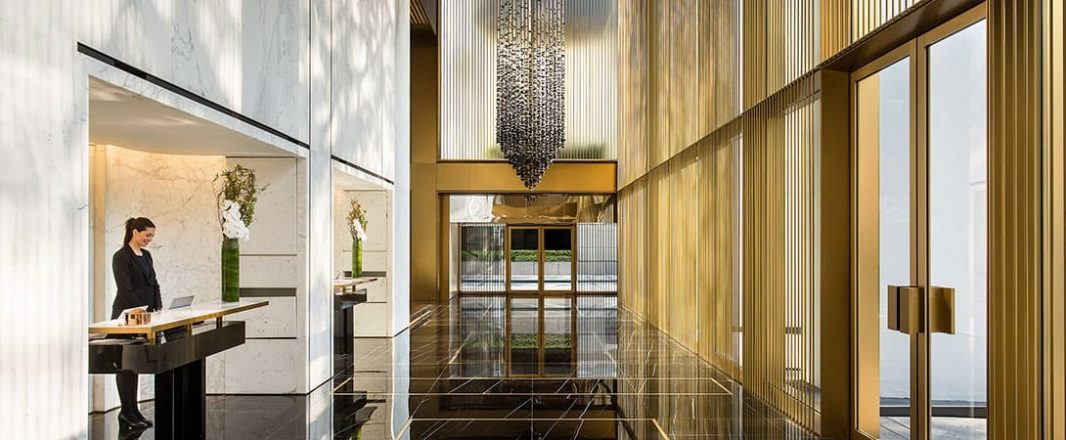
Indeed what I appreciated about The Murray was the sense of quiet you got when you walk into the hotel from the hustle and bustle of the city. The design lines are simple and clean, there’s not a lot of clutter in the lobby and public spaces, no cute and quirky design piece you have to gawp at and take an Instagram immediately because your social media instincts tell you to do so.
“We kept the key features – the original driveway and ramp goes underneath the arches. Event spaces have been maintained. We’re getting a lot of queries for car launches – where else in central Hong Kong can you have a space that can accommodate 20-30 cars for exhibitions?” said Palmer.
Where else too in Hong Kong will you be able to have a European restaurant and bar on the rooftop where you will have a 360-degree view of the city and watch the cockatoos in flight? Popinjays, the finale of the soft-opening, will open in early July and I have no doubt it will be a hit with the city’s residents.
Palmer confesses he’s addicted to taking on iconic hotels and repositioning them. “I like to evolve hotels and take them to the next stage,” he said. He also opened the Langham London and worked with the group for 11 years. While there, he worked on the conversion of an office building to a hotel in Chicago.
“That has some relevance to this project,” he said. “It’s not an easy thing to organize. The key lesson is architectural and space planning, you need to work ahead, surround yourself with like-minded people and you have to influence the owner so that the end product from consumer usability is good.
“It’s like having a sort of blank canvas each time – you need a high degree of honesty and let people speak their minds. Our mission is to give Hong Kong a unique hotel – to translate the architectural straight lines into the interior of the hotel. In the reception, we have removed barriers between customers and colleagues – all the equipment is on the side.”
As for food & beverage, Palmer noted, “In Asia, all the major cities have come up with gastronomic offerings and hotels have been influenced by free standing restaurants. Fashion, retails and materials have also changed things.
“The important thing in running a luxury hotel is you must be careful not to overdo it with iconic bars and restaurants so that you are not over-run by the local market and guests still feel like it’s their private residence.”
Asked how he intended to keep this balance with the opening of Popinjays, which is bound to attract local custom, he said the intention is also to make the hotel interesting and iconic with locals but there’ll always be a place for residents.
Asked how he felt about the trend towards making hotels more communal, he said, “That’s fine but you need a balance.”
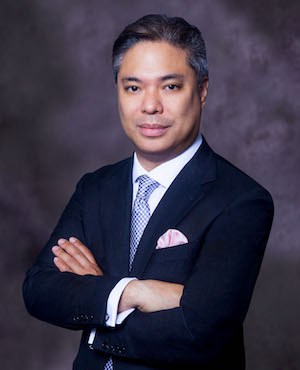
Anton Kilayko: “We will offer experiences that are relevant, understanding the background of our customers.”
The concept of luxury travel has changed too, he said. “People want private arrival and departures, engagement with colleagues and Niccolo insiders to make the stay more engaging.”
As such, the hotel is working on providing content for its guests – be it information about the city, stylised maps around specific interests or through The Niccolo Lectures. “Recently, we had a guest, a woman from Colombia who’s a stylist of Michelle Obama’s cookbook and she gave a lecture in food styling to our residents,” said Anton Kilayko, brand director. “We will offer experiences that are relevant, understanding the background of our customers.”
Kilayko said it won’t be using any of the concierge apps. “There needs to be a balance between the physical and digital world. There’s a certain degree of comfort to holding something physical, that’s written and stylized well. Not everything needs to be digital – we will use tech where it makes most sense to attract both types of clients, the millennials and the older generation of guests.”
Added Palmer, “Tech should assist the guest experience, not complicate and confuse.”
The room experience was indeed private and comfortable. And for someone who has to sleep in complete darkness, The Murray has the best blackout curtains I’ve ever experienced, so much so that they warn you to leave some light on before you touch that button.
Timing-wise, The Murray could not have picked a better time. The Hong Kong market has picked up and as the first new luxury hotel to open in this part of the island in several years, Palmer said, “We expect to be established by the last quarter of this year.”
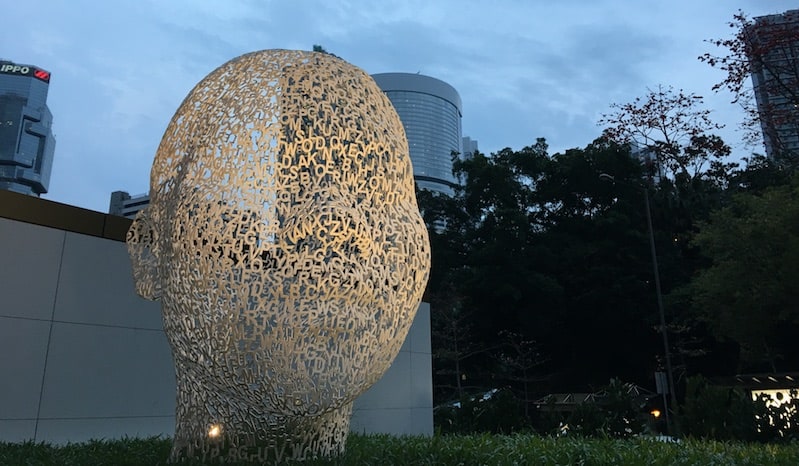
Courtyard of The Murray: Is this what Luxury 2.0 feels like?
As I left the hotel, I found myself wondering, is this what Luxury 2.0 feels like? In my world of tech overload, I felt like it had lessened my psychic load. Walking through the parks each day made me feel close to nature, walking into a space that’s clean and simple without all sorts of stuff on the walls for me to look at made me more relaxed and sleeping in total darkness, especially in a city of blinding lights, made me dream of flying birds, not dollar bills.
• Images credit: The Murray & Yeoh Siew Hoon