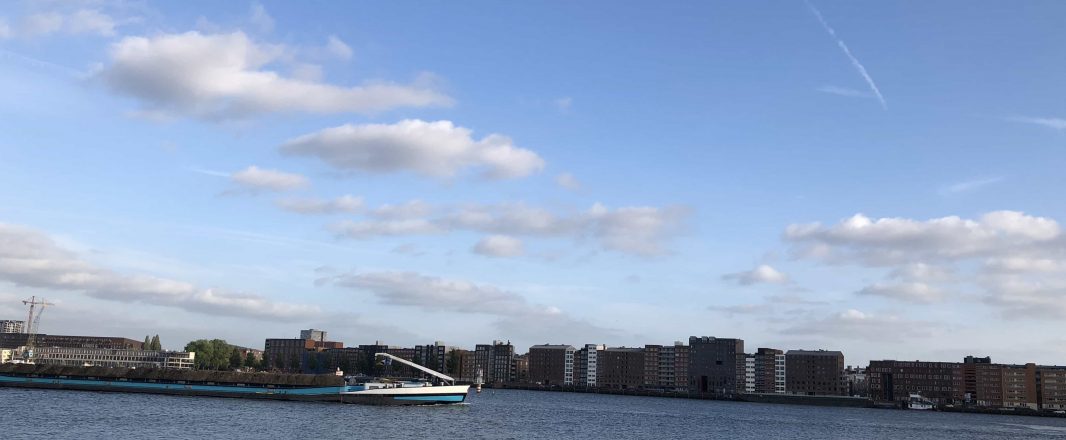
The promise of summer is in the air as I walk through the streets of Amsterdam. The smells from both the canals and coffee shops waft through the air as I stroll aimlessly in a city made for walking and cycling, although these days, bicycles seem to have taken over.
I find crossing the streets in Amsterdam has become even more intense than in Ho Chi Minh City. In the Vietnamese city, you know the rules – just go and everyone will avoid you. Here, they seem determined to mow you down, because they feel they have the right of way.
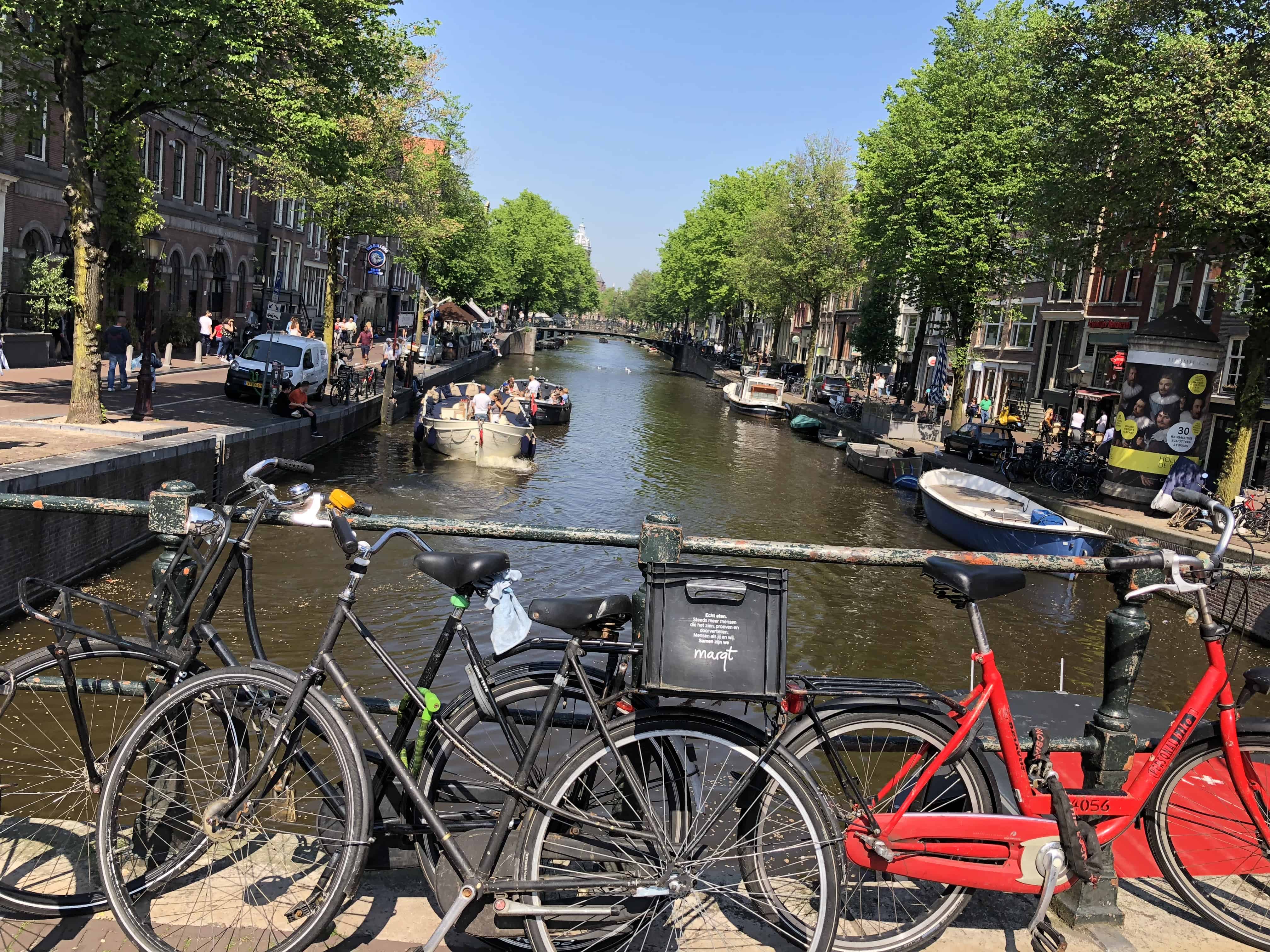
Amsterdam: A city teeming with tourists and bicycles that locals are asking for more controls.
The city is teeming with tourists. Like the 18 million who visit it every year and contribute 2.8 billion Euros to its economy (according to a study commissioned by the municipality of Amsterdam last year), I love Amsterdam – its canals, cobbled streets, houseboats, museums, and its air of liberalism and tolerance both heady and novel to us coming from more authoritarian environs in Asia.
I am not sure its inhabitants love us equally. At a dinner at Hotel de Goudfazant (which is not a hotel but a restaurant housed in a huge warehouse), I struck up a conversation with a waiter, who was curious to know where I was from and what business I was in.
He pointed to a nearby table and said, “That’s a group from Booking.com. They bring in a lot of tourists and now they are also offering private apartments like Airbnb.” I found him incredibly well-informed about the industry.
“There are some people who don’t like all these tourists staying in private homes and our city officials are doing something about it,” he told me. “I don’t mind but many people do.”
I wonder what he would have thought if he had sat through the sessions at Phocuswright Europe and learned what I learnt
1. Private accommodation: It’s only just beginningg
One, we’re only at the tip of the iceberg as far as private accommodation is concerned. Olivier Gremillon, who was headhunted from Airbnb to head Booking.com’s new Homes division, spoke of the company’s intentions to grow this division.
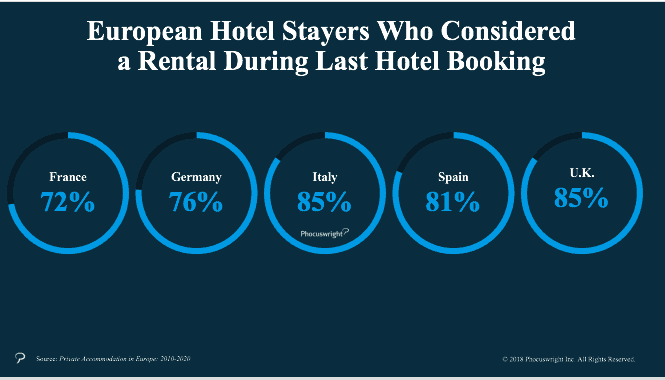
Of its 28m listings, five million are in this private/alternative accommodation segment, 1m more than Airbnb. According to Phocuswright data, vacation rentals account for 28% of Europe’s accommodation market in 2017 and consumers in Europe love rentals (chart below).
2. Scale: Infinity War
Two, the big are getting bigger and the combined forces of consolidation and competition could well squash smaller, independent companies.
In Europe, the big two – Expedia and Booking – command 64% of the online travel market, less than their combined 95% share in the US, but still that’s a big chunk.
Then there’s Google whose vice president product management Richard Holden kept repeating the word “comprehensiveness” and “speed” when asked about where Google was going with its travel products. Flight search has gone from 36 markets to 72 and will reach 75 by year end. It has 98% of flight coverage in Europe.
Listening to him go through the menu of Google products in travel – flights, hotels, Trips, Book on Google, not to mention its maps and digital assistant which underpins everything, the movie, “Avengers: Infinity War” kept coming to mind in which Thanos’ quest is to secure all six stones – space, reality, power, mind, time and soul – so that he can control the universe. I wonder which last stone Google will secure before it controls travel.
There is some backlash to its growing power – it’s been slapped with 2.42 billion Euro fine by the EC for breaching EU antitrust regulations – but that’s a small dent for a company that earned US$109.65 billion in revenues last year.
Incidentally, Google has an Area 120 programme – Holden likened it to an internal incubator – where teams of engineers work away at their own ideas which are not connected at all to the mainstream business. Does “District 9″ come to your mind?
3. Data, privacy and all that hush hush stuff
Interestingly, the upcoming GDPR regulations, which will come into play in the EU on May 25, did not factor much in on-stage debates probably because no one really knows how that will play out.
It’s like blockchain, you know it’s there but you wonder if it’s a Damocles sword in the making or just a benign presence we will have to learn to live with and pray it doesn’t come and bite us in the posterior if we leave it well alone.
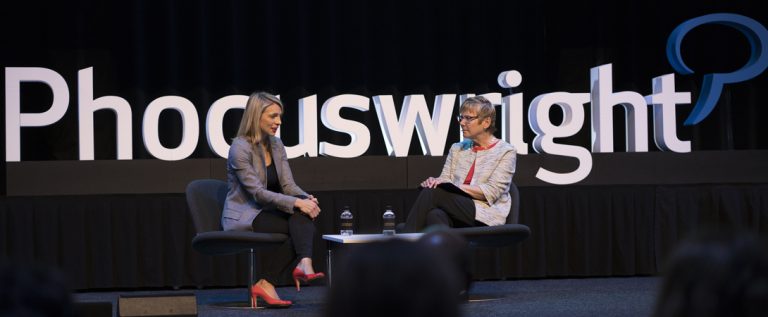
Maud Bailly: “People will also choose us because we respect their privacy and protect their data.”
Maud Bailly, chief digital officer of AccorHotels, mentioned it briefly in her opening conversation when she said the hotel group, which has gone from 12 to 26 brands in its quest for scale, has had a chief data protection officer working behind the scenes for the last year.
Privacy rules are being re-designed, educational sessions are being held. “It’s a huge world of preparation – questions like, how do we share data between hotels? But we also believe that it will become a criteria for choosing a brand – people will also choose us because we respect their privacy and protect their data.”
AccorHotels is working on “augmented hospitality”, she said, with a three-pronged approach – acquisitions of new brands, acquisition of tech companies and an enriched offer. “Now you don’t go to Accor to just stay, but enjoy enhanced f&b, co-working, events/concerts and maybe even a luxury train experience.”
Bailly, who used to work with French train network, SNCF, said hotels are like train stations – “full of people, very operational and you serve people”.
Bailly’s comments about data privacy becoming a differentiator made me wonder though if the GDPR could become the very thing that could work against the smaller and independent players which it is ironically trying to protect.
How can startups and smaller businesses afford to hire the army of experts and lawyers needed to ensure compliance with GDPR while to companies like Facebook and Google, which triggered the regulations, it will be but a tiny part of their huge machinery.
4. Global power but where’s the local accountability?
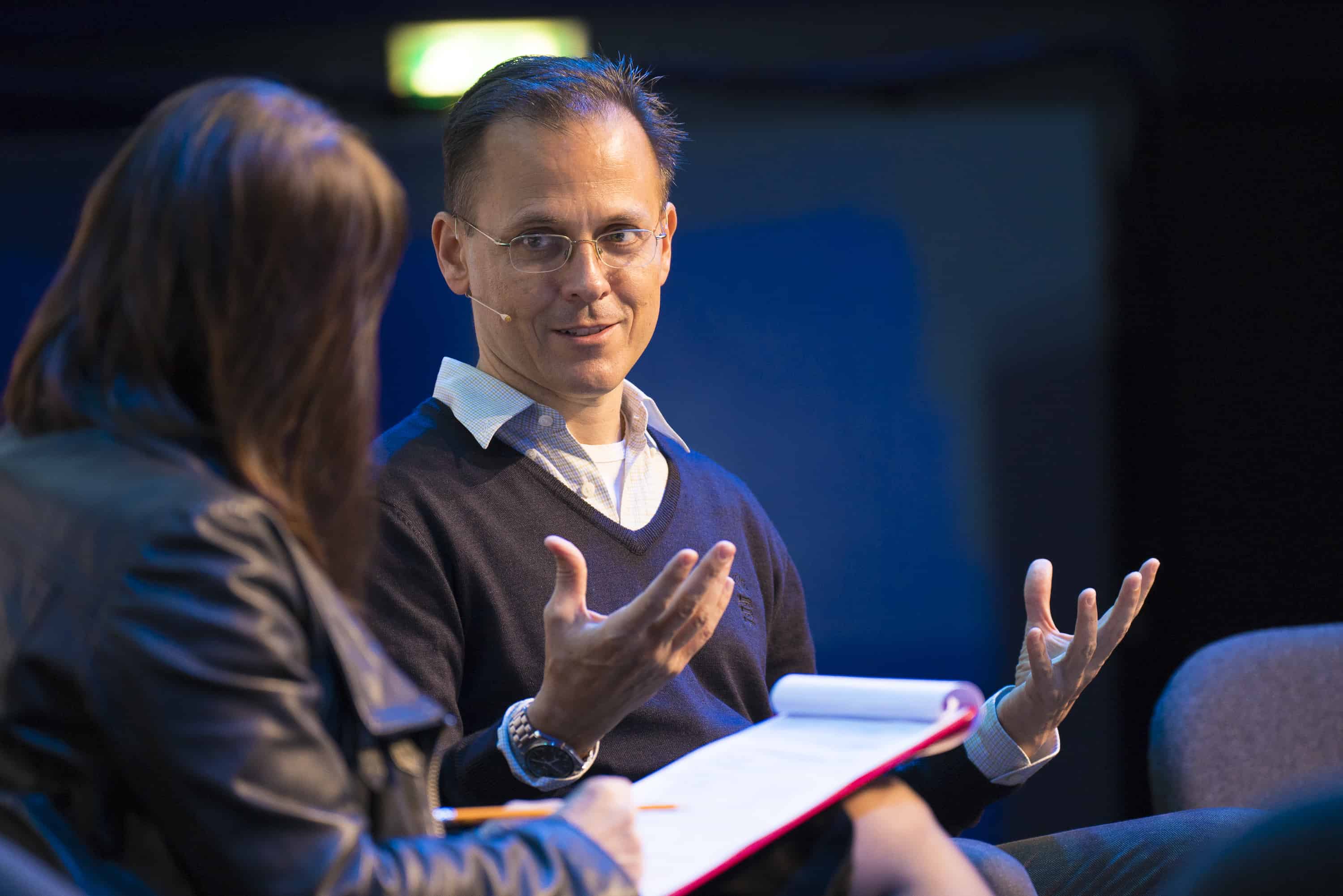
Fritz Demopoulos: Growing tension between globalisation and localisation – global companies should have more local accountability, he believes.
Globalisation is not only happening West to East but East to West and every which way. Fritz Demopoulos, CEO of Hong Kong-based Queen’s Road Capital, addressing the issue of expansion of Chinese brands, spoke about the increasing tension between globalisation and localisation.
Against the backdrop of the Facebook and Cambridge Analytica data scandal, the EU fine on Google, the backlash against Airbnb in cities like Amsterdam and Barcelona, Demopoulous argued that global companies, by their nature, tend to have less local accountability.
And he feels that irrespective of whether it’s American, European or Chinese, all global companies have to be more mindful and responsible to the local communities they operate in.
He argues therefore whether as consumers, we must do more to support local businesses which usually demonstrate a larger sense of responsibility and accountability to their markets.
5. South-east Asia is the new India, hope for a new Malaysia
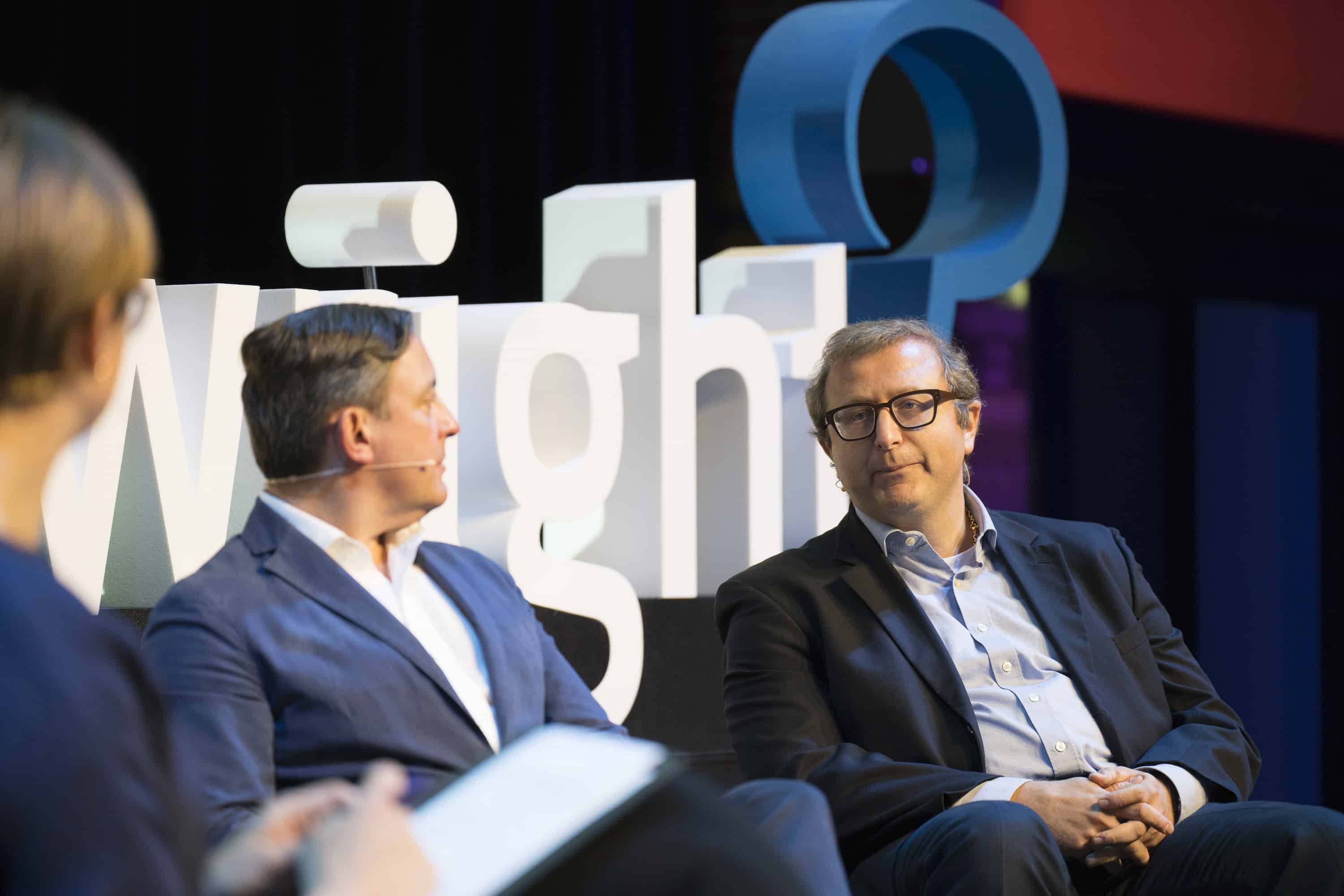
Andrea Traversone (right) picks Malaysia and Vietnam as his two top markets of interest.
China is of course the big prize in Asia and WIT Europe speakers spoke of the exciting innovation going on in this market in areas such as cashless payments, messaging and facial recognition.
Most interesting to me was to hear the word “Malaysia” uttered in the WIT Europe investors panel. It’s been such a long time since my country has been mentioned in investment conferences so when Andrea Traversone of Amadeus Capital Partners singled out Malaysia and Vietnam as two markets he was interested in, my ears pricked up.
Saying “South-east Asia is the new India”, Traversone, who’s invested in a fashion e-commerce play in Malaysia, said for Malaysia, it was about product-market fit for this market of savvy middle class consumers which is “somewhere between Singapore and India”, while for Vietnam, it’s about “the amazing scale with a huge population of expatriates”.
Rod Cuthbert, chairman of Rome2rio, in the panel on “Lessons From Asia”, brought up the recent change in government in Malaysia as new reason to hope for Malaysia to rise again as one of ASEAN’s economic powerhouses.
Travestone, meanwhile, singled out digital hotel franchises as models he was interested in, citing companies such as OYO and Treebo in India and RedDoorz in Singapore.
6. Lessons From Asia
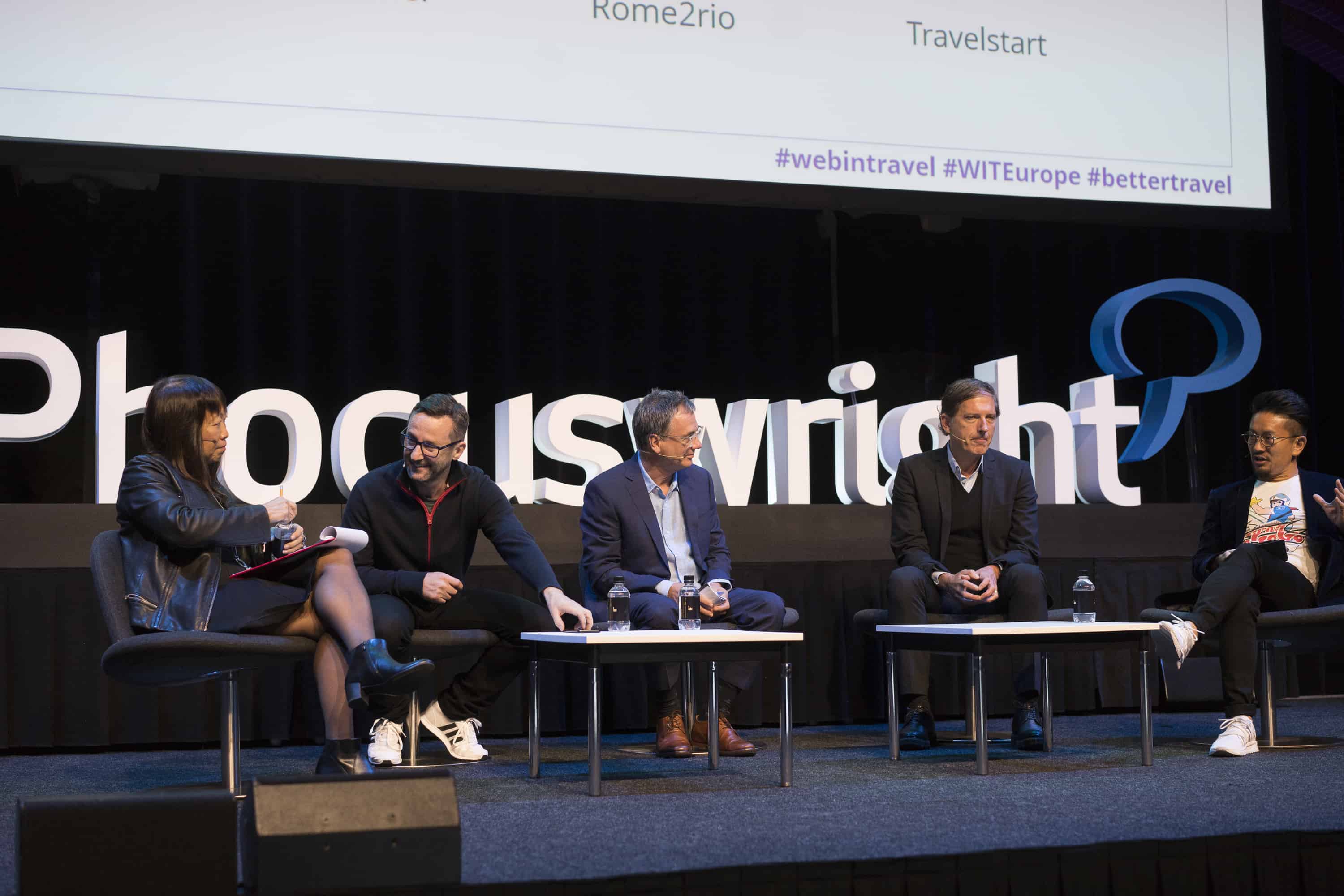
Sharing lessons from Asia and emerging markets are, from left, Bobby Healy, CarTrawler, Rod Cuthbert, Rome2rio, Stephan Ekbergh, Travelstart and Kei Shibata, Venture Republic.
Talk about Asia being the market of opportunity is not new but most foreign companies still struggle to get the right dynamics between product/market fit, process (execution) and harvest, said Demopoulos.
Kei Shibata, CEO of Venture Republic, said local autonomy was important which means hiring local teams while Bobby Healy, CTO of CarTrawler, believes you need local investors and commitment. His company has done well in South Korea but has not succeeded in China, he admitted.
Stephan Ekbergh, CEO of Travelstart, whose company wants to dominate Africa, sees parallels between Africa and Asia in that consumers in both regions have leapfrogged to mobile and this was influencing all aspects of travel, including payments. His company, which was recently invested in by Travelstart, has also acquired a bed-and-breakfast company called Nightsbridge.
Winning in emerging markets, he believes, takes guts and persistence.
Cuthbert reminded the audience of the size of the rail market in Asia with China and Japan alone carrying 1.2b passengers on high speed rail each year, more than half of the worldwide total of high speed rail passengers.
It’s an opportunity Claire Gilmartin of UK-based Trainline clearly wants to tap. Her company has just signed on Japan Railways and is in beta-testing.
Shibata also shared another number – 1.3 billion “very active users” on WeChat, LINE and Kakao combined, reiterating the fact that these three platforms were very active in travel and hence watch this space.
On the day I departed Amsterdam, I booked an Uber. My driver was a young Turkish man who played Quran verses on his radio, this being the month of Ramadan. He told me he finds it soothing to cope with everyday stresses.
And so I left Amsterdam, somewhat soothed by the thought that this is what a global city should feel like, accepting of local differences and diverse traditions. I hope its doors remain open and welcoming for tourism.