Hospitality faces its fair share of challenges when it comes to recruiting fresh blood and retaining promising talent. With changing demands from a modern-day workforce, how can a traditional industry like hospitality keep up with modern expectations?
Brendan Toomey, Vice President, Human Resources APAC, for Hilton International, shares the latest initiatives the group has undertaken to earn its reputation as Asia’s Best Multi National Workplace in 2018 by Great Place to Work.
Tools to build resilience and boost wellbeing
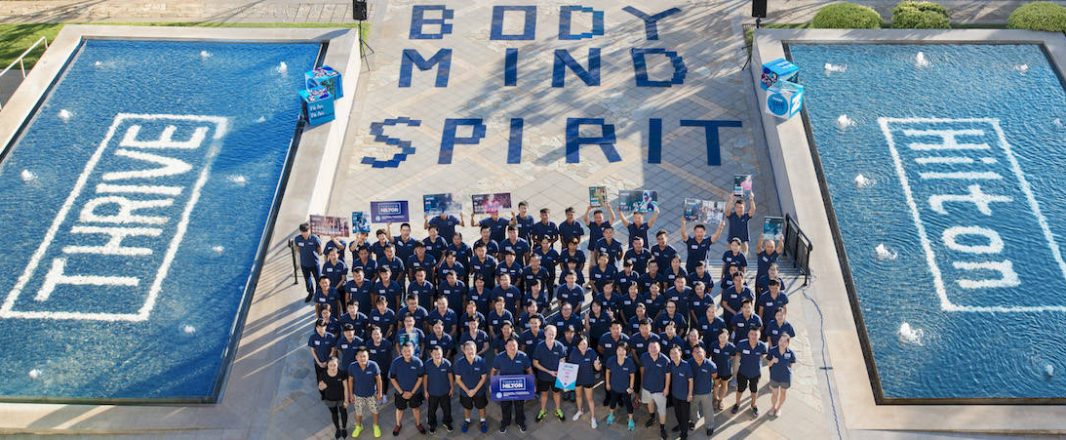
One of its latest developments is Thrive@Hilton, a programme to help Hilton’s ‘team members’ or staff feel more “resilient, focused and optimistic” about their role in the company.
The programme was developed in partnership with Thrive Global which, founded by Arianna Huffington, offers science-based solutions to reduce stress, and improve wellbeing and performance within organisations.
“It’s all about helping team members to flourish in mind, body and spirit. In each of those three pillars, there are specific areas of focus. In the ‘Body’ piece, it’s all about the health and wellbeing, our environment; our food has to be nutritious,” said Toomey.
“We’re giving team members ‘micro steps’ that help them manage their work and life stresses in daily life. We live in an environment where we’re always on, always connected… the point of Thrive@Hilton is to give team members a toolkit that helps them think about healthy living and balancing work and life.”
Changing perceptions of hospitality jobs and helping staff remain relevant
 Hilton is also working to undo the negative stigma that has clung to the hip of the hospitality for a long time, positioning it as a dynamic industry instead of an archaic one.
“There is a stigma attached to our industry… long hours, late nights, shift work. We are solving the problem by educating hotel schools and parents, connecting and advising them on the vast array of opportunities that exist in our business,” said Toomey.
It is pushing the message that job roles in hospitality are changing all the time, as technology begins to automate various basic services in a hotel.
“We still spend time with our trainees to work across multiple departments… they understand the mechanics and fundamentals of how the business operates. But equally they need to understand the whole commercial side – the e-commerce, the sales, marketing, revenue management.”
In the “Mind” pillar, Hilton focuses on lifelong learning – helping people understand what opportunities exist the industry and what avenues they can take to advance their career.
One such initiative – Elevate, Engage, Excel – is a combination of three programmes developed to suit every stage of a typical career span.
“It’s not just about online tools but career conversations where our team leaders can talk to them about their futures and how they can achieve their goals.”
Keeping younger talent engaged and motivated
For younger ones, it’s all about being in “the golden age of travel”. Younger employees express a strong desire to be exposed to different cultures and spend time in different countries. For that, Hilton developed an 18-month management programme for future leaders to gain work experience in a different country, every six months.
However, it also needed to differentiate between younger recruits who are a lot more conscious about their career progression versus mid-career professionals who are perhaps less pressed to think about their next step in the way that they used to.
“We actually create projects that are very different from what they do day to day that are outside their comfort zone… it’s almost like an innovation lab, letting people of different ages to contribute differently.”
Toomey highlighted Hilton’s F&B Masters competition where staff from across different properties compete and showcase their passion for food and beverage.
He recounted a story of an employee working in human resources in China who never let go of her dream of working in F&B, but felt inhibited by her parents’ disapproval. After emerging as the winner of Hilton’s F&B Masters competition in all of greater China, she used it as a way to prove to her parents that it was something she was truly good at.
“If it wasn’t for the F&B Masters, that talent doesn’t bubble up and we don’t get to otherwise see it or recognise it… its elevating their opportunity for these team members to showcase their skills,” said Toomey.
Taking concrete steps to increase female workforce
One of the biggest challenges in recruitment, says Toomey, is about hiring female talent, particularly in countries where female work participation rates are much lower. Hilton has found itself needing to make more conscious effort to recruit women in India, Sri Lanka and Maldives.
“We try to open hotels with much higher percentages of women than the national average. We aimed to hire 35% [at a new hotel property in India], which we ended up doing but it was a concerted effort.”
Depending on what type of role, it generally aims to maintain a 50:50 balance of men and women. “We want to make sure we are putting forward a variety of voices that make such a brilliant workforce.”
However, much of this effort must come from the top down, with corporate leaders needing to assess their own hiring practices and how it can affect balance within the workplace.
Toomey admits that while in APAC, the male-to-female ratio is targeted at 50:50 there is a drop off in female employees as you go up the career ladder.
“We now incentivise our corporate leaders to think about the way they hire in a much more diverse way than they did five years ago. Three to four years ago, we only had a very small number of female GMs running our hotel. Now, we have about 30-40 and our year-on-year growth is at about 67%, off a small base, but it’s growing.”
Developing a gamified “digital community ecosystem” for giving back
Thrive@Hilton’s third pillar, ‘Spirit’, is about ‘giving back’ to both the team and the greater community.
Toomey stated that Hilton is working with a third party to build a ‘recognition app’ that will be used to foster a “digital community ecosystem” that connects staff with each other and simplifies the ability to send messages.
“By providing ‘on the spot recognition’ for efforts in service, it is hoped workers will feel more appreciated at work, day in and day out. It’s about making sure team members are acknowledged for what they do on the same day.”
Through this, staff can earn points they can use to redeem rewards from an online store. It incentivises positive behaviour and indirectly boosts retention rates through gamification.
Mobilising local workforces in rural communities
Hilton also works with local governments to train people from rural communities with hospitality skills that would qualify them to work for the hotel company.
Toomey outlined how Hilton funded and collaborated with the Myanmar government to develop The Hilton Vocational Training Center at Hilton Nay Pyi Taw, which trains locals who could then go on to staff Hilton properties within the country.
Currently in its third year, the two-year course offers participants English-language coaching, and they are paid a stipend during training. Up to 90% of its participants go on to obtain jobs within Hilton.
“It’s about creating jobs and connecting with the community, making sure money goes back into those communities. If I think about how we make a difference in the world, this type of initiative shows how, as a business, you can really affect the whole lifecycle of a community.”