
I know it sounds like I am starved for recognition but it always gives me a small buzz when I hand over my Malaysian passport to the immigration officer at Incheon, Seoul and the little machine in front of her greets me in my native language – definitely warmer than the welcomes you get from humans at most airports.
In an age when they are talking about kissing on the Internet, even having sex with robots and how marriages with robots could be legalized before 2050, any form of human intimacy established through robotics now should be viewed as the harbingers of change that they are.
And if there’s one country that epitomises change in hyperdrive, it’s South Korea.
I arrived in Seoul a couple of days before the Trump-Kim Summit was due to be held in Singapore, realising that if there’s one place that has the most at stake from any outcome of the talks, this is it.
It’s been more than 70 years since the two Koreas were divided. Imagine the possibilities if reunification ever happened – not that anyone is holding their breath for it to happen anytime soon, and the outcome of the summit seems rather vague other than a lot of photos and selfies, but still, it doesn’t stop South Koreans from hoping and speculating what could happen.
At the North Asia LCC (Low Cost Carrier) Summit in Seoul, organised by CAPA (Centre For Aviation), local aviation leaders acknowledged it would be good for tourism and, of course, re-building peace and understanding between the two nations.

Eastar Jet’s Jong Gu Choi (second from left) believes North Korea will open its skies first before its land borders in the event of any reunification.The incumbent low cost carriers in South Korea feel six is already too many and are bracing themselves for more new entrants.
Jong Gu Choi, CEO of Eastar Jet, who travelled to Pyongyang in 2015, said, “North Korea will open its skies before its land. If that happens, it means that instead of taking 55 minutes to fly to Pyongyang via the West Sea, it would take 20 minutes over the DMZ (Demilitarised Zone). It will also open the Russian and Chinese markets as well.”
It also means a bigger, combined market of approximately 80 million (South’s 53m and North’s 26m) for the hyper growth that’s coming on the low cost carrier front.
Since 2005, when the first low cost carrier was launched, there are now six airlines and passengers flown have grown from 40m in 2005 to 100m a year last year. And five new low cost airlines are pending regulatory approval, among them Air Daegu, Air Phillip and Premia Air, which plans to be the country’s first dedicated low cost longhaul by 2020.
Already the incumbents feel that six is too many and are bracing for the increased competition, including “stealing pilots from each other”.
South Korea’s oldest low cost carrier T’way has also announced its vision of flying long haul routes by 2020 and to achieve two trillion won in sales as well as 25m passengers by 2025. “The short haul market is saturated,” said Hyung Yi Kim, executive vice president. “Our goal is to become a company that can go beyond Asia to North America, Europe and South America by 2025.”

Premair Air’s Jong Chui Kim wants to offer “premium long haul service at low cost”. Fund raising has begun for the new airline set to take flight by 2020.
Meantime, Premia Air, whose mission is to offer “premier (long haul) service at low cost”, has started fund raising from private equity and institutional investors.
CEO Dr Jong Chui Kim, known for his track record in turning Jejuair around, said it would start with three aircraft (either B787 or A320Neo) and fly within the 6-10 hour range. It will offer two classes and its economy would offer a 35-inch pitch. “Korea travellers who want to travel more than 5 hours emphasise comfort over price,” said Dr Kim.
The prospects are promising, he said. “In 2016, 22m Koreans travelled and only 13% flew more than five hours. In 2017, 17m Japanese travelled abroad and 44% of those flew more than five hours. Korea’s per capita GDP is reaching USD30,000 and that’s the point economists say travel will grow exponentially, and so that demand is about to explode.
“With the right product and right service, the market should grow.”
Jinair was the first LCC in South Korea to go longhaul, flying to Honolulu and Cairns. Premia’s intention is to also fly similar, high density routes but be careful about picking the airports it flies to. Within Korea, there are 19 airports and the government plans to develop Gimpo airport into a global hub.
It is clear the next battle in low cost in North Asia is going to be in the long haul sector. Japan Airlines has announced plans to set up a subsidiary by 2020 and while details weren’t that forthcoming with its name still under wraps, Hiroyuki Uehara, VP Strategy Development for JAL, said, it would be in the range of the 777s. It is also in talks with American Airlines with which JAL has a partnership to determine the implications of this new venture.
He said JAL would take lessons from other airlines which have set up low cost subsidiaries such as Qantas (Jetstar), Singapore Airlines (Scoot) and ANA (PEACH). He hinted it’d take on a collaborator, possibly an IT company, not another airline, for a small stake.
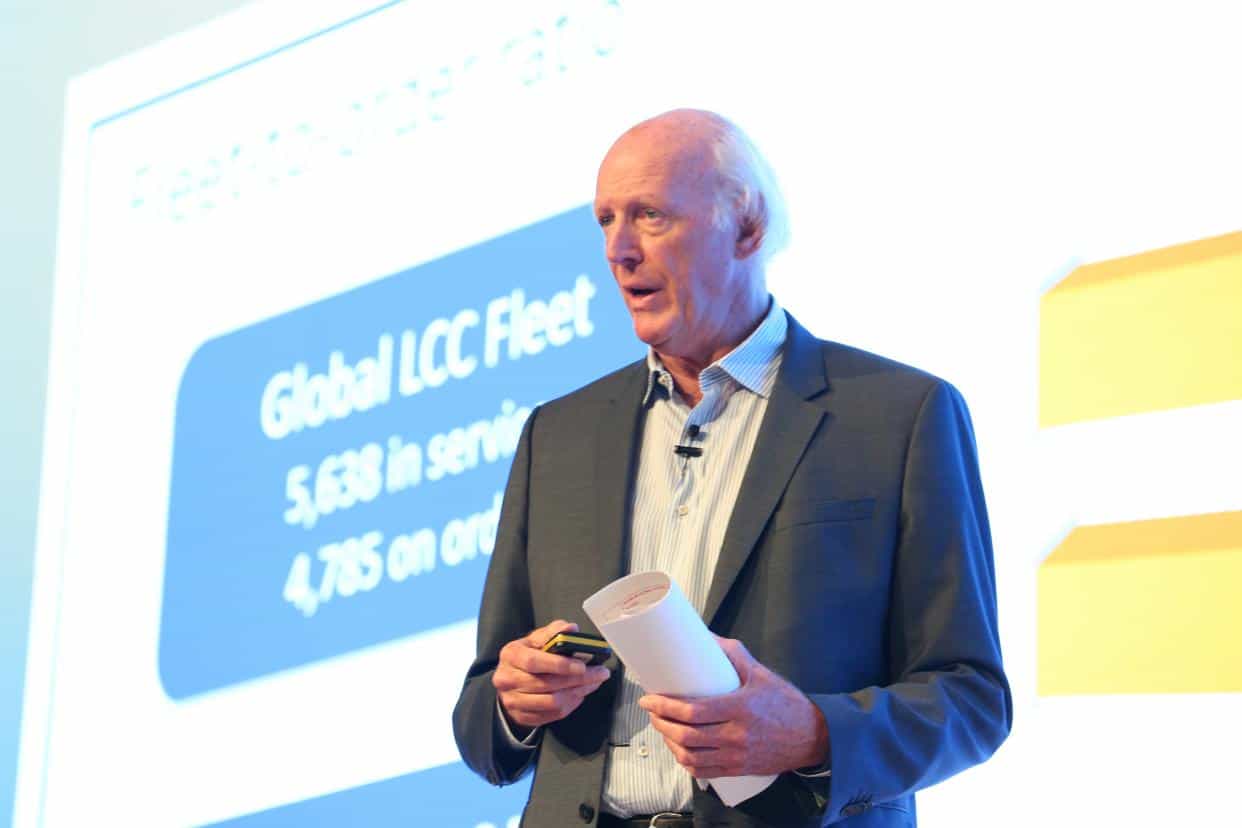
Peter Harbison: It’s really starting now, low cost activity in North Asia. Expect competition, consolidation and exits.
Peter Harbison, executive chairman of CAPA, said that while the North Asia low cost carrier market had a slower start than in South-east Asia, it’s “now really starting”.
Indeed, the entire sector is on fire across APAC, with the region accounting for 50% of the world’s LCC aircraft orders, and 60% of the 112 LCCs in the world. “We will see fierce competition, high growth and consolidation or exits,” predicted the aviation veteran.
With new technology making it possible to fly long haul with lower unit costs, new city pairs are being created and the number of city pairs has doubled in 20 years, exceeding 20,000 for the first time in 2017, according to CAPA.
The key question of course is the price of oil and if it will rise beyond a point when it reduces the cost advantage of low cost carriers, said Harbison. Calling 2017 “a fairytale year in oil prices”, he said rising oil prices will start to benefit full service carriers, comparing Qantas’ 7.25 cents per ASK with AirAsia’s 3.06 cents – which means then full service carriers, facing their own set of challenges, will be better equipped to snuff out their low cost competitors.
All this is of course good news for digital travel players – low cost carriers have always been at the leading edge of distribution and technology and the increased activity will mean more disruption in how consumers plan and book their travel.
So ladies and gentlemen, fasten your seatbelts. While the airlines fight it out in the skies, we, the travellers, are set for what promises to be another golden era in low cost travel.
• Featured image credit: SPmemory/iStock-Getty Images