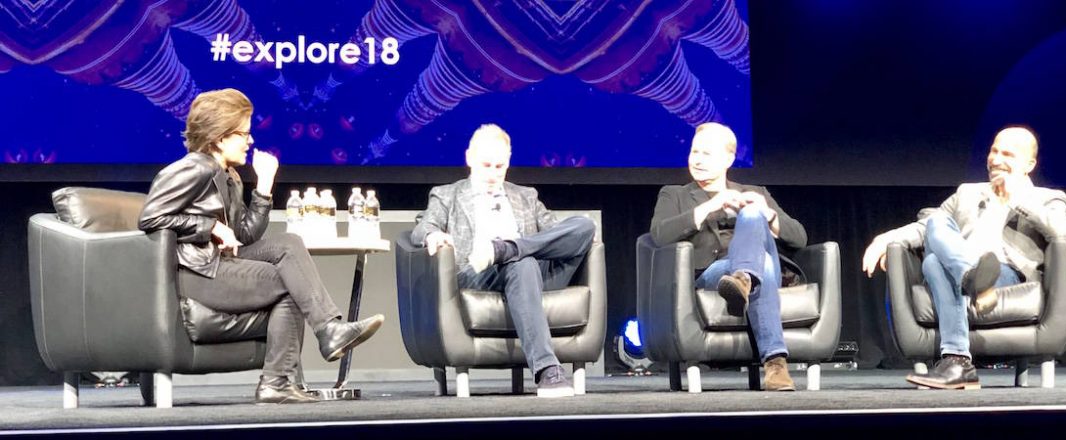
Never has so much power been in the hands of so few over so many. As such, there’s a need for more governance and for tech giants to take their responsibilities seriously. Yeoh Siew Hoon reports from Explore 18, Las Vegas, where tech giants like Amazon, Uber and Expedia Group were interviewed by Recode founder, Kara Swisher.
If there is one thing 2018 will be remembered for, it will be a reminder of how technology has created monopolies, how tech giants now rule our world and how vulnerable society and humanity has become to their goings-on. Never has so much power been in the hands of so few over so many.
As such, it was inevitable that the conversation on stage at Explore 18 between tech journalist Kara Swisher and tech CEOs, Andy Jassy, Amazon Web Services, Dara Khosrowshahi, Uber and Mark Okerstrom, Expedia Group centred around their responsibility to society.
Swisher, co-founder of Recode, said that in the age of AI, “it is very important to have this conversation because everything that can be digitised will be”.
As she spoke, Marriott was having to deal with the fallout of its data breach affecting 500 million customers, Facebook was embroiled in the UK over the Cambridge Analytica data scandal and the media was filled with news of the arrest in Canada of Huawei’s CFO. No one specifically addressed the arrest of Meng Wanzhou but everyone naturally stressed the issue of data security.
Jassy said, “For any company that has data, security is paramount. We spent the first half dozen years on security and for the last four to five years, security has been our biggest seller. We have more people working on security than anyone else.”
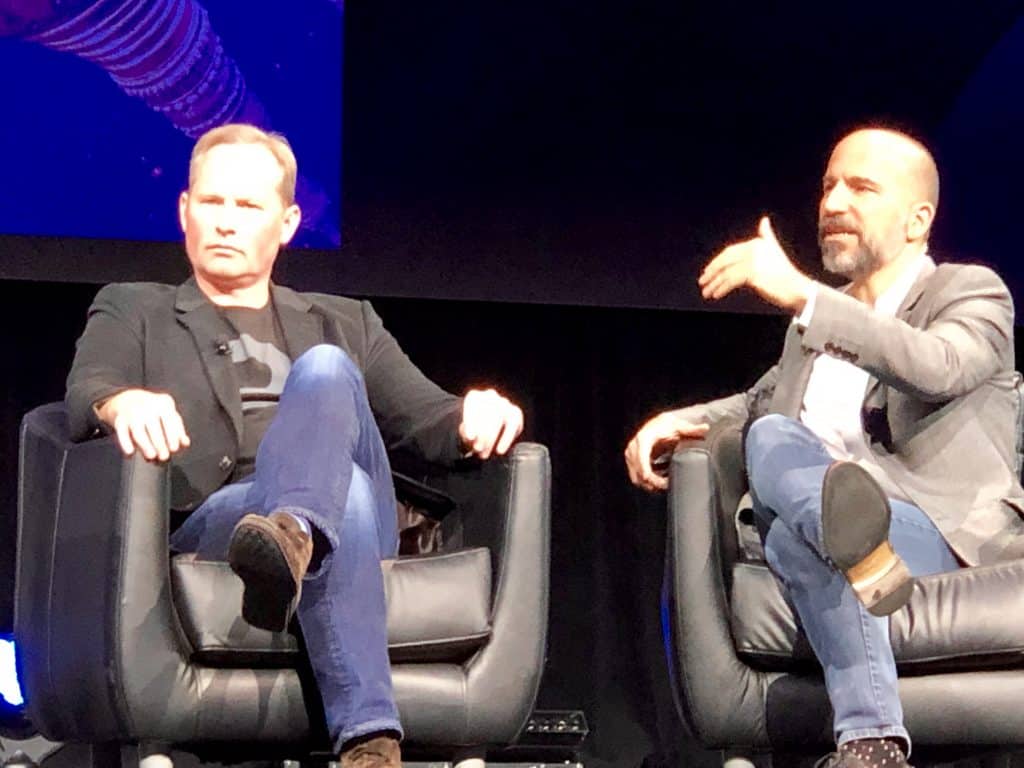
with his successor at Expedia Group, Mark Okerstrom, who believes “big tech needs big leaders.”
As big as the AWS business has grown – $27b revenue with 46%;growth year on year, Jassy said, “We are at the relative start of the business in the US. Over the long term, in 10-20 years, very few companies will own their data sets – all will move to the cloud.”
Security is only one side of the multi-sided coin of tech though; there’s also good corporate behaviour.
Khosrowshahi, who stepped into Uber in August 2017 and had to do a massive job cleaning up the scandal-plagued startup, said, “We are technologists, we are not editors. The position that tech took was, we built this platform, and we can’t take control or responsibility – that was at the time appropriate, based on a bunch of engineers working on it.
“But as platforms became more powerful and allowed for the scope of good people being good and bad people being evil, they realised the damage that could be done is so broad. Now tech understands, it is now our responsibility and we have to lean in.
“For us, safety is our top priority, so we got to it. The point is, tech is playing catch-up at a sport we weren’t good at.”
Okerstorm said, “Big tech needs big leaders. A lot of problems Facebook is seeing and that you (Khosrowshahi) walked into are incredibly complex and you need great leaders. We have to see more of that and that these platforms get corporate governance.”
Jassy said it starts with hiring the right builders. “If you have the right type of people, you will know that launch is the starting line, not the finish. We try to build a leadership team of builders who listen carefully to what customers want and to look at what’s wrong before they go wrong.”
In that sense, you have to build the right customer feedback loops to see what’s happening on the platform and deal with the problem rather than “let the ditch get deeper”.
Khosrowshahi said one challenge was the pressure in the tech world for growth. “The pressure the markets put on you, if you miss by 1 or 2%, you get crushed.”
Admitting it was a tough task to “be slower and more careful”, he said, “Never let a good crisis go to waste. I didn’t have to come in and convince people that things had to change. Everyone knew it had to change.”

Swisher asked whether it was time for founders of tech giants to leave, and let the grown-ups take over?
Okerstrom said, “If we have great products, we are going to do just fine. We have a chairman that takes the long view. He controls the company, that’s a great gift.”
Jassy said, “In the last 21 years, we have always had fans and critics. We learnt early on that whatever people say, it doesn’t impact what we do for customers. What matters is the right customer experience and we spend 99.9% of our time on customers.”
When asked who he considered the bigger competitor, Google or Booking Holdings, Okerstrom picked the former. “They are doing things that make their products look more like us, we cannot ignore that.”
Chipping in, Khosrowshahi said, “The opportunity for innovation comes when new platforms are born.”
Referring to Google, he said, it takes every profit dollar out of the data and the companies who show at the top are those like Expedia. That makes it hard for startups.
He said that usually it’s the smaller players who recognise opportunities and move in. Uber recognised it with mobile and AWS recognised it with data and cloud, and that powers are coalescing as platforms mature.
Asked how they stayed on top of their game, Jassy said “tolerance of failure” and for Uber, it’s measurement of output which is revenues.
Okerstrom believes in “distributed innovation” – to create “autonomous groups that do stuff”.
Citing Alibaba, he said, “That’s taking distributed innovation into an ecosystem” and described it as a “huge superpower that has created innovation for the little guy”.
On the future, Khosrowshahi spoke of introducing Uber’s bus service in Cairo – micro buses for 15 passengers. “We have to radically change transportation and save cities from congestion.”
It’s been a tough year for self-driving at Uber – an Uber self-drive car crashed and claimed a victim in May – but “we want to get back on the road. We have rebuilt systems from the ground up, but we haven’t tested it in the real world yet.”
“That’s taking distributed innovation into an ecosystem” and as a “huge superpower that has created innovation for the little guy.” – Mark Okerstrom citing Alibaba.
Okerstrom said there were more opportunities to personalise and that AI will take travel to the next level. He hoped to have Expedia Group play a bigger role in global governance around alternative accommodation. “Regulation tends to be behind and tends to favour the status quo.”
On regulation, Khosrowshahi said, “While the intent is positive and necessary, our experience with regulation is awkward looking vs forward looking. Regulators should be looking at the space but they need to be careful. If they protect the status quo, that affects innovation.”
The last word goes to Expedia Group’s chairman Barry Diller, who believes tech giants are handling their problems as well as they can. “Money is rolling in and you need to get slapped in the face before you do something about it. They will be huge revenue generators for the future. Wise regulation is a good idea, it will happen. When and how, I don’t know, and I am not sure we should be worried about it – if it’s backward looking or not.”
Quoting Jeff Bezos, founder of Amazon, Diller said, “If you are a large company, invite attention, invite criticism. Do not be defensive. You deserve to be investigate, queried, criticized. Most of the troubles people get into comes from being defensive.”
Featured image: Recode’s Kara Swisher with from left, Andy Jassy, Amazon Web Services, Mark Okerstrom, Expedia Group and Dara Khosrowshahi, Uber.