Consumer confidence needs to be boosted, not broken, during fragile, early stage of recovery
As destinations restart their domestic tourism engines, it is critical that governments agree on health and safety protocols, and that travel brands deliver on their promise around the new procedures, so as not to confuse the customer and lose their trust in the early, fragile stages of recovery.
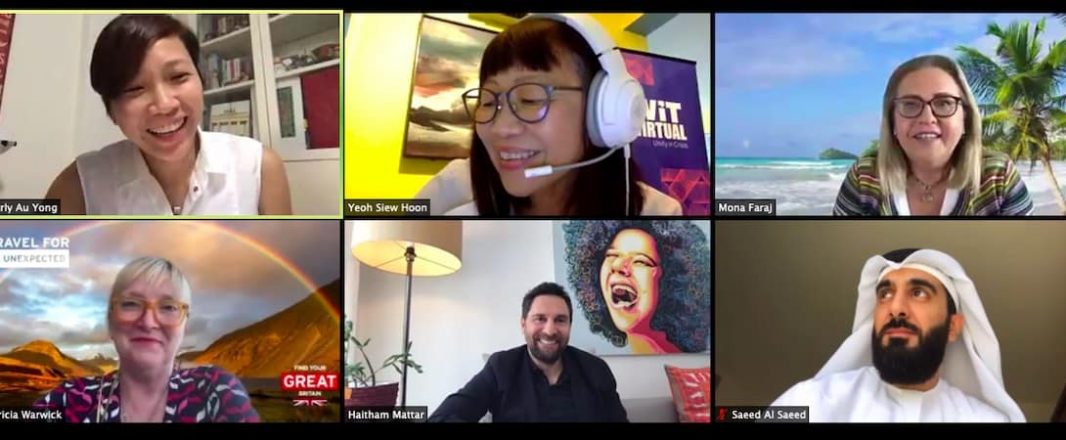
That was one of the key messages that came out of the WiT Virtual Middle East: Destinations In The Spotlight panel which featured four tourism boards (Saudi Arabia, Britain, Singapore, Abu Dhabi) and how they were restarting their domestic tourism industries.

Haitham Mattar said it was important governments ensured strict implementation of health and safety protocols.
In its “Life after the pandemic” survey, Insight Out Consultancy ME noted that 51% of respondents said they were confident to travel but with caution and Haitham Mattar, senior advisor to the Ministry of Tourism of Saudi Arabia, said that it was really important that governments ensured strict implementation of the protocols around physical distancing and sanitisation across all travel touchpoints.
Commenting on potential stumbling blocks to recovery, Mona Faraj, managing director of Insight Out, said it was important the industry wins back consumer confidence. Referring to an article that went viral in the UAE about a guest experience in a hotel, “he clearly reflected the misalignment between the brand promise and what was actually being implemented”.
She added, “Yes, there are plenty of great marketing messages out there. But we just need to ensure that it’s being really implemented on the ground, or else whatever confidence is being built from a consumer front” will be lost.
Wego’s search intent shows customers searching for options for June and July
The fact that panelists were actually speaking about restarting was certainly a positive in the evolution of this crisis that has decimated tourism globally.
Data trends shared by Mamoun Hmedan, managing director of Wego, showed a common development across markets in the region – consumers poking their heads up to search for travel options for June and July, but not much activity for after. “Since the beginning of May, we’re starting to see some travel intent and search activities happening. The majority of these people are shopping around trying to figure out travel options around June and July, but we’re not seeing any travel search towards August.”

He said in Saudi Arabia, where the impact had been severe with stoppage of domestic flights and religious travel, people are starting to search for domestic flights in June, “especially after the announcement from Saudi airlines to restore or re-open flights domestically”.
As for Dubai, “there is a big expectation that July is going to be a big month especially with Dubai saying that they’re going to slightly re-open for inbound for international travellers to come in”.
Qatar is another bright spot. Said Hmedan, “Qatar Airways didn’t stop flying completely. They maintained their 30-40 destinations over time and they kept 30% of their total fleet in the sky. Now they have made an announcement that they’re going to take it up to 52 destinations by the end of this month and 80 destinations by end of June.”
Saudi Arabia plans launch of summer programme, Visit Britain works on “Ring of Confidence”
To prepare for the restart of domestic tourism, the Saudi Arabia government is working on initiatives to “introduce Saudi to the Saudis”. Mattar noted that, with 34 million population and fewer opportunities to travel abroad, this was a great opportunity to create products for the local market.

Visit Britain is planning to launch a “Ring of Confidence” campaign, said Tricia Warwick.
“The team from the Ministry of Tourism has been really proactive in initiating discussions with the Ministry of Health, Ministry of Transport and all the relevant ministries in order for us to come together on one platform and put out a holistic promotional plan for the summer.” One highlight is around road trips, for example, the Red Sea Route as well as fly-drive holidays.
In 2019, travel and tourism in Saudi Arabia grew by 14% to make up 9.4% of total economy, creating 1.5m jobs (11.2% of total employment). Domestic tourism spending totalled $17b in 2018, out of total tourism contribution to GDP of $65.21b.
Visit Britain is planning to launch a “Ring of Confidence” campaign (a working title) for its local tourism and meet and fuck locals in uk industry and is looking at a possible July 4 timeline to kick off its domestic tourism campaign, said Tricia Warwick, director Asia Pacific, Middle East and Africa (APMEA).
In 2019, tourism contributed £127b to the economy, representing 9% of GDP, and supporting 3.1m jobs. Of this, domestic tourism accounts for a big chunk – in 2019, British residents took 99.1 million overnight trips (for all purposes) in England, totalling an expenditure of £19.4 billion, with an average trip length of three nights. Inbound visits totaled 38.9m, a three percent growth on 2018, while inbound tourism spending totaled £25.5b, up 11% year on year.
The news that visitors from Ireland will not be subject to quarantine has been welcomed, although there is uncertainty now over requirements for visitors from France. Initial reports had suggested visitors from France be exempt, but subsequent reports have cast doubt on this development.
Nevertheless, Warwick said, it now has to work out “exactly how we tell people what is available and what’s open” and to be careful about “staying close to the social distancing principles”.

Beverly Au Yong: Right now, we are trying to engage the consumers in new ways.
“There’s going to be a lot of information and preparation that the travel industry is going to help us disseminate about the best way to go about your trip,” she said.
Beverly Au Yong, area director (Middle East), International Group, Singapore Tourism Board, admitted this as one of the biggest challenges facing the city state, which received 19.1m arrivals (+3.3%) in 2019 and tourism receipts totaled S$27.7m (+2.8%), representing 4% of GDP.
“Right now, we are trying to engage the consumers in new ways. Generally speaking, Singaporeans, as a whole, we do like our vacations. We do like to get away from our very tiny apartments whenever we can.”
Saeed Rashed Al Saeed, marketing director, Department of Culture and Tourism, Abu Dhabi, noted, “We are definitely looking at the domestic market as a stepping stone towards recovery. A lot of the businesses that are part of the ecosystem have been suffering for the past two months.”
Abu Dhabi welcomed an estimated 11.35 million international visitors in 2019, inclusive of overnight and same-day visitors, and the industry earned 5.8 billion AED, up 6.6% over 2018.

Saeed Rashed Al Saeed: Looking at domestic market for recovery.
He said international travel restrictions were not within the control of tourism boards but what it can do is “prepare ourselves and our hotels to be ready to accept people who have been stuck in between four walls for the longest time”.
“I anticipate that we have a resilient enough economy that not too many people have been affected so adversely to the point that they cannot no longer afford a staycation at least once or twice in the coming six months.”
On Faraj’s part, she said she’d love to see the routes between UAE and Saudi Arabia opening up. “We know very well that in the UAE, the domestic market is not sufficient to cover all the supply that is out there, especially if all hotels decide to all open up in July or August.”
More marketing dollars to reactivate tourism, digital and educational messaging to lead the way
The good news is, the four tourism board panellists said they’d be investing more marketing dollars to restart tourism and messaging would be divided between sharing educational information as well as reinforcing brand marketing. Visit Britain’s Warwick and STB’s Au Yong expected the majority of funding would go towards “telling you it’s safe, secure and open for business” and “establishing trust and confidence”.
Mattar noted, “If I think of a country like Saudi, which is relatively unknown when it comes to tourism, I think I’d be really more bullish and go 90% on education, but making sure that the education doesn’t not only resonate with health and safety, although that’d be the biggest component, but also education around experiences and the culture and the major changes in the country.”
Most of the budgets would also skew towards digital media because of the reach and ROI measurements, although Warwick said if she had the budget (we proposed an imaginary $100 million), she’d also want “big noise and cut through” and that means outdoor and television “because we never have enough money to do that. So if you give me $100 million, I’ll be off doing that, but with a big percentage skewed to digital.”
Warwick also said this was a good time for tourism boards to experiment, referring to the Live from Australia weekend, in which Tourism Australia organised a line-up of virtual experiences “from underwater experiences to backyard BBQs”.
“When I see what Tourism Australia gets up to, generally speaking, they’re pretty forward thinking in their marketing and their approach. I think everything’s worth trying, I think this is the era to trial things.”
Just as with all markets around the world, the Middle East has also seen a huge migration of consumers online and the panellists were asked if any new marketing channels had caught their attention during this period. Mattar said with Saudi being one of the highest video consuming nations in the world, videos as well as gamification would be one direction forward for the Ministry of Tourism.
STB’s Au Yong said influencers would play an even more critical role “in telling people, hey, this is a good place, this is a safe place, this is a fun thing to do” while Abu Dhabi’s Al-Saeed said he was looking more at micro-influencers – “not just those with millions of followers but people that actually resonate more with the smaller audiences that they have”.

Mona Faraj: Collaboration between tourism boards to promote regions is a possibility.
Faraj had a different take on influencers, saying she believed “it’s about people like you and me and the message that we can pass about a destination”.
On the issue of collaboration, such as that seen in Hong Kong by the Heritage Tourism Brands Group which launched an “Our Home” video, Faraj said this was certainly a model to be emulated in Dubai. Collaboration between tourism boards to promote regions vs individual destinations as travel picks up is also a possibility, although panellists agreed that may be harder to execute.
Warwick said her team was in talks with eight other tourism boards in Europe to explore the idea of “coalition missions”. “Why don’t we do a mega fan, that takes people to multiple destinations, not just our own, so that we share the love. It’s about getting people back travelling again and back to, in this case, Europe.”
“And now we’re courting British Airways to come with us on this journey, and whoever else who wants to join in.”
In the post-Covid-19 world, panellists agreed that other than cleanliness and nature/beach resort holidays cited by consumers in the “Life After The Pandemic” survey, other factors such as insurance, safety, and contactless solutions would become more important to consumers. “Every destination or hotels that can adopt that sort of technology will probably become first choice,” said Mattar.

• To watch the on-demand video of this WiT Virtual episode, click here.