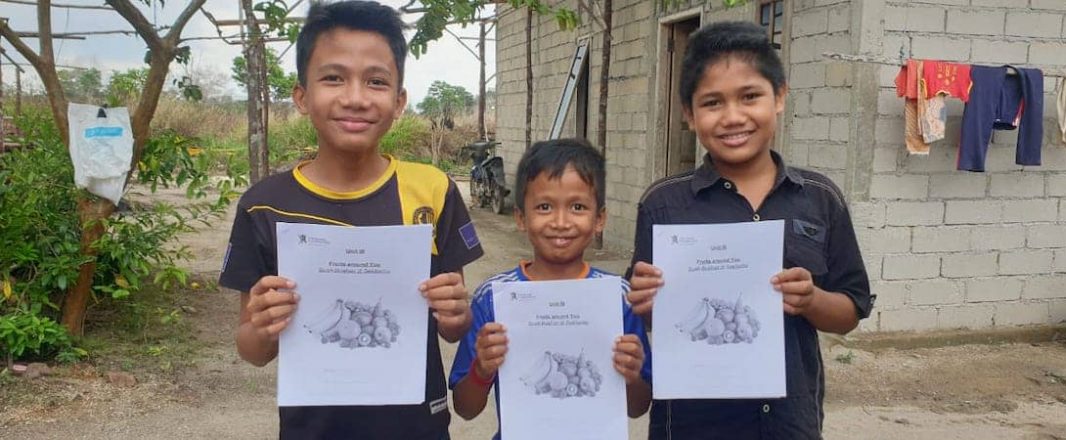
WiT is helping raise funds for The Island Foundation this year. Attendance for its WiT Virtual Summit on June 24 is free and it is asking for contributions to be made towards The Island Foundation through this link.
The Island Foundation (TIF) – a charitable organisation focused on developing sustainable education initiatives in Indonesia’s Riau archipelago – has found itself extending its role beyond education and literacy to curb the pandemic’s impact on small island communities.
Courtney Saville, executive director, The Island Foundation said it was quick to react in the initial phase of Covid-19. “There was not a lot of awareness or interventions happening locally so we really stepped up into that place and provided a lot of that support.”
TIF developed a series of posters to raise awareness, set up simple handwashing stations and ran tutorials on hygiene. “When things started to look a bit uncertain… [and] once lockdowns made us step back, local communities stepped up,” said Saville. She explained that many began producing their own handwashing stations within local communities, to keep efforts to curb the virus going.
The initiatives also had the added effect of bolstering TIF’s reputation amongst these small island communities, encouraging more students to enrol in its education programme. “Families are seeing what support we’re giving to those [working] with us already.”
However, TIF’s education programme has faced new challenges during the pandemic. It’s learning centres have been closed and shifting to new methods like online learning are simply not practical because of unreliable phone signal and the steep cost of internet. It renders these small island communities particularly vulnerable, as they are part of the invisible poor, said Saville.
So, in light of the pandemic, TIF developed hardcopy ‘learning packs’ for students to complete at home, in following with the same themes. Meanwhile, TIF’s local teachers are “doing a lot of their own online learning…that [is] really setting us up to revise our programme for what it’s going to look like when schools do reopen,” said Saville.
“This is a time for us to really regroup, take a look at our programme and iron out some of the kinks that are there or enhance it in other ways and really try to start pushing to grow our impact.”

TIF’s continued efforts throughout the crisis serve to protect communities that are particularly vulnerable to the shocks created by the coronavirus.
“The Riau islands [is] one of the highest performing in terms of economic output provinces in Indonesia. However, you do have a lot of poverty… [many are in] in informal employment, therefore they’re susceptible to economic shocks like the coronavirus.
“Small island communities are notoriously excluded from development programmes and often overlooked in national and provincial data…[these] people found in areas of high economic activity don’t have access to that economic progress and therefore they are left behind.”
“When tourism started to close down in the islands, a lot of people lost their jobs but then the flow-on affects fishing to palm oil production, and daily workers who don’t have that job security. So in a lot of ways, they’re trapped in a cycle of poverty because the national systems and programmes often don’t take into consideration the needs of small island communities because their populations are so small.”
More than ever, the pandemic exposes the cycle of poverty that continues to harm small island communities in areas like Riau, Indonesia. “Because education outcomes are low, their job opportunities are also limited and that also links onto environmental degradation… it’s a cycle that’s self-perpetuating” said Saville. Roughly a quarter of students do not reach national reading standards and two thirds do not reach national mathematics standards. Indonesia is also a poor performer globally in education.
TIF is continuing to find new ways to break that cycle through its education programme, despite current circumstances. Before Covid-19 took its grip, TIF ran eight learning centres (currently closed) across Riau, led by approximately 1100 trained local teachers (and six of its own), which supports over 2500 students between the ages of six and 12.
TIF’s curriculum was developed by education consultants and based around themes of sustainability and caring for the environment, so it would be more strongly linked to students’ local context, rather than just the national curriculum taught in schools.
All of these efforts feed into TIF’s broader sustainability mission – striking the balance between preserving the natural environment, supporting health and education, and increasing economic security and opportunity. With children being its primary beneficiary, the hope is that by raising awareness of the importance of protecting the environment through sustainable practices, it will create a positive cycle that will carry into the future.

That being said, Saville emphasised that closing the education gap transcends TIF’s community efforts and while it runs complementary to national policy and reform, broader change is necessary. She commended the Indonesian government for its national education initiatives, but said it is still “a slow moving beast”.
“The key is that you have to have multiple stakeholders working on these issues…. There needs to be that localised support… to develop education in small island contexts,” explained Saville.
As a non-profit organisation, Covid-19 has naturally also brought on challenges surrounding funding. Fortunately, TIF still has funds to continue its work during the pandemic but it raises questions of how to effectively secure financial support during this time.
Saville pondered the drawbacks of leveraging on Covid-19 or ‘sticking to the programme’ and pushing the foundation’s core message. “We might lose our central message if we just lean into the coronavirus message… previous donors have funded us for this programme, we’re not a disaster organisation.”
Nevertheless, Saville remains optimistic that despite the economic pressure many companies are currently under, there would not be a total drop off in funding and support.
“Corporate giving might drop off because maybe they can’t justify it in their budgets. At the same time, it’s such a small percentage of their budgets for the most part… and there’s a lot of pressure for them to operate sustainably… I don’t think that level of accountability will suddenly be removed… It might solidify it more because this pandemic is highlighting a lot of inequality around the world.”
For those who cannot donate, Saville said simple sharing TIF’s story and ambition is crucial to highlighting the importance of its cause.
WiT is helping raise funds for The Island Foundation this year. Attendance for its Virtual Summit on June 24 is free and it is asking for contributions to be made towards The Island Foundation through this link.