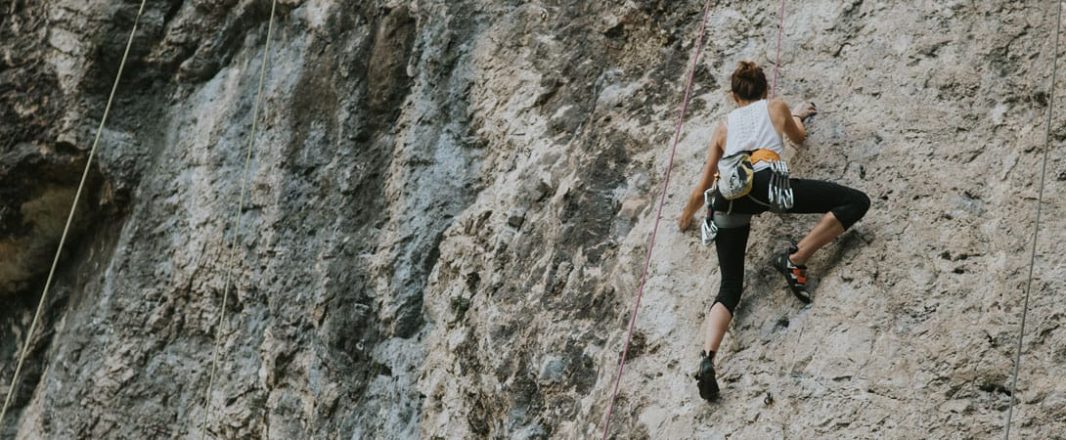
Just before Year 2000 kicked in I had the crazy idea that I wanted to mark the decade’s end on top of South-east Asia’s highest mountain, Mount Kinabalu in Sabah, East Malaysia. I called my best friend, living in Hong Kong at the time, and proposed the idea. Even crazier than I am, she said yes.
We had no idea what we were in for. We went, thinking it was a walk in the park. We were so unprepared – ordinary sports shoes, garden gloves, plastic raincoat, no spare anything – even carried a 1kg cake up the mountain to celebrate. That was all we cared about – the end point, the celebration.
This memory came back to me while we were preparing and planning for our hybrid day of WiT Experience Week. We didn’t know what we were in for, we only cared about the end point, the celebration.
We had gotten the official go-ahead from the Singapore Tourism Board (STB) three weeks prior to October 1 and on September 11, we announced that we would be the first travel pilot hybrid event in Singapore, as well as within the Northstar Travel Group.
There was clearly a lot of pressure to deliver, and an equal amount of anxiety because none of us in our team had ever done it before. We had run WiT Singapore as a physical conference for 15 years, and even though every year is different and the stakes higher there were processes in place, things we knew we could expect and even if the unexpected happened, we knew we could handle them.
This was a completely new world.
We had done virtual events before – 30 since March – and we had experimented with a six-hour virtual event on June 24 which, despite everyone telling us it wouldn’t work, did, in terms of operations and customer feedback. But this was higher stakes – our tentpole event – and in the hybrid world we had to blend a physical world with virtual.
On top of that, we had to follow strict guidelines laid down by the Ministry of Health – no more than 50 delegates, only cohorts of 20 allowed to mingle, contactless registration, social distancing, masks on at all times when seated and speakers can remove masks only on stage.
To deliver, we stitched together a partnership between venue (Marina Bay Sands) and one main tech partner, Global.Signin, to use their tech platform, GEVME, who then brought in two other tech startups, Jublia and Pigeonhole Live, to integrate business matching and interactivity into the platform.
Here are the key learning points.
• Throw out the old rules, start with a blank canvas
We had to throw out the old rule book. At the time of planning around July/August we had discounted the idea of anything physical. What worked physically – a full three-day event – would not translate virtually. So we took out a blank canvas and asked, what about … We flattened it over four days – three hours for the first three days, and six hours for the final day. We reckoned customers could handle that load, as could we.
• Event design is even more important in virtual – creating an experience vs a series of webinars
Once we had decided on the format, we thought of the experience we wanted to deliver. One of the biggest challenges of virtual events is for the customer to feel they are part of a conference experience still and not just attending a series of webinars stitched together. We wanted the customer, from Day 1 to Day 4, to feel connected to the singular theme, to connect the stories unfolding each day so that they are invested in the theme from beginning to end, much like watching a television series.
Our old habit of pinning our events around themes and storyboarding and storytelling came in particularly handy. We storyboarded our theme “Travel Zero.O” around the movie “Back To The Future”.
The “time travel” device allowed us to tie the four episodes together – Rewind, Reboot, Rebuild and Rewrite – and enabled us to connect the past, present and future. We invited our customers to hop onto our “time travel” machine from Episode 1 and join our ride into the future, ending with Episode 4.
Ready to take the four-step shuffle with WiT? from Web in Travel on Vimeo.
• Keep the familiar within the unfamiliar, co-create a lasting memory
In the new, strange world we were navigating it’s important to keep a sense of familiarity – what’s the one thing your customers remember you for? People are longing for emotional connections in a physically disconnected world.
One of WiT’s familiar themes is our annual WiT For Good charity auction in which we raise funds for the betterment of women and children in Asia. Since 2005, we have raised more than US$500,000 in these initiatives and we didn’t want this to be sacrificed at the altar of Covid.
We showed our audience a “Blank Canvas” on Day 1 and we invited them to co-create a piece of art with us, by visualising the future of travel. We asked them to give us words to describe “Travel 2025” and, at the closing of Day 4, we revealed the physical piece of art that was auctioned off for charity.
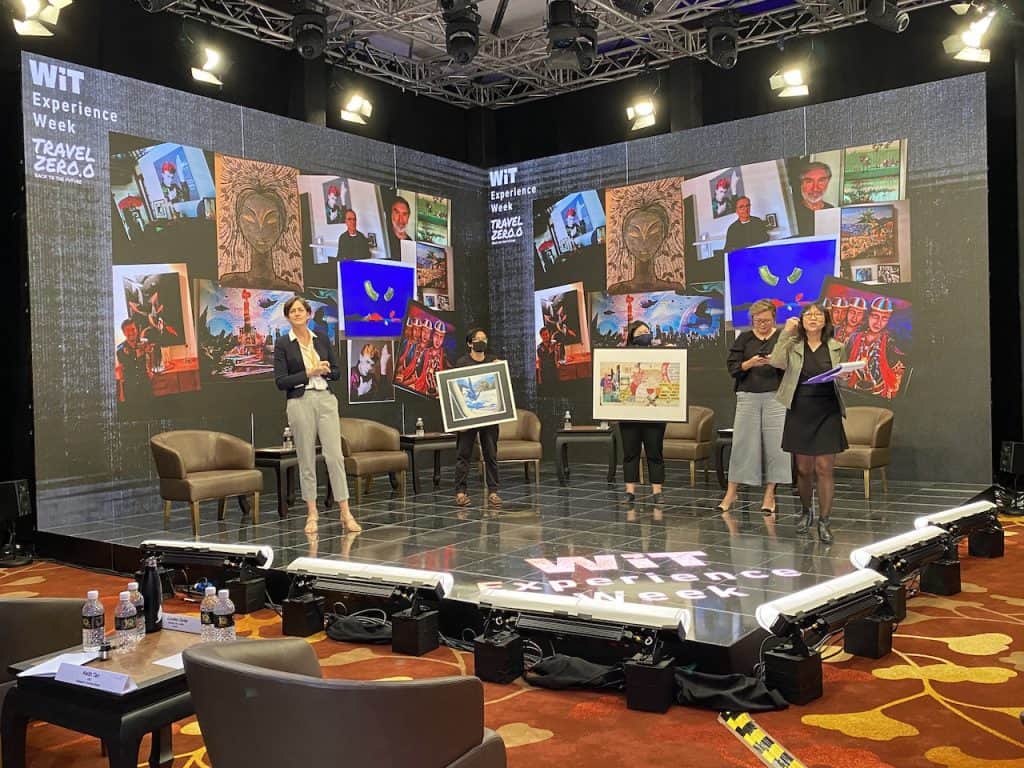
Not only did it create a lasting physical memory of a historic event but it allowed everyone to create something together – symbolising the spirit of collaboration that has been the hallmark of Covid-19. In our post-event survey, this art piece was singled out as a highlight of the event.
• In tech, do not trust; in people, you trust
Expect the tech to fail but make sure your teams working to deliver the tech do not – that they are fully committed towards the same outcome, and will do whatever it takes to achieve that.
This was the toughest bit – putting together the tech platform to deliver on our visualisation. One tip is to start with the experience you want, then work out the tech needed to deliver on it, not the other way round. Technology should empower, not inhibit.
We found a tech partner in GlobalSign.In with its GEVME platform. We sat down with the team to explain what we wanted – content flow, business matching, sponsors’ lounges, interactivity and destination experiences – that it has to feel like a WiT experience. How do we stitch it all together? For business matching and interactivity capabilities, we brought in two other tech startups – Jublia and Pigeonhole LIVE – to integrate with GEVME.
Most techies will tell you this is a recipe for disaster – stitching together a made-for-WiT platform in three weeks. Yes, there was indeed lots of pain – all of us were doing it for the first time – but lots of gain too in the end. There were glitches – we broke the tech on Day 2 – but what was important was, we pushed through and delivered as a team.
What could have been done better? One, don’t try to do too much. We did. Two, don’t over-complicate the agenda. Tech is not bamboo, it does not bend. Three, most important, have that high-level meeting at the very start, involve everyone from all teams – product, tech, operations – so that everyone has their eye on the outcome.
Communication is the difference between life and death. It’s not enough to have the bosses agree that this can be done, every team member must want to do it, and can do it. A strong cool-headed project manager who can communicate across various disciplines is critical. Match that with a team willing to learn and take risks and you can achieve almost anything.
• Piecing together the venue and destination experience
Other than having like-minded partners in tech we needed the right partners to deliver the hybrid event, and Marina Bay Sands’ Hybrid Broadcasting Studio was the perfect fit. MBS had been home to WiT for the last eight years and it felt right, almost sentimental, to return. We hammered out a partnership in record time, and executed in unison on the tech as well as safety protocol under strict guidelines from the STB.
Behind the scenes, three teams worked in tandem – our team overseeing the programme flow, calling the show and lining up speakers; GEVME operating the tech platform, cuing virtual speakers on and handling the streaming; and Marina Bay Sands’ tech crew handling the production and recording.

To deliver the destination experiences we partnered with Klook, which put together two virtual tours. We also partnered with local tour experts – foodie Karni Tomer for her cooking class and XMC Experience for its Feng Shui at Marina Bay Sands tours. To round it off, DJ One With Aldrin hosted a dance party. We wanted to show that you can still experience a destination, plus the destination is what anchors an event in the minds of delegates. It’s what gives WiT identity, and identity is critical in a virtual world.
• One event, one audience
You have to think of the audience as one entity to be engaged with, regardless of platforms. You have to keep thinking of how to connect the virtual audience and the physical audience into one experience. There are many tools within the tech platform – polls, Q&A, chat – to do this, but you need the human touch – some tricks and skills – to bring them together. That you have to learn on the fly.
• The human element – face-to-face still matters, but pack it with meaning
Having been immersed in the virtual world for so many months, I myself was skeptical about the necessity of having a physical event. The responsibility of health and safety also weighed heavily on my team’s mind. We were also unsure of our customers’ appetite for physical interaction – after all, many of us had been working and living under some form of restrictions and how comfortable would they be mingling with others, even if it was only 40 people in controlled environment?
However, when STB offered us the opportunity and assistance to stage a safe event, we didn’t hesitate. As soon as we could work out the economics – which we did through a partnership model – we went for it. As did our partners.
The excitement and emotion of those attending the physical event at Marina Bay Sands was palpable from the start. It was clear people had missed being with people. Finally, they had the physical watering hole to quench their thirst for human interaction. The energy of being on a physical stage in front of physical attendees is uplifting, not draining as it is speaking to a screen.
That day convinced me that physical events will be back in full force, when allowed. You cannot hold back the tide of human desire. But that doesn’t mean we should go back to the bad old ways of doing things. We will emerge into a world where customers have learnt to expect more from us, and we must deliver beyond that.
I look forward to a future of events with less waste, thoughtful content, entertaining storytelling, deeper meaning and higher purpose and, of course, profitability for all who aim to do better.
Final lesson: Back to the hike up Mount Kinabalu – ignorance is bliss. Not knowing what you are in for but having a clear visualisation of the outcome – that celebration with the cake – kept us going. It was a similar visualisation of the outcome – happy customers – that kept my team going on the climb to the top of Hybrid Mountain. Now we laugh at the heart-stopping moments.
• Featured image credit: yasinemir/Getty Images