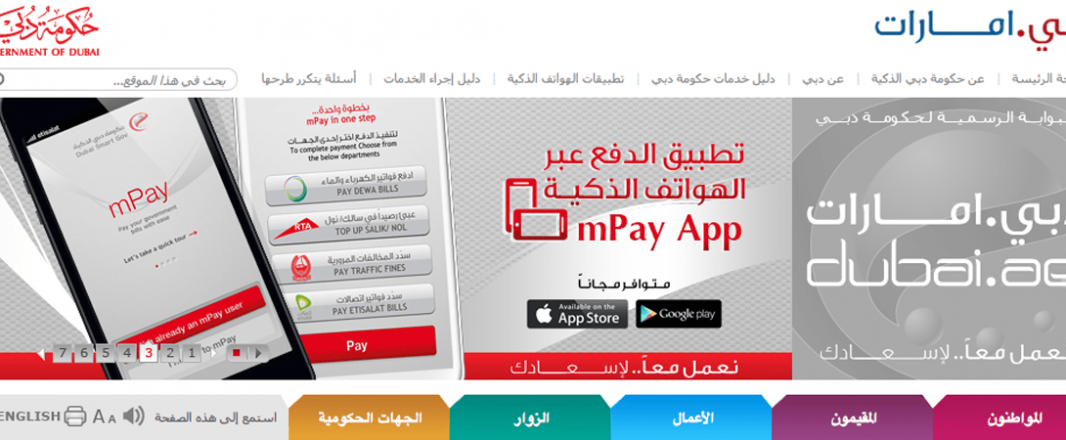
If there was one key message I took away from my three-day visit to Dubai, it’s how huge mobile is and how pervasive mobile adoption and usage is in the region. “Everyone has a smartphone here,” my friend told me, “and we do everything on it.”
And if I was already impressed in Shanghai (where I was the week before) with the prevalence of smartphone adoption in the city, well, Dubai blew me away. Because it is such a compact, high density place, you really feel and see the connectivity everywhere you go.
Even parking tickets are paid via mobile through a phone credit system and it reminds you if you are about to exceed your parking time. How convenient is that? Certainly better than the coupon system still used in Singapore where you have to punch holes in a card and run back to your vehicle because you’ve exceeded your time limit.
My friends tell me that the government is really pushing everyone to use as much mobile as possible for services so that the habit becomes ingrained.
 At Cleartrip, which launched in the Middle East in 2011 and declared a US$10 million investment in the region, Tarique Khatri (left), senior vice president, says that if you remove the Indian domestic business sector, the region’s ahead of India in terms of mobile traction.
Mobile accounts for up to 15% of Cleartrip’s bookings in the Middle East and 25% of searches. And customers seem more confident of booking on mobile than on the website, said Tarique. Having localised payment options helps of course.
“We have customers whose first experience of Cleartrip is with mobile. There’s a certain set of customers on mobile who are more confident about booking online.”
So this leapfrogging to mobile could well overcome the payment issue which continues to hamper e-commerce in the Middle East. “If more consumers move to mobile, it could potentially overcome the payment problem,” said Tarique.
“There is reluctance for people to book online right now, the trust factor is still not there. But this is changing because the government is putting a lot of effort to get the infrastructure in place and we are seeing some aggregators of payment gateways coming up.
“The challenge with payments is that a lot of integration needs to be done and you need to work with two or three payment gateways. This is a challenge for the industry still – there are not enough options to book online.”
At Emirates, the airline is set to launch its new iPad app after the first round of performance testing among its staff, said Sameer Poonja, Manager Solutions Design – Digital (right). 
“We wanted to test it with our staff first and one of the things they really liked about it is the live flights module where you can see at a glance where all the flights are and you can follow every flight down to the tail registration and aircraft type.
“They all thought this was very cool.”
Sameer said Emirates was seeing big uptakes in mobile bookings and currently, about 16-18% of the airline’s business comes through its branded website.
Said Sameer, “Mobile is very exciting – I pay all my bills on mobile for example. We expect that tablets will drive even more bookings because of the user interface.
“There’s also a big trend towards last minute flights. As you know, we have a huge expat population in the Middle East and there’s high demand for last minute flights from say, Doha to Dubai.”
The Emirates iPad app will be launched in March and an Android version will follow.
The “we do everything on mobile” point was drummed home when I was at the Dubai Mall – it must have been going on to 1am and the mall was packed with tourists from neighbouring countries – and I saw a mother with her baby in a pram. There was an iPad attached to the pram’s handle and while the baby was entertained by her personal screen, her mother continued shopping.
Which kind of makes sense really – after all, prams are the ultimate mobile vehicle and someone should design a pram with inbuilt entertainment devices – if they haven’t done so already.
Note: Both Tarique and Sameer will be speaking at WIT Middle East taking place in Dubai on March 26-27. See programmehere.