BUT don’t despair. Connect@Changi launched to revive business travel, Budget to deepen position as global Asia node in startups and deep tech.
I know. It’s shameless, borrowing from the great Ernest Hemingway and his “baby shoes, never used” quote, but I felt rather teary, looking at my stash of vitamins and supplements the other day and wondering which I should keep or kondo.
Melatonin, like the Timeshifter app I bought in 2019, have become relics in my new life of no travel. No more jetlag, just lag.
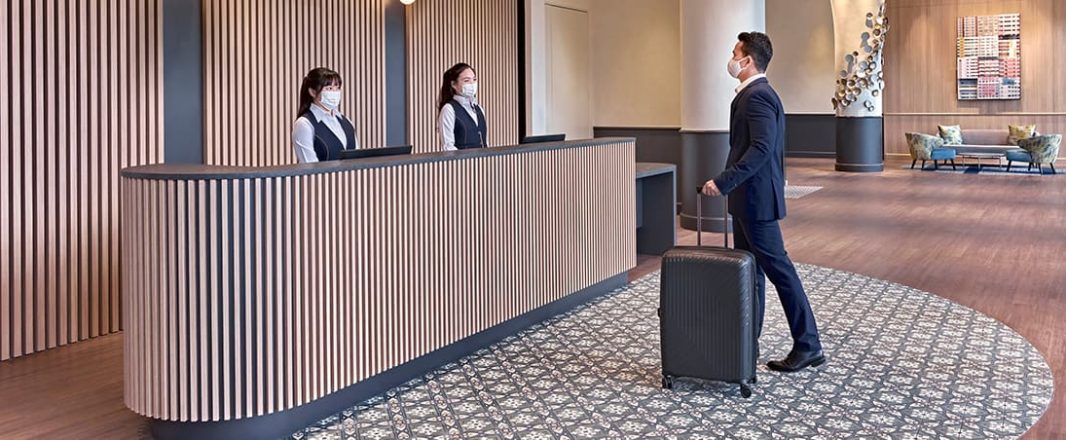
Which is why my heart skipped a beat when I read the news that the Temasek, the Singapore-based investment company, has launched the first phase of Connect@Changi, described as “a pilot short-stay facility designed to support safe in-person exchanges between business travellers and their Singapore-based counterparts despite the Covid-19 pandemic”.
This is good news because it marks another step towards the government’s attempt to reopen Singapore’s borders progressively, and to get business travel moving again in a safe and measured way.
What it has done is repurpose space at Singapore EXPO and MAX Atria, the convention and exhibition facility near the airport, to create guest and meeting rooms to allow business travellers to meet with either Singapore or regional counterparts safely, without impacting the local community.
This week, the first phase of 150 premium guest rooms and 40 meeting rooms of various sizes opened. By May, it will have around 660 guest rooms and 170 meeting rooms and when fully completed later this year, it will have the capacity to host some 1,300 business travellers at any one time.

Basically, travellers test a few times (once on arrival, then on days 3, 7 and 14 as well as prior to departing the facility, depending where they are returning to). They then stay, work and meet within the facility.
Okay, I know it’s not about me getting out but allowing others to come in, but it’s a small baby step in opening up and maybe I can meet some business associates although it’s hard to imagine who’d want to go through all that to stay put in one place – but then again, there are plenty of high net worth individuals who have businesses and financial stakes in Singapore, and business has to go on.
You can also imagine executives wanting to meet with counterparts across the region, using the facility as a meeting point and for larger-scale video conferences and hybrid meetings.
By doing this, Singapore clearly wants to preserve its position as a vital business and economic hub for the region.
On top of that, its national budget unveiled this week includes a slew of initiatives aimed at catalysing the growth of startups and small and medium enterprises (SMEs), as well as support for deep tech.
In announcing the budget, Singapore Finance Minister and Deputy Prime Minister Heng Swee Keat said that Singapore must deepen its position as a global-Asia node to emerge stronger from Covid-19.
Here’s a list of the key initiatives summarised in this e27 article.
• Platforms to spur corporate innovation efforts
The government will invest in three platforms (Corporate Venture Launchpad, Open Innovation Platform and Global Innovation Alliance) to help corporates innovate and collaborate and remain competitive.
• Improved intellectual property laws
The Intellectual Property (IP) Strategy 2030 is being developed to strengthen existing IP laws in Singapore, with more details to be announced on World IP Day in April.
• Increased support for the deeptech sector
500 fellowships will be launched under the National Research Foundation to improve deeptech expertise in areas including cybersecurity, Artificial Intelligence and healthtech.
• Enhanced venture debt programme
To ensure high-growth startups have access to the necessary capital, the venture debt programme will be extended and enhanced – with an increase in the cap on loan quantum support from S$5 million (US$3.8 million) to S$8 million (US$6 million). Under the debt programme, the government also shares up to 70% of the risk on eligible loans with participating financial institutions.
So even as Singapore takes practical steps to save the present with initiatives such as Connect@Changi, it is looking towards the future, and making big bets. It’s this blend of pragmatism and vision that makes this place unmistakably Singapore.
Incidentally, unlike lipstick sales, sales of melatonin skyrocketed in the US in 2020 due to what is termed “Covid-somnia” – according to this report, it jumped more than 40% in 2020, with Nielsen data showing that consumers spent $825,559,397 on melatonin supplements last year, a 42.6% increase compared to 2019.
I wonder what I could get for my stash on eBay?
• Featured image credit (the pilot short-stay facility for international business travellers to stay and conduct meetings): Connect@Changi