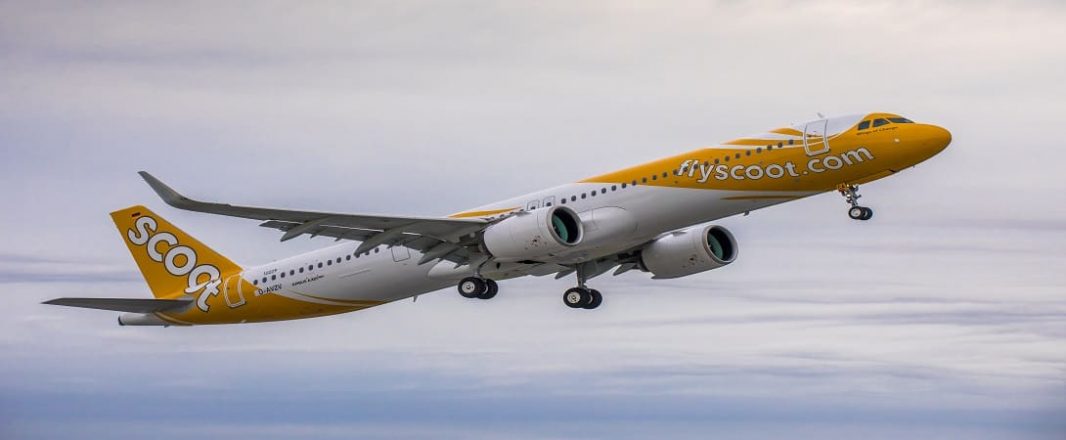
AS it waits in the wings to take off, in anticipation of borders reopening, Singapore low cost carrier Scoot is clearly convinced that its new aircraft, the A321neo, will hit the sweet spot in its flight path to recovery.
On Monday, CEO Campbell Wilson held a virtual media briefing to announce the inaugural flight of the Airbus A321neo to Thailand. Scoot has received three of the 16 A321neo jets that will join its fleet by 2024, part of a 2019 order that was intended to support growth plans before the pandemic upended global aviation.
The A321neo is in a sweet spot somewhere between the current B787 Dreamliners, and the A320neo and A320ceo jets that make up its current fleet. Being smaller than the wide-bodied Dreamliner, the A321neo will give Scoot the option to serve certain routes more frequently thereby better aligning with customer demand and optimising utilisation.
At the same time, it can carry an additional 50 passengers, and has a longer flight time (6H) than the older A320s (4-5H), meaning greater unit cost efficiencies on popular routes, and the possible opening up of “new routes that were not possible before”, said Wilson.
Though he declined to specify any new destinations Scoot had its eye on, he pointed to the possibility of “resum[ing] routes that were previously terminated due to economic feasibility” and did confirm that the new jets will be deployed to Bangkok from June, and to Cebu and Ho Chi Minh City from August.
The commonality of the A321neo with the other Airbuses in Scoot’s fleet allows efficiency gains in terms of engineering and maintenance, and even pilot and cabin crew training. It will also enhance the customer experience with jetlag reducing ambient lighting technology and a quieter cabin with better air quality, and make significant sustainability gains for the airline, both of which are key pillars of Scoot’s strategy to emerge stronger from the Covid-19 crisis.

Referring to the crisis as “a series of separate crises”, Wilson shared some of the measures that were taken in response to the pandemic.
Smoothing over the customer experience was a key priority for Scoot, which it proved by being one of the few airlines that offered cash refunds to customers. It also allows a one-time free date change for new bookings.
To keep revenues flowing, Scoot also made a quick pivot to carrying cargo. Wilson said Scoot was one of the first airlines to start operating cargo charters, and also modified two of its single-aisle aircraft to be able to carry cargo in its cabins thereby optimising carriage.
Asked about other potential pivots, Wilson said that Scoot will stay flexible and agile, but is still part of the larger SIA group, and would prefer to leverage the opportunities of the group rather than duplicate them, citing KrisShop as an example of this strategy.
Scoot has also set itself the highest health and safety standards to be ready for travel in a post-pandemic landscape, being the first LCC in the world to attain the “Diamond” standard in the APEX/SimpliFlying global health safety audit, and the first LCC to operate a flight with fully vaccinated pilots and cabin crew.
When asked to forecast when post pandemic travel might recover, Wilson cited IATA’s 2023 projection, but added the specifics of that recovery remained fluid.

On its part, Wilson says Scoot is in a good place to capitalise on the recovery of travel. For starters, it has kept a larger-than-needed fleet operational, cycling the aircraft into service to keep them “warm” and ready to respond to spikes in demand, which will likely happen as soon as the regulatory environment eases, as it did in Europe and America.
More importantly, Scoot is using the lull to consolidate its position as a world class LCC, with the flight of the A321neo just one prong of this strategy. Scoot has an additional 48 planes on order (7 Dreamliners and 41 Airbuses) as part of its commitment to maintaining a modern, efficient fleet of aircraft.
Scoot has also made significant investments in technology. Pursuing a low-touch, almost contactless customer journey, Scoot is increasing online check-in options to include check-in via app and chatbot and is enroute to having online check-in across its network, with 41 of its 68 destinations already offering it.
Self-service ordering and payments will also be available via ScootHub, from traveller’s mobile phones.
It has also upgraded key infrastructure like an enhanced revenue management system and introduced new distribution tech along with new flight planning and rostering systems that will increase operational efficiencies, while digitising work where possible.
With the implementation of sustainable operations being another key strategic goal, the A321neo also plays a role in Scoot’s commitment, along with the SIA group, to Net Zero carbon emissions by 2050, boasting 22% less fuel burn per seat, 5,000 tonnes less CO2 emissions per year per aircraft, and a 50% reduction in both noise and NOX emissions.
In addition, fleet renewal will bring more fuel-efficient aircraft into operation, digitising in-flight collateral will reduce paper consumption and onboard weight thereby improving fuel productivity, and there will be a transition away from single-use plastic and towards sustainably packaged meals.
Despite the uncertainty surrounding the recovery of air travel, Wilson has confidence in Scoot’s position. The Asia-based leisure-oriented LCC model, is certain to return eventually, says the CEO, and Scoot has used this “downtime” effectively to upgrade, in the hopes that when travel returns, it finds itself perfectly positioned to make the most of it.
• Featured image credit: Scoot