OVERHEARD while walking the dogs this week.
“I am an artist and now I can make my own NFT.”
“So cool ya, can make our own art and sell.”
Curious to find out the source of this exchange, I turned around and saw two young boys – probably no more than 12 years old – striding along, with nary a care in the world.
Ah, to be that young and invincible, and believe that art is your oyster. What I wouldn’t give to be in their Converse shoes again?
That very day, coincidentally, I had gone to two art exhibitions – first, a physical art exhibition featuring the works of the late Michael Ong, organised by art gallery Asian Palette, and second, an NFT art exhibition titled “Tezos NFTs: The New North Star”, organised by a blockchain adoption entity, TZ APAC.

A florist by profession, Michael was also a prolific painter and artist. His extensive works were unearthed by his nieces, Vera and Freda, after his death and were shown at this exhibition. Michael was inspired by nature – flowers, plants, twigs, branches – and he also worked with his hands.
He turned flowers into pieces of art, which decorated weddings of celebrities and royalty. He took old newspapers, folded them, rolled them and pieced them into works of art. He took wood and made stamps out of them, and used them in his paintings. Some of his paintings were multi-textured and layered, that you could stand for hours and marvel at the details. (Watch video of Michael’s story here)
My head filled with nature, I headed to the NFT art exhibition, held as part of Singapore Art Week. At the entrance was a queue of folks not much older than the two boys I had listened in on.
QR code scanned, I walked into the warehouse-turned-art gallery, did a double-take at a physical painting that looked like an overturned bucket of water and headed straight for the bright lights of the NFT showroom.

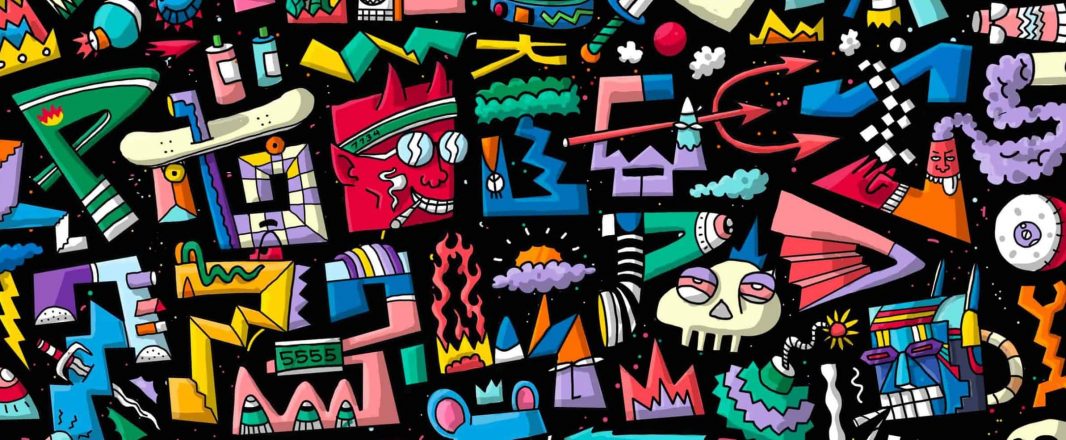
Inside, LED screens glowed with various pieces of artworks from a pixelated bunny to a tiger’s head to psychedelic landscapes. To me, they look like giant JPGs or GIFs but no, these are NFT art pieces featuring over 15 digital artists from Singapore, Malaysia, Indonesia, South Korea, India and Brunei.
The exhibition also included a piece called “Permanence”, which, according to the press release, “explores how blockchain technology brings about its own state of permanence. This is reflected through the capturing of a moment on-chain as art, and re-injecting it back onto the blockchain”.
The piece is created by someone named radarboy3000, who is “Singapore’s prolific generative crypto artist” whose works “leverage generative design to build artwork at the convergence of data, minimalism and experience”.
Convinced I had stepped into another universe or, perhaps another generation, I decided to try out the interactive experience of minting my own generative artwork.
Unfortunately, for reasons too long to get into here, I was blocked by technological forces – something to do with Safari vs Chrome, Android vs iOS – and I couldn’t connect to whatever I needed to connect to, to mint my own permanence in time and place it in my own Tezos Kukai wallet.
I also found myself wondering how Michael Ong’s works could be translated into the world of NFTs, but then perhaps ne’er the twain shall meet … every generation has its own artists for its time.

But I saw possibilities of how technology can bring digital and physical spaces together – something we’ve explored with our hybrid events the past two years – and beyond that, using tech to bridge art, culture and travel together to alter our experience of a place, whether virtual or physical.
It wasn’t unlike the experience I had at Carrieres des Lumieres in Provence, France, where an old quarry has been converted into a space in which art and music come together in a multi-media sensory experience, turning an empty, cold, stony space into an art gallery-cum-concert hall-cum-theatre.

Or last weekend, the first outdoor silent cinema screening I attended in Singapore, which turned an empty piece of grass land by the sea into a cinema, with no expensive build-up necessary.
Using Cinewav technology, developed by Singapore-based film-makers Jason Chan and Christian Lee, it requires no screens, just an empty white wall on which the movie is projected; no speakers, just an audio file that sits in your mobile device and plays through your own headphones; no noise pollution – just you and the movie in a silent setting under the stars. It has the ability to turn any space anywhere into a cinema.
Imagine what such technology can do for all the spaces we have in travel and the experiences we could create. No need to build new, re-use, re-purpose …
The world is big enough for several worlds and as with any worlds that are newly-forming, it’s currently hard to see the NFT forest from the trees but I am pretty sure the technology and what it can do will make their way into travel, one way or another.
In this interview with WiT, Yanolja’s Jongyoon Kim is pretty bullish about it, saying travel with its rich content and inventory is perfect for NFTs, blockchain and the metaverse. He also sees the power of technology to digitise and connect spaces in travel and hospitality, beyond the hotel room. There are of course the sceptics, always healthy to have, and it will be interesting to see what transpires by the end of this year.
When Web 1.0 started, it was all about transactions – that was the only thing OTAs cared about. Then it evolved. Now we have Web3 in which everything can come together.
This week, John Lennon’s eldest son, Julian, announced his plans to sell a range of NFTs featuring digitised pieces of Lennon and Beatles memorabilia from his personal collection.
Imagine.