
“The total restructuring and rethink of accommodation real estate” and “the rise of digital nomads” will be two of the biggest changes coming out of the pandemic, according to two leading investors who spoke at The Bridge Series, Episode 1, organised by WiT and Phocuswright.
When asked by Phocuswright’s managing director Pete Comeau, to imagine 10 years from now how they would complete the sentence “wow, the pandemic provided fertile ground for …”, Chris Hemmeter, managing partner of Thayer Ventures, a travel and hospitality-focused fund, “I think that the old days of thinking about accommodation, real estate as a hotel model only are over. I think multi-family is becoming a hybrid asset class, and I think that there will be more including single family homes and luxury villas. I think the whole world of hospitality, real estate and the monetisation of hospitality real estate is going to be the biggest fundamental shift – happening pre-pandemic but accelerated by the pandemic.”
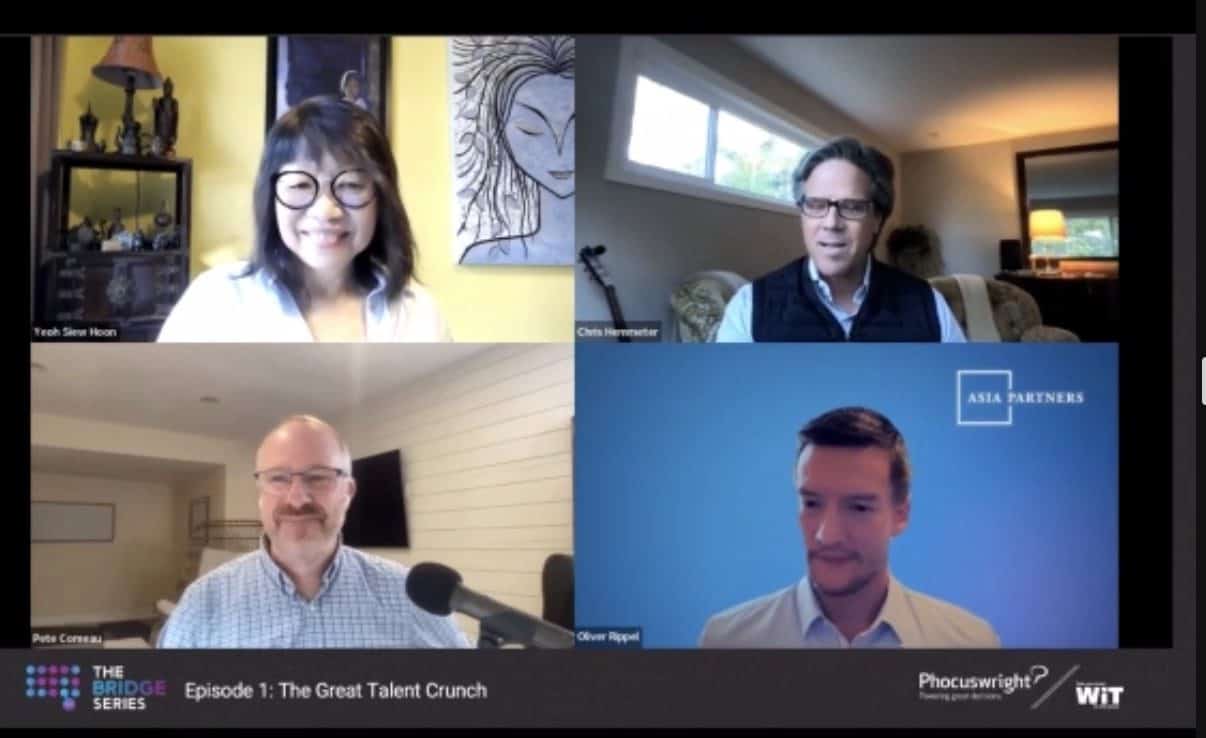
Chris Hemmeter (top right) and Oliver Rippel (bottom right) being interviewed by WiT’s Yeoh Siew Hoon and Phocuswright’s Pete Comeau
Oliver Rippel, founding partner of Asia Partners, a growth equity firm focused on tech investments in South-east Asia, said the trend of digital nomads will be huge – moving from short term travel to travel to “relocate temporarily to a new location”.
“We see this already with our entrepreneurs,” he said. “It’s much less of hitting three countries within 24 hours but being co-located with the team on the ground for sometimes weeks, even months. What does that mean in terms of accommodation, how I organise and structure my travel, where to stay, what kind of services I need – where I’m almost like becoming a resident for a few weeks or months. I think we have barely scratched the surface on (this trend).”
Speaking to the event’s theme “The Great Talent Crunch”, Thayer noted that hospitality was where the crunch was being felt the most and this would push the industry to look for tech innovation and business model innovation “this really desperate need to rejig the model so it’s less dependent on labour, at least in non-guest facing labour”.
Clearly he believes it’s a great time to be in the productivity-driven software business in hospitality and travel which is why Thayer is invested in Optii Solutions, a startup that uses predictive technology to optimise hotel operations. He said the pandemic had resulted in a willingness by hotels to experiment and test and “that has enabled good software companies to get a bite at the apple”.
Rippel, whose fund is invested in RedDoorz, calls it a “a new age hospitality company”, combining SaaS-and-marketplace model. “You’re not only providing technology, but you’re also helping the hotel leverage that technology to optimise demand and ultimately revenue and profit generation. We find that interesting. It’s not just a naked solution, just digitising for the sake of digitising, it’s actually saying, hey, we can do better and we can do things more efficiently at the same time.”
Hemmeter observed that the hospitality delivery model has not changed much since the 1950s. “Let’s face it, the back office is full of people doing sort of nonsensical things like night audits, and on site accounting. And no one has bothered to change that because RevPar has been growing successfully at a pace that’s outpaced the growth in labour cost.
“Now, we’re suddenly so disrupted … that the model has to change. Otherwise, the big elephant in the room which, by the way, are the people that own the real estate, are going to start kicking out management companies left, right and centre and trying to figure out how to do it themselves, because at some point, they have to monetise their real estate.”
On the crunch in tech talent in South-east Asia, Rippel said that while Singapore remains the commercial capital for tech startups, the pandemic has created a change in the “chessboard” of talent – work from home and remote work have enabled companies focused on South-east Asia to supplement their technical teams with talent from India, China, Vietnam and Indonesia, to cite a few places. “Overall, the trajectory is positive,” he said.
The US is also facing “the great developer drought” with startups competing with the likes of Amazon and Google which can afford to pay massive salaries and benefits. On how his startups are competing for talent, Hemmeter said, “Look, Google and Facebook can pay all they want, as much as they want to, it ain’t a startup. Startup environments are different, they’re fun, and they’re dynamic. And there’s equity involved – people like skin in the game. And so good startups with velocity still manage to attract talent.”
Asked if the sentiment is different in South-east Asia with a younger generation who might still be lured by the global tech brands, Rippel said the emergence of local and regional role models such as Grab “and more to come” has made it easier for youths to see themselves “as part of an emerging startup ecosystem” and “people are shifting more towards the startup ecosystem, away from the more established players”.
On the opportunities they see in the travel space, Hemmeter said that Thayer, being focused exclusively on travel, tech and mobility, said the pandemic has created “an opportunity for those large private companies that had seen some resilience through the pandemic and had strong tail winds coming out of it, to get on the offensive, to take advantage of the moment and get out there and win”.
Working on that thesis, it found Inspirato, a membership-based luxury vacation rental club, which it took public through SPAC Thayer Ventures Acquisition Corp in February 2022. “The luxury traveller is a very interesting category, super powerful and resilient. It’s a supply side driven story, it’s got this velvet rope subscription process that you have to be inside the velvet rope in order to have access to the supply. So it has this fundamental flywheel effect, which gives it a competitive advantage globally.”
Asked how much of an appetite Asia Partners has for travel, Rippel said, “We have a huge appetite for travel which can be fulfilled through RedDoorz. We think there’s tremendous opportunity from regional expansion as well as further brands in the market …”
“Having said that, travel is one of the large sub sectors that have tech and tech enabled businesses and budget hospitality is just one of those use cases within travel, so ultimately we are open.”
And he believes that destinations such as Thailand, Vietnam and the Philippines will shine again from an inbound perspective. “There’s no doubt about it, in my mind.”
* Watch their full interview here.
• Featured image credit: Getty Images