
World home cuisine, crowd funding, B2B ticketing solution – all part of moves to go beyond travel
VELTRA, Japan’s leading tours and activities player, rolled out a new brand and corporate identity this week to mark its 10th anniversary and although it says the timing had nothing to do with the pandemic, its new mission, “Celebrate the difference” certainly celebrates a very different company that has emerged from Covid.
“We had been working on this new brand identity in 2019 to shake things up, to review the mission,” said CEO Wataru Futagi. “Veltra had the biggest share of outbound travellers in Japan and over the past decade, we had been a growth company, consistently growing. It came to a point where we felt we had saturated the market – we were so dominant – and so we wanted to continue with our DNA of change.”
As luck would have it, Covid came along to change everything. “The travel market disappeared. We found ourselves, a high growth company year after year, in a situation with no market.
“We faced this uncertainty and danger and it forced us to review and give up many of the preconceived notions about ourselves. It was a good opportunity to think beyond travel, to provide services not dependent on travel, to go beyond it. We reviewed new types of businesses and challenged ourselves.”
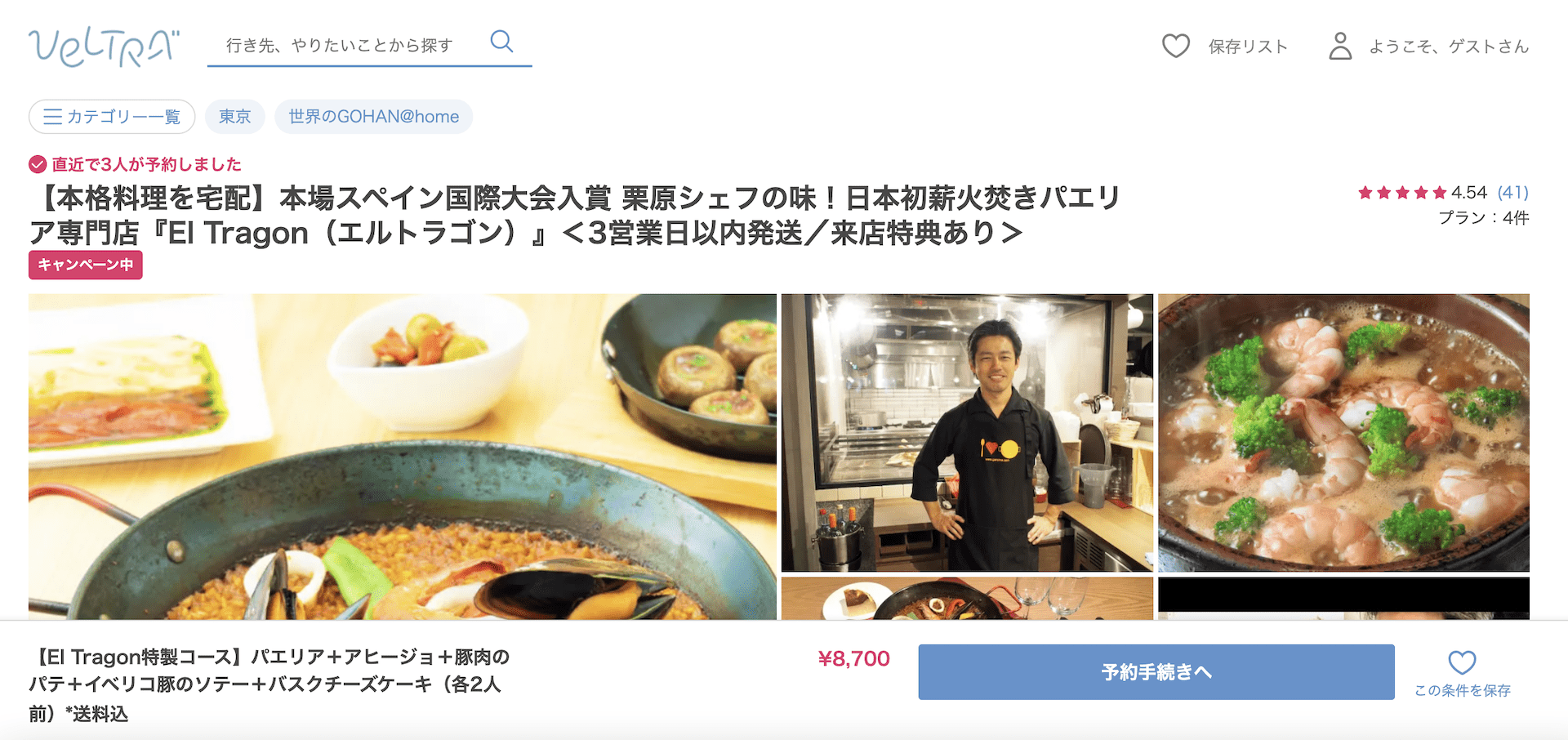
Paella, the best seller, a product it had to create from scratch.
It launched Sekai no Gohan @home (World’s Cuisine at home) where it delivered the world’s cuisine to people’s homes in Japan. Offering 130 types of cuisines from 30 different countries, it found that the most popular one was Spanish paella, which it had to develop from scratch because most of the Spanish restaurants in Japan didn’t do delivery service.
It launched Zenes crowdfunding, to help entrepreneurs who wanted to create products, not restricted to travel. So far, about JPY21 million (US$171,000) has been raised for over 30 projects. The most successful project raised JPY4.2M (US$34,000) – to support a travel company and a mango farmer in Taiwan who had lost customers due to the pandemic. The funders receive their mangoes in return.
Thirdly, it launched LINKTIVITY, a MaaS platform linking transportation tickets, passes and attraction tickets in Japan including JR, Metro, Tokyo skytree and others. Clients include GetYourGuide, Klook and KK Day and VELTRA is waiting for Japan’s borders to reopen and when inbound travellers return to roll out this product bigtime to global OTAs. In December 2022, LINKTIVITY made an alliance with, and took in US$1.5 million investment from Japanese telecommunications giant, NTT West.
Said Futagi, “Up to 2019, we were all about travel and changing the definition of travel through tours and activities. Our message was not about where you go but what you want to do while there and we created a market based on what could be done. Now, with the new brand, there is no mention of travel. Our core business remains travel-oriented, but we have gone beyond that – to all experiences.”
Of course, like everyone else, Futagi is looking forward to the day when Japan will reopen its borders to inbound travellers. In North Asia, only South Korea has reopened and all eyes are on when Japan will make its move.

Wataru Futagi: “There are powerful lobbying groups putting pressure on the government to open borders to make it easier for overseas travellers to enter Japan.”
Said Futagi, who has not travelled outside Japan the past two years, “We hope it will be quite soon. Everyone’s hoping that something will happen before Golden Week, the end of April, when a few national holidays are clumped together, and Japanese people can travel abroad again. We are seeing advance evidence of Japanese people booking overseas trips during Golden Week.
“There are powerful lobbying groups putting pressure on the government to open borders to make it easier for overseas travellers to enter Japan.”
When travel resumes, Futagi intends for VELTRA to maintain its dominant position in Japanese outbound. “We will continue to position and protect our position against overseas OTAs, that is not going to change. We will put much resources into growing this segment.”
During the pandemic, like every travel player, it had to pivot to domestic but found the market competitive with very low margins. “For travel agents in Japan, it was a difficult time to do business because profit margins are so low. Operators in Japan work on a low margin business model, this makes it difficult to provide quality services.
“Overseas suppliers work on 20-30% commission but it’s below 10% in Japan – it’s a difficult environment to do business and make a profit.”
Nevertheless, it’s learnt a lot about the domestic market and a total of 2.2 million new members have registered for VELTRA services and it intends to capitalise on the domestic market by capturing the lifetime value of the new customer.
Local travellers also have different tastes and preferences than foreign visitors, who favour big cities such as Tokyo and Kyoto. “With domestic travel, people have their own cars and can go to different places.”
This, by the way, is what he himself did when “I went round and round in circles in Japan”, he laughed. “Compared to what you can find overseas, there are not many all-in-one activities including transport, meals, apart from the mid to large coach tour operators in Japan. You need to drive by yourself or hire a car if you want to take in more authentic experiences, such as eco/adventure tours.
“There’s an opportunity for developing products to fulfil this gap,” he said.
And even as it tells customers to “celebrate the difference” with a different VELTRA, one thing that will not change is its customer care. “Many people compare us to Klook or KK Day but we offer something they don’t come close to – we take care of customers from beginning to end, from booking to participation to satisfaction at the end. We pride ourselves in our superior customer service and customer experience and that’s a strength we want to preserve.”
* Watch VELTRA’s new brand movie here.