There’s been lots written about the new Airbnb logo. Some have panned it. Some have mocked it, comparing it to bits of the human gentitalia. Some have applauded it.
![Symbol[1]](https://webintravel.com/wp-content/uploads/2014/07/Symbol1.png) But beyond the logo change, there’s something bigger happening, something that we in travel should watch carefully.
But beyond the logo change, there’s something bigger happening, something that we in travel should watch carefully.
With its new logo, Airbnb is trying to own the word “belonging”. It calls the new logo, Belo, “the universal universal symbol of belonging, as travellers seek a more intimatediscovery of the destinations they visit, as compared to the moretouristy experiences”.
“Belonging” is a very powerful idea. Not only does it move Airbnb one step ahead of the “sharing” economy it pioneered but it taps into an innate human desire to want to belong – “belong anywhere”, as Airbnb is promising.
I recall the late Dame Anita Roddick of Body Shop speaking about this idea in the 90s and it was this she tapped into when she came up with her message for the brand she created.
She said that cosmetics on their own didn’t really work but what she wanted to do was give women hope and a sense of belonging – that by buying Body Shop products, they were buying into the cause of “against animal testing”.

Brian Chesky / Image credit: Airbnb
And here’s Brian Chesky’s, founder and CEO of Airbnb, view of the future. (I took this paragraph from this latest article written by New York Times’ columnist Thomas Friedman.)
The 20th-century economy was powered by big corporations that standardized everything because they never really knew their customers, argued Chesky. “The 21st-century economy will be powered by people” — where the buyers all have identities and the producers all have personal reputations — “so I will be able to sell something directly to you and delight you and surprise you, and the selection you’ll be able to choose from won’t be 4 but 4,000,000.”
Now last November, I just happened to catch Friedman and Chesky together on stage and it is evident that Friedman is a fan of the Airbnb model.
To him, the real innovation from Airbnb was to create a platform of “trust” – “where everyone could not only see everyone else’s identity but also rate them as good, bad or indifferent hosts or guests. This meant everyone using the system would pretty quickly develop a relevant “reputation” visible to everyone else in the system.”
As an Airbnb user myself, I can pretty much vouch for this. For my upcoming holiday in France, I went through Airbnb to find a house in Brittany – one big enough to house my group of eight, close enough to the friends we are visiting and oh yes, must have Internet access.

Image credit: Airbnb
I found one that ticked all the boxes, contacted the owner directly, negotiated and agreed on the dates and rates and then booked through Airbnb. This was what I found interesting – even though the owner could have taken the booking directly, he chose to do it through Airbnb and give them the commission.
And just as I got to know him through his profile – he’s a fashion blogger, has a family and a resident cat which I have agreed to look after during my stay – he too could also find out about me because he also has access to my Facebook profile.
To me, the level of trust here is higher than with a traditional hotel transaction where when you check in, you are asked for your credit card to guarantee payment. That always makes me feel that I am forced to trust the hotel but the hotel doesn’t trust me even though I may have stayed them before.
I think what’s worth noting is that the Airbnb model is clearly working.
The metrics shared by Chesky in Friedman’s column are pretty impressive.
- “Fifty-six percent of guests staying on Airbnb on a recent weekend were doing so for their first time. Last week, guests left reviews for hosts in 42 different languages. Over 17 million total guests have stayed on Airbnb. It took Airbnb nearly four years to get its first million guests. Now one million guests stay on Airbnb every month.”
- “Roughly 120,000 people stayed in Brazil in Airbnb-rented rooms for the World Cup, including travelers from over 150 different countries. Airbnb hosts in Brazil earned roughly $38 million from reservations during the World Cup.”
- July 5, 2014, was Airbnb’s biggest night ever. “Its platform hosted over 330,000 total guests staying around the world — in thousands of cities and over 160 different countries.” In Paris, nearly 20,000 people were staying in Airbnb rooms on July 5. In 2012, that number was under 4,000.
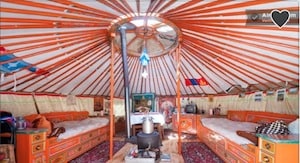
Airbnb picks – Original Mongolian yurt in Dresden / Image credit: Airbnb
With the new logo comes a redesign of its sites and mobile apps. The interesting element to me is the “Discover” feature which acts as a recommendations engine, something that led Wired magazine to announce that “Airbnb is quietly building the smartest travel agent of all time”.
I quote:
“For a long time now, Airbnb has been an awesome place to go if you know where you’re going and you know when you’re going,” says Mike Curtis, Airbnb’s vice president of engineering. “But we realized that we have all of this data that other people don’t have. We have travel patterns. We have the reviews. We have the descriptions of the listings. We know a lot about neighborhoods that we can infer from the text in there.”
To do this, the company has formed an eight-person Discovery team. Their mission? To build language processing software that mines Airbnb’s data and figures out what’s really happening out there in the travel world. In other words, Airbnb is building a kind of omniscient, machine-powered travel agent of the future.
But beyond the technology and the new logo, I think what Airbnb has reminded us in travel is how to speak to our customers again.
In the past years, I feel travel suppliers have become so preoccupied with all the changes happening in the market – fragmentation of channels, meeting new investor demand, new room technology, challenge for talent – that they’ve forgotten the basic premise of why people travel.
People travel to discover. Business travellers want to discover new opportunities. Leisure travellers want to discover new experiences.
And the best form of discovery is usually found through local people on the ground – business associates and friends and, in Airbnb’s case, local hosts who, after your first visit and depending on how it turned out, end up becoming your friends.
This is at the heart of the Airbnb promise and this is what hotels are competing with in this new world.
My message to hoteliers: Don’t let Airbnb own that conversation, change it or become part of it.
• Video below – Airbnb introduces the Bélo: the story of a symbol of belonging