
AFTER its Series B fund raise of six billion won (about US$4.6 million) last November, Seoul-based OTA, Tripbtoz, is planning to take its video-based travel app outside South Korea. To date, the startup, founded in 2017 by former Expedian Jiha Jung, has raised 10.5 billion won (about US$8 million).
Korean visual effects company Giantstep Inc., NICE Investment Partners, SJ Investment Partners and T.S. Investment participated in the latest funding.

Jiha Jung: “This MZ generation wants self-expression.”
Jung, who worked at Expedia from 2014 to 2017, is looking to open offices in Singapore and San Francisco to “export its self-expression, one-stop platform” to South-east Asia and North America. In South Korea, its app which allows travellers to “play, share, stay”, targets the 20-30-year-olds, 60 percent of whom are women, says Jung.
“This MZ generation wants self-expression, versus the previous generation who had social connection needs and before that, safety needs and survival needs,” he said. “Generation 2030 is the biggest online consumer in South Korea and 80 percent of consumption on OTAs is by youths.”
With the industry and consumers in transition, with lines blurring between the real world and metaverse, he wants to create a metaverse within Tripbtoz to excite its customers to create and share content and “minimise the steps of booking hotels”.
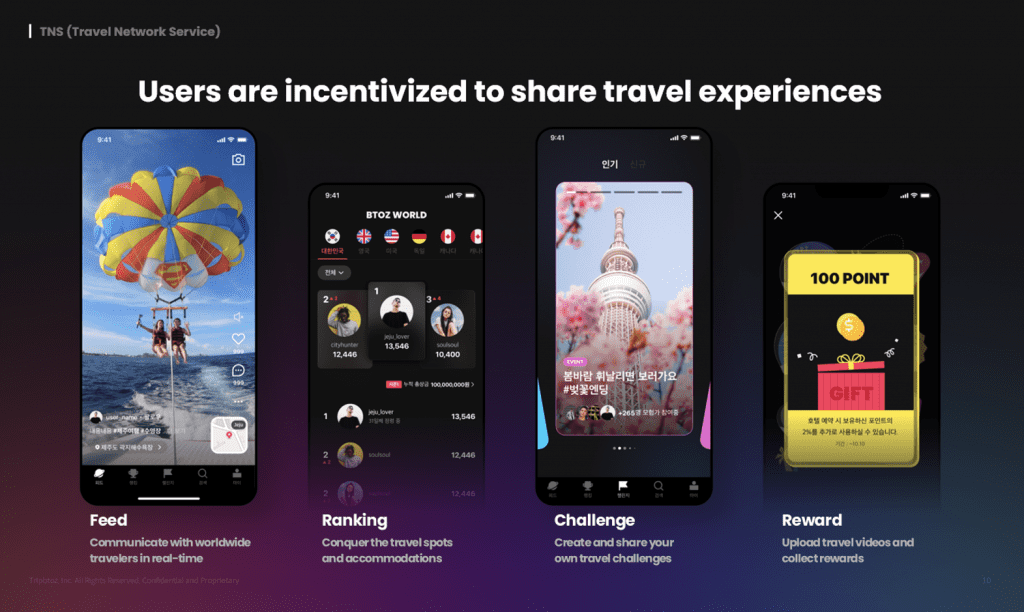
“We want to create a one-stop platform that travellers use at every stage of their travel,” said Jung, sharing this illustrated model of Tripbtoz, which won the WiT Seoul Startup of the Year in 2018. Pre-trip, it allows customers to search places; during the trip, customers can create content and follow recommendations by Tripbtoz; and post-trip, they can upload memories onto the app. Users who upload videos receive discount coupons in compensation.
Jung said that since the launch of the service in July 2017, its business has grown an average of 138 percent a year. Its staff force has grown from 15 to 80 through the pandemic. Despite South Korea outbound travel coming to a stop, Tripbtoz was able to pivot successfully to the domestic market.
Jung claims it made $30 million worth of hotel transactions in 2021, three million of which was shared with users in the form of Tripcash, its loyalty currency. Users, each of whom have their own unique QR code, can then use their Tripcash to buy everyday goods in South Korea.
He said the business has been profitable and achieved the breakeven point since last September.
Its new app, launched eight months ago, features a metaverse environment in which users can “plant” themselves in virtual worlds and create “self-expression” content. “They can create fake backgrounds and travel anywhere, and share that content. This is a generation that’s mobile first and 5G connected and during the pandemic, embraced the metaverse enthusiastically. This is a new experience for young people, they can switch between physical and virtual reality without hesitation.”
With this feature, he hopes to turn travel which is say, twice a year event into an everyday event in which users can “travel anywhere, anytime”.
In taking its model outside South Korea, Tripbtoz is looking to launch an English version of its website by this September, followed by Chinese.
Acknowledging that the South-east Asian market is highly competitive, Jung said Tripbtoz would focus on user needs and user satisfaction. “Our reward system is very different from others. Users are much more involved in our product.”
It is also looking to scale its hotel content. Currently, 40 percent of the hotel content is in South Korea with the rest global. It has direct contract with 3,000 hotels in South Korea and Japan.