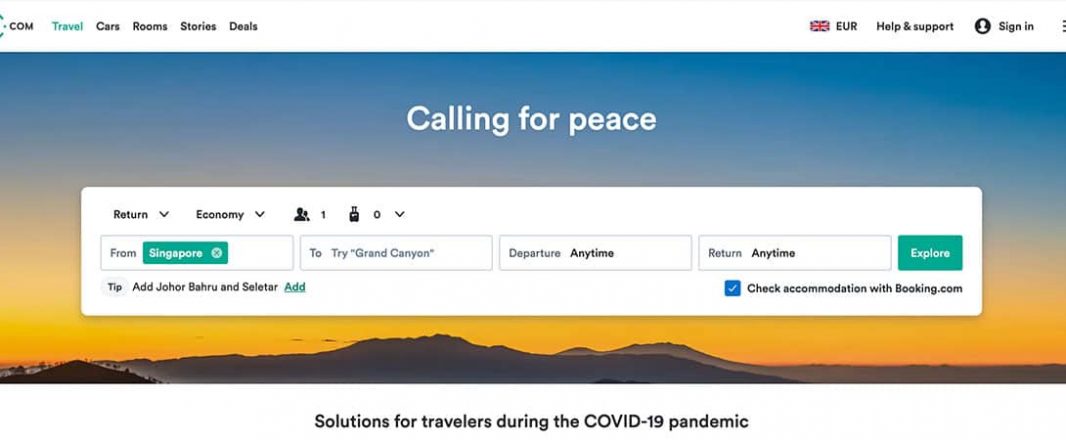
“I’d love to be wrong but volatility is here to stay,” says Dlouhy
IT’s been 10 years since Oliver Dlouhy founded Kiwi.com and took the flight world by storm by making virtual interlining its forte. But with the last two “feeling like 10”, the Czech entrepreneur, based in Brno, seems a lot more grounded, ready to take his startup on the next stage of its journey.
First lesson learnt – stay focused on flights. “Before, we were investing in different verticals, thinking our flight product was strong enough. Now we realise it’s far from perfect. We have cut the different verticals, packages, inter-modal, mobility, and stay completely focused on flights.”

Oliver Dlouhy: “I think differently now about risks, investments and building the company. I don’t want to build an extremely innovative product at any cost. It’s a much safer bet and more appreciated to solve current problems than to build a new fancy product that customers may not want or need.”
That turned out to be a good decision because now it’s ready to move Kiwi.com beyond price and add a layer of guarantee around refunds and cancellations “so that customers know exactly what they are buying”.
Explaining, Dlouhy said, “From a customer perspective, Kiwi.com was a price-focused company pre-Covid. Back then, this was a relevant USP – airline services were generally smooth, there were few disruptions, we had 1% cancellations.
“During the pandemic, we went from price to refund-oriented – automating the refund and disruption processes. We became a company that had to cushion issues or problems between airline and customer.
“There are 700 airlines, it’s extremely fragmented and for the customer, it’s impossible to navigate all the conditions and fine print and make educated purchase decisions.
“We are building a suite of products that will align all the airlines into one unified product so that it is visible and transparent to the customer. They will know exactly what they are buying. Today it’s not just about price and flight duration, but the fine print – how will my refund be treated if the flight is cancelled, how much to change my flight.”
This virtual layer around the fine print will be guaranteed by Kiwi.com. “In some cases, we are taking the risks – refunding the customer out of our own pocket. Our job is to make sure we don’t get broken by this.”
He believes its experience in virtual interlining will stand it in good stead to take this risk. “During the first six to seven years of Kiwi.com, we have learnt to deal with multiple airlines, booked through different sources, in one single itinerary. When a customer books virtual interlining, he doesn’t care that Ryanair has different baggage conditions from Wizz Air – they look at the itinerary as one single entity.
“Now we are extending the technology and set of processes to all the flights. We released many different products the past year – virtual fare types, connection guarantees, refund guarantees – these will be packaged and bundled and offered to customers for some fee.”
“It will take many years to get to those quiet years of free travel without disruptions”
While business has turned around and travel is recovering – Dlouhy said both top and bottom lines are now double what they were in 2019 – he expects volatility to stick around, pointing to the travel chaos seen in Europe this summer as well as the unstable geo-political conditions around the world.
“The decoupling of west and east, the Ukraine war, relations between China and the US – this world is here to stay. I’d love to be wrong but it will take many years to get to those quiet years of free travel without disruptions.
“I don’t know big the swings will be. In 2020, we had very tight balance sheets and we had to make very difficult decisions. It was a healthy process but I don’t want to go through this anymore.”
Which is why the €100 million convertible bond it recently raised will not all be used to expand the business but “we will keep some portion for a rainy day which I am afraid will come”.
“We have been profitable since May last year so we didn’t need the money to save the business,” he noted. “We see opportunities to accelerate the transformation of flights, investing in product and hiring engineering and product talent.”
Given the expected volatility, he said companies which develop processes to take volatility from operations will win. “Those who can scale up or down very quickly will win. We learnt this the hard way.
“Our goal is to be able to provide the most comprehensive and competitive inventory in the market. There’s still a long way to go but we believe we are a much better company now to withstand crisis.”
Investing in customer service to regain goodwill
He’s also cognizant that Kiwi.com needs to build back the customer goodwill it lost during the pandemic because of its inability to refund customers, resulting in a rash of complaints filed against it in February 2021.
“We have recovered some portion of money from the airlines. There’s still tens of millions of Euros that will never be recovered,” he said. “We started refunding out of our own pockets, it’s the right thing to do. We made many customers unhappy because of the refunds and chaotic communication.”
He said the company was investing in better customer service and had learnt a lesson about communicating better with customers and setting the right expectations.
Asked if there had been a drop in popularity of virtual interlining given that travellers naturally preferred direct flights given the pandemic, Dlouhy said, “Of course, everybody would prefer direct flights, there are very few people who enjoy connections. Before the pandemic, the biggest advantage was the price and availability of direct flights. However given the disruptions, virtual interlining has become the only way to get from A to B on many routes. So we have not seen any decrease in popularity in virtual interlining – it’s been fully offset by supply issues and lack of direct connectivity.”
Being a flight company, he’s also cognizant of sustainability concerns. “Our point of view is to bring options to the customer. Sometimes there are itineraries that have higher carbon footprint than others – they may be less expensive – but it’s our responsibility to give customers a choice.”
The challenge is there are “very few relevant alternatives for flights“, he said. “Out of 150 busiest routes in Europe, only 51 can be travelled by train in less than six hours.”
While Dlouhy calls Kiwi.com a tech company first, then a travel one, he does not believe any one piece of tech can solve all problems. “There are three pillars for any innovation to take place – some tech, processes built around the tech and negotiations/business development. You need to connect the three to build something meaningful for the customer.”
When asked how the last two years had changed him, Dlouhy, who was named one of Europe’s top 300 innovators by Forbes in 2020, said, “I have bigger respect for what we have built, and understanding we can lose it just like this.
“I think differently now about risks, investments and building the company. I don’t want to build an extremely innovative product at any cost. It’s a much safer bet and more appreciated to solve current problems than to build a new fancy product that customers may not want or need.”
While this may sound different from the Dlouhy who, 10 years ago, declared he wanted to change the world with Kiwi.com, he commented, “It’s not that different. There are so many imperfections in flights. We can change the world of flights.”