Tours and activities, experiences will be most impacted, says Magpie’s Watts
Christian Watts, CEO and Founder of Magpie Travel, is already designing products around ChatGPT. He says we haven’t scratched the surface of what the tech can do.
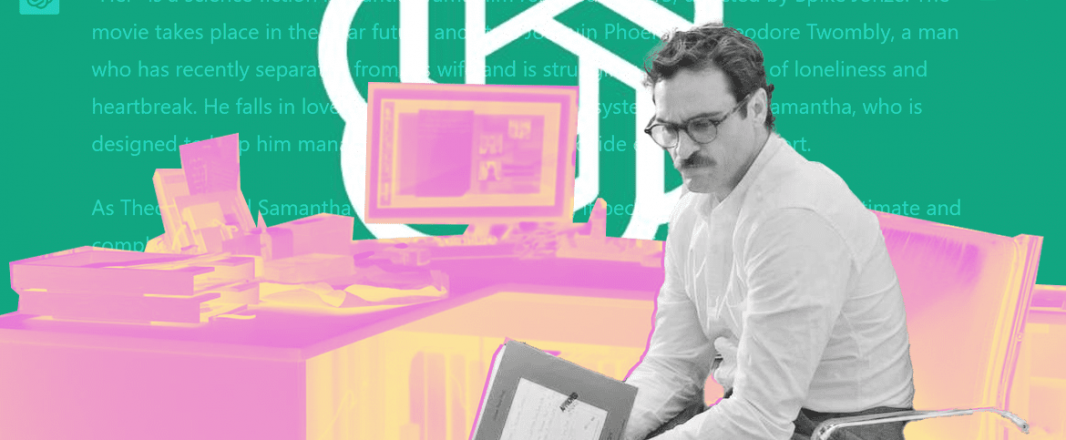
A decade ago, Spike Jonze directed a movie called ‘Her’ about a writer named Theodore, played by Joaquin Phoenix, who forms a bond with his operating system, OS1, voiced by Scarlett Johansson. Although making the movie was a form of catharsis for Jonze, who was processing his own breakup at the time, the film quickly gained popularity for its unorthodox depiction of the future.
Unlike the dystopian hellscapes that we’re used to seeing in movies, Her paints a future that’s normal and inviting. The city is sleek, and its lights produce a soft, warm glow. Yet, there’s a tinge of loneliness throughout the film. And in the background, operating systems powered by Artificial Intelligence are conversing, aiding, and forming relationships with their human users in the most non-menacing way.
The subtle-yet-significant technological leap takes Theodore, and many of the humans in Her’s fictitious future, by surprise – but it doesn’t alarm them. The advancement seems almost natural, albeit peculiar.
Fast forward to 2023, and we’re all buzzing about ChatGPT.
While Open AI’s superstar chatbot has garnered some controversy, most people are adopting and accepting the advancement at rapid pace. According to data compiled by UBS, since its launch two months ago, ChatGPT is on track to surpass 100 million monthly users.
This means that ChatGPT has been adopted faster than Instagram and even TikTok. UBS reports that TikTok took nine months to reach 100 million users, Instagram took 30 months, and Spotify took 55 months to hit that benchmark.
“I think it’s the biggest thing I’ve seen”, says Christian Watts, founder and CEO of Magpie Travel, a content distribution software company for the tours and activity industry. “In my lifetime, Internet was the biggest thing, and then the mobile phone… but I think this is up there with both of them. Maybe not in this version, but as far as what’s going to happen from this direction – I think this might end up being the biggest of all.”
ChatGPT’s hyper-accessibility means that it’s being applied in many ways across different industries, travel and hospitality being no exception. Still, a level of finesse is required when utilising the tool, as opposed to simply throwing everything at the proverbial wall to see if it sticks. Knowing how to use it effectively is going to separate the bandwagoners from the real users in the months to come.
As Watts explains, “Tours, activities and experiences – I think that’s the most impacted. Hotels are very transactional whereas experiences are a part of the destination which is much more about discovery and information, and it’s also the area closest to this content.
“The typical blog we’ve read for the last 20 years is “Top 10 Things to Do In San Francisco” when we go travelling – those are the things that will be impacted, those recommendations and the next version of the itinerary planner, whatever that is, those are heavily impacted by this.”
ChatGPT’s ability to produce content within seconds is unparalleled. It’s something that the creative industry is pretty nervous about. But, as far as the disruptive nature of ChatGPT goes, Christian isn’t too sure about its “Google killer” reputation. The tech will change things in significant ways, but not specifically in ways that most people assume.
“I don’t think it’s going to revolutionise Google, mainly because you’re not asking Google the same things – you don’t need paragraphs of content most of the time. But I think it’s going to eat away at Google, and Google has responded with Bard (AI search engine), so we’ll see what happens with that.”
It’s worth noting that Bard recently caused shares of Google-parent-company Alphabet to plunge when it provided inaccurate information during a trial run. The company lost US$100bn in market value. Similarly, ChatGPT’s true party trick doesn’t revolve around factual accuracy. The chatbot has been called out a number of times for providing false answers – although the tech is clever enough to disguise its flaws behind professional-sounding language. No, ChatGPT’s real power is in how it’s able to replicate human cadence – a “skill” that Magpie Travel has tapped into when designing metadata for its clients.
“At Magpie we manage product content for tours and activities companies – so we manage their descriptions and highlights.” explains Watts.
“We see people struggle to write them. We take those descriptions and send them out to distributors, we integrate with Viator and we send them to Klook and all these resellers… but if people have bad product descriptions because the human (writing it) doesn’t speak English as a first language or isn’t very good at writing, it’s a problem.
“So, now we take different aspects of that product description – you can just paste in some highlights, a really bad description, as long as it’s accurate to the places that you see – hit a couple of buttons and it produces a product description as well as any human could write it. I’ve not seen one that’s worse (than a human), it’s incredible, the results. We’re just going to make better product descriptions for operators, they’re all going to have really good descriptions now, whether that’s on their own website or an OTA website, those are going to be really well-written to maximise conversion.”
The subtlety of AI-driven tools like ChatGPT entering major industries like travel is fascinating. Just like Her, the implementation of AI isn’t hostile. And there’s no overnight exodus of human workers leaving their desks to make way for virtual employees. Although Watts does believe that ChatGPT will impact the human workforce one way or the other.
“Everyone likes to say that it’s going to enhance jobs and it’s an enhancement tool, and it is, but that’s just nice to say. No one wants to come out and say ‘Listen, we’re gonna fire 30% of our department that sits and writes blogs, but it is going to replace those tasks. Good companies will find places and other tasks for those people to work on but companies that can’t manage that transition, I do think it’s going to replace jobs.”
Like the many technological revolutions before it, the idea that Artificial Intelligence could displace jobs resurfaces a classic dilemma – does one continue to support tech that could render certain roles redundant, or push back against change to ensure a sense of consistency? With the momentum that ChatGPT has garnered lately, it seems like the choice has already been made – adopt, adapt, or be left behind. In January, Microsoft supercharged its investment in ChatGPT’s developer, OpenAI, with an additional $10 billion.
Here’s an added bonus – ChatGPT’s success isn’t reliant on consumer adoption.
Watts elaborates, “I think the difference with this is that it’s so accessible. There’s no app to learn. You hear people talking – and it feels like ChatGPT is in every other word that people are building apps all around. I think it’s going to be fast, the adoption here.
“And on the consumer side, you don’t need to adopt anything – it’s just content that’s being fed to you. You don’t need to know you’re a part of the AI world to be consuming it… and liking it, and sharing it.”
It seems like the real obstacle in ChatGPT’s rise, for better or worse, is all the noise surrounding it. It’s good, it’s bad, it’s the real deal, it’s a fad, it’s the blueprint of the future, it’s a one-trick pony, it’ll never replace human creativity, it’ll learn to be creative someday…
With everyone wanting a piece of the AI pie, it’s hard to determine what’s concrete data and what’s hearsay. With rumors of GPT 4’s release not too far off, Christian says the hype is only going to get louder and buzzier before it starts to normalise.
“There’s not much information (about GPT4) out there and the people who do have access are quiet about it. People are saying it’s an equal step up from the last one. No one seems to know what that means but the hype may keep coming. Obviously, it’ll normalise eventually, but it might be a while.”
“I don’t think humans have got their heads around what this means yet. When this came out, everyone sort of jumped in and played with it. And the people who dug in for 10 minutes or more came out thinking, ‘Oh my God, this is the real thing’. That’s been my experience. When you have conversations with people, you realise it keeps getting broader – the applications and where this could go. I’m spending a lot of time reading and learning about this stuff and my head hasn’t stopped yet – it’s still expanding as far as the vision of where this could go.”
We’ll have to wait a few years to decide if ChatGPT truly is the first step towards the next stage in human-machine communications, and possibly, relationships. In the movie Her, Scarlett Johansson’s OS1 was the result of the human need for a “voice” or assistance that’s available all the time, literally. Whether or not ChatGPT answers that need by becoming a virtual travel planner at 3:00AM on a weekday night, or if it simply assists customer service personnel with an additional layer of language proficiency remains to be seen.
“Sam Altman, CEO of OpenAI talks about how this may result in the failure of capitalism,” adds Christian. “Sounds quite dramatic but he’s serious. This is going to be a bigger change than humans can handle and with the next stages of this, capitalism might fail – with universal basic income or something else, this could take over a lot of white-collar jobs. A lot of us – I think – weren’t expecting this.”